
CS2 Skin Liquidity Guide: How Easy Is It to Sell or Trade a Skin?
Published: 09.07.2026
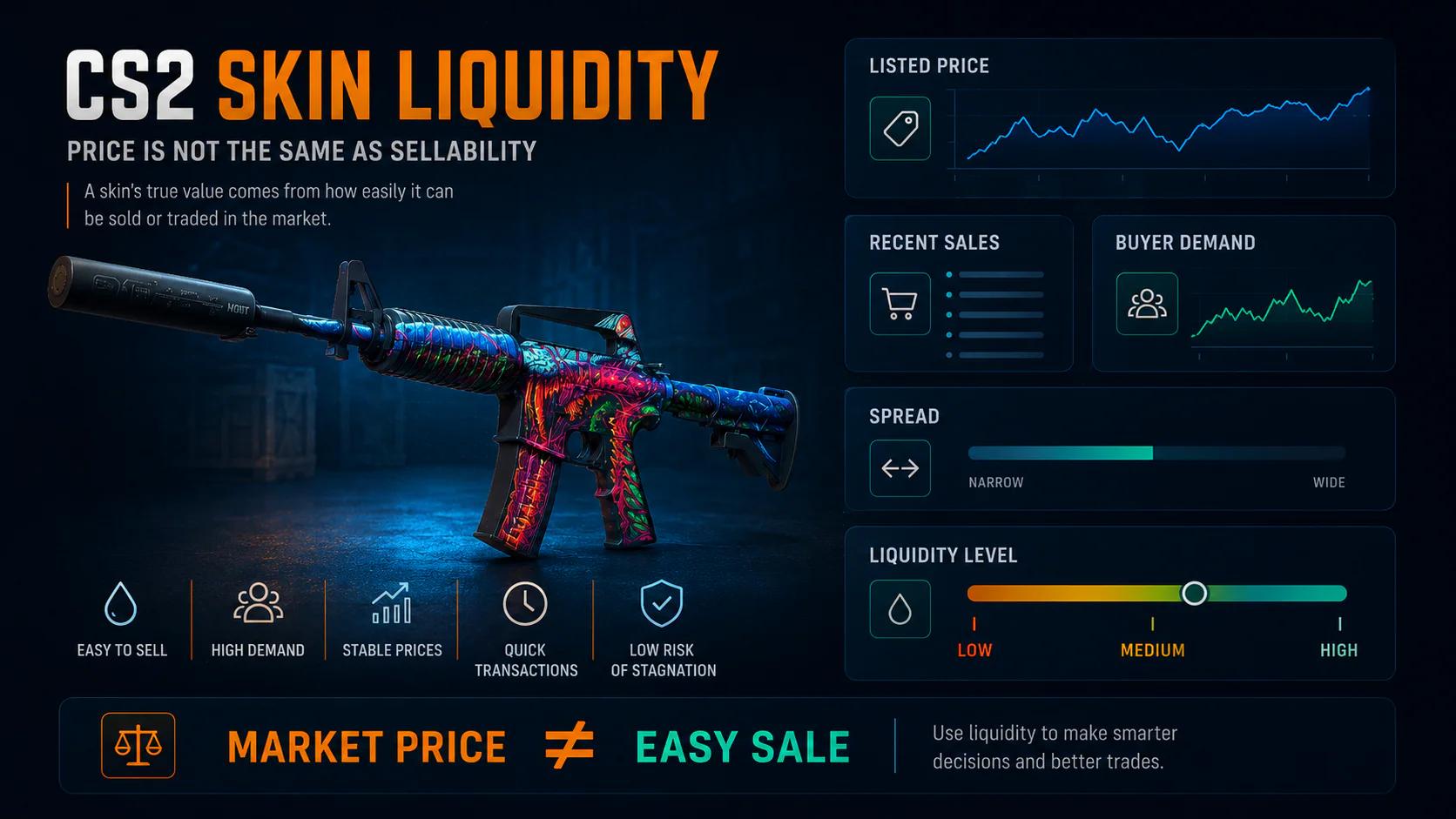
CS2 skin value is not only about the market price shown on a listing page. A skin may appear expensive, rare, or visually impressive, but that does not always mean it is easy to sell, trade, or convert into usable balance at the price you expect. This is where CS2 skin liquidity becomes important.
Liquidity describes how easily a skin can be moved in the market. A highly liquid skin usually has active demand, clear pricing, and enough buyers or traders to make selling or swapping it more straightforward. A low-liquidity skin may still be valuable, but it can require patience, negotiation, discounts, or a buyer who understands a specific float, sticker craft, pattern, or collector feature.
This matters before buying expensive skins, opening cases, accepting trades, or evaluating skin value. A skin’s listed value, float value, wear level, rarity, StatTrak status, stickers, patterns, weapon popularity, and demand all affect how practical that value really is. For users comparing CS2 skins, reviewing CS2 case opening outcomes, or studying expected value and EV ratio, liquidity helps separate “theoretical value” from realistic market flexibility.
What Does CS2 Skin Liquidity Mean?
CS2 skin liquidity means how easy it is to sell or trade a skin at a realistic market price. A liquid skin is usually easier to price, easier to compare, and easier to move because more buyers or traders recognize its value.
A listed price is not the same as sellability. Anyone can list a skin at a high asking price, but that does not prove buyers are willing to pay that amount. Liquidity is about actual demand, not just visible listings.
A skin can be valuable but illiquid. For example, a rare collector skin, an old CS:GO item, a special pattern, or an expensive sticker craft may have a high theoretical value, but only a small group of buyers may understand or want that exact version. In that case, the seller may need to wait longer or negotiate more carefully.
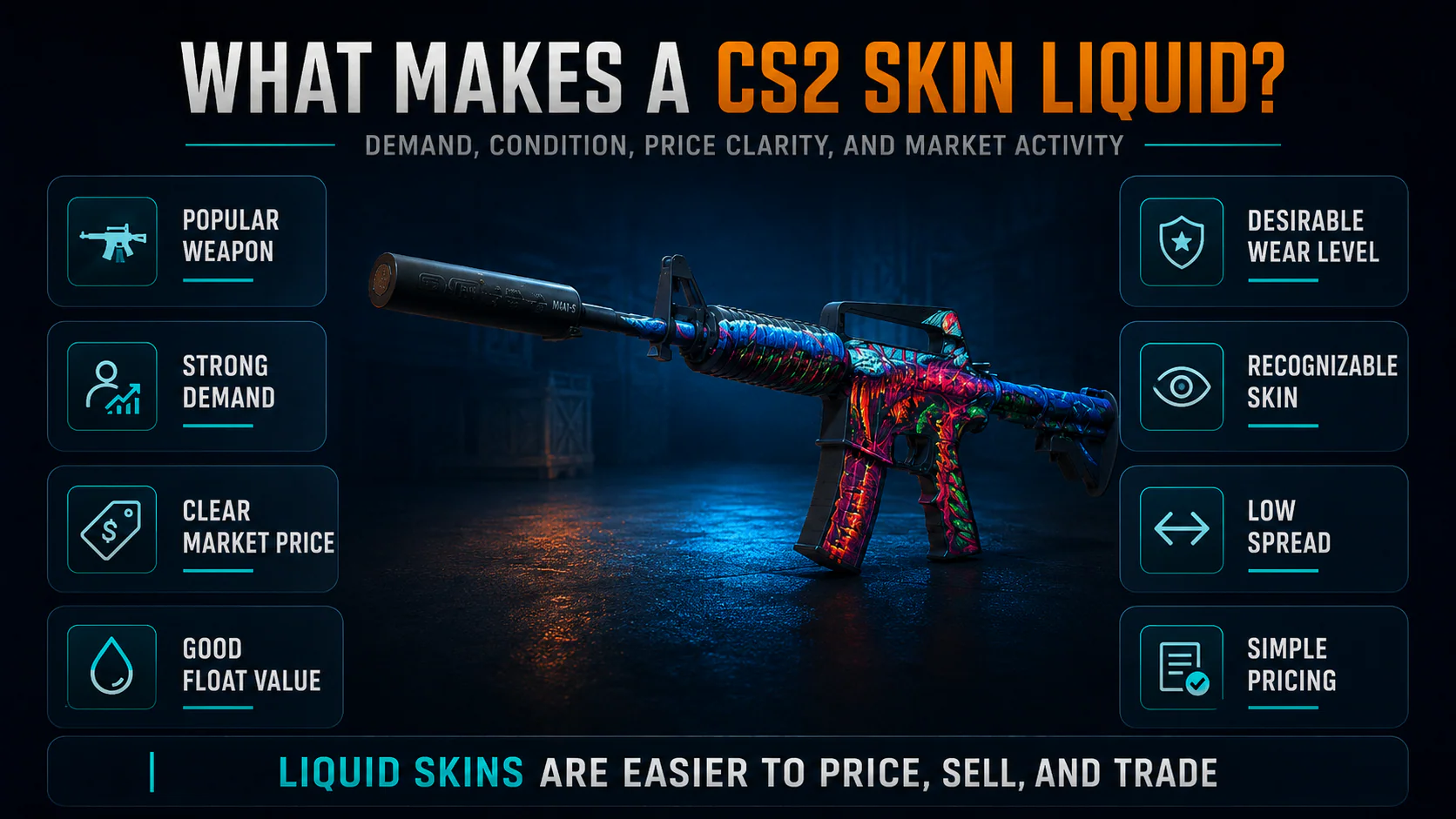
Liquidity depends on several factors:
How popular the weapon is
How recognizable the skin is
Whether similar skins sell regularly
How clear the market price is
Whether the float value and wear level are desirable
Whether the skin has complicated sticker or pattern overpay
Whether enough buyers are active in that price range
Popular skins usually sell faster because they appeal to a broader audience. Rare collector skins can still be valuable, but they may need the right buyer. This is why liquidity matters for players, collectors, traders, and users who open cases and want to understand whether a possible drop is easy to resell or trade.
Why Liquidity Matters Before Buying or Trading Skins
Liquidity matters because it affects how flexible your inventory is. A skin with strong demand can often be easier to resell, easier to trade, and easier to compare against similar items. A low-liquidity skin may require more time, deeper market knowledge, or a lower price to attract interest.
For beginners, liquidity is especially useful because it reduces uncertainty. When a skin has many comparable listings and visible demand, it is usually easier to understand whether a trade offer is fair. When a skin is rare, customized, or hard to price, the user has to rely more on research and judgment.
Liquidity can help with:
Easier resale
Faster trades
Lower chance of needing large discounts
More reliable price comparison
Less uncertainty when exiting a position
Better understanding of real skin value
More practical inventory management
Low-liquidity skins are not automatically bad. Some collectors intentionally buy rare or niche items because they value uniqueness. The issue is that users should understand the trade-off before paying a premium. A skin that looks expensive on a listing page may still be difficult to sell quickly.
Liquidity is especially important for expensive skins. The higher the price, the smaller the buyer pool usually becomes. A small difference in float value, wear level, pattern, or sticker placement can also create a much larger pricing difference, which makes careful evaluation more important.
Market Price vs Liquidity: Why Listed Value Is Not Enough
Market price is an estimated value. Liquidity is how easily that value can be realized through a sale or trade. These are connected, but they are not the same.
A high market price does not always mean high demand. Some expensive skins are niche collector items with limited supply and limited buyer interest. Their listed prices may look strong, but they may not move quickly unless a buyer is specifically looking for that item.
To evaluate a skin properly, users should look beyond the highest active listing. Where available, it is useful to check recent sales, listing depth, demand signals, and the gap between what sellers ask and what buyers may actually pay.
A few pricing terms are important:
Listing price: The price a seller asks for a skin.
Real sale price: The price at which a similar skin actually sold.
Buy order price: The price buyers are currently willing to pay immediately, where buy orders are available.
Spread: The gap between seller asking prices and buyer offers or recent realistic sale levels.
A wide spread can signal lower liquidity because sellers and buyers do not agree closely on value. A narrow spread can suggest stronger market activity because the difference between asking price and buyer demand is smaller.
Realistic pricing matters. A skin priced too aggressively may sit unsold even if it has a high estimated value. A fairly priced skin with clear demand usually has a better chance of attracting buyers or trade offers.
The Most Liquid CS2 Skins Usually Share These Traits
The most liquid CS2 skins usually share broad player demand, recognizable design, and clear pricing. They are often tied to weapons that many players use regularly, which gives them a larger buyer base.
Common traits of liquid skins often include:
Popular rifle skins
Popular pistol skins
Common knife models
Recognizable classic designs
Clean or desirable wear levels
Broad demand across many buyers
Pricing that is easy to compare with similar listings
Weapon categories such as AK-47, AWP, M4A1-S, M4A4, Desert Eagle, USP-S, and Glock-18 often receive strong market attention because they are widely used and highly visible in gameplay. Popular knives can also have broad demand because many players view knives as status items.
This does not mean every skin for a popular weapon is automatically liquid. Price, condition, rarity, stickers, float value, and market timing still matter. However, skins with broad recognition and active buyer interest are generally easier to sell or trade than obscure skins with narrow appeal.
Weapon Popularity, Gameplay Visibility, and Demand
Weapon popularity is one of the clearest drivers of skin liquidity. Frequently used weapons tend to attract more buyers because players see them more often in matches and care more about how they look.
AK-47, AWP, M4A1-S, M4A4, Desert Eagle, USP-S, and Glock-18 are examples of high-interest weapon categories. Skins for these weapons often receive more attention than skins for rarely used weapons because they appear more often in actual gameplay.
Visibility also matters. A skin that players see every round, inspect frequently, or associate with highlight moments may have stronger demand than a skin for a situational weapon. Player preference and weapon meta can influence this demand over time, so users should avoid assuming that popularity is permanent.
Skins for rarely used weapons may still be collectible or visually appealing, but they often have weaker liquidity because fewer players actively seek them.
Rarity, Collector Demand, and Low-Liquidity Risk
Rarity can increase value, but rarity and liquidity are not the same. A rare skin may have limited supply, historical importance, or collector appeal, yet still be hard to sell quickly because the buyer pool is small.
Collector demand can be strong but narrow. Some buyers look specifically for old CS:GO skins, discontinued items, rare patterns, expensive sticker crafts, or historically important skins. These items may command attention among experienced collectors, but they often require more market knowledge than normal skins.
Rare or collector-focused items may include:
Old CS:GO skins
Discontinued or rare skins
Contraband or historically important skins
Expensive sticker crafts
Rare Case Hardened patterns
Special low-float items
Unusual pattern-based variants
The key is to distinguish scarcity from liquidity. Scarcity means few items exist. Liquidity means buyers are available at a realistic price. A skin can be scarce but still slow to sell if only a small number of people want that exact item.
High-value listings may require patience, negotiation, and strong market knowledge. Low liquidity is not automatically bad, but it should be treated as a trade-off. Buyers who understand the item and are comfortable holding it longer may accept lower liquidity. Beginners should be more careful because pricing mistakes can be expensive.
Float Value, Wear Level, and Condition-Based Liquidity
Condition affects both skin value and skin liquidity. In CS2, wear levels describe the visual condition of a skin, while float value gives a more precise number within that condition range.
The main wear levels are:
Factory New
Minimal Wear
Field-Tested
Well-Worn
Battle-Scarred
Cleaner conditions often attract more buyers because many players prefer skins with less visible wear. Factory New and Minimal Wear versions may be easier to understand from a pricing perspective, especially for popular skins. However, Field-Tested skins can still be very desirable when they look clean and offer better value compared with cleaner versions.
Very worn versions may have lower demand, but this depends on the skin. Some designs hide wear better than others, while some Battle-Scarred versions may appeal to users who like a darker or more rugged look. The important point is that condition demand is skin-specific.
Lower float versions may sell better when buyers are comparing similar skins. A low-float Minimal Wear skin, for example, may be more attractive than one near the worse end of the same wear level. Extreme low-float skins can attract collectors, but they may require buyers who understand and are willing to pay overpay for float rarity.
Gloves are especially condition-sensitive. Wear can be more visible on gloves than on many weapon skins, and small float differences can strongly affect appearance and pricing. Anyone evaluating gloves should compare similar models, finishes, and float ranges carefully.
StatTrak, Stickers, Crafts, and Patterns
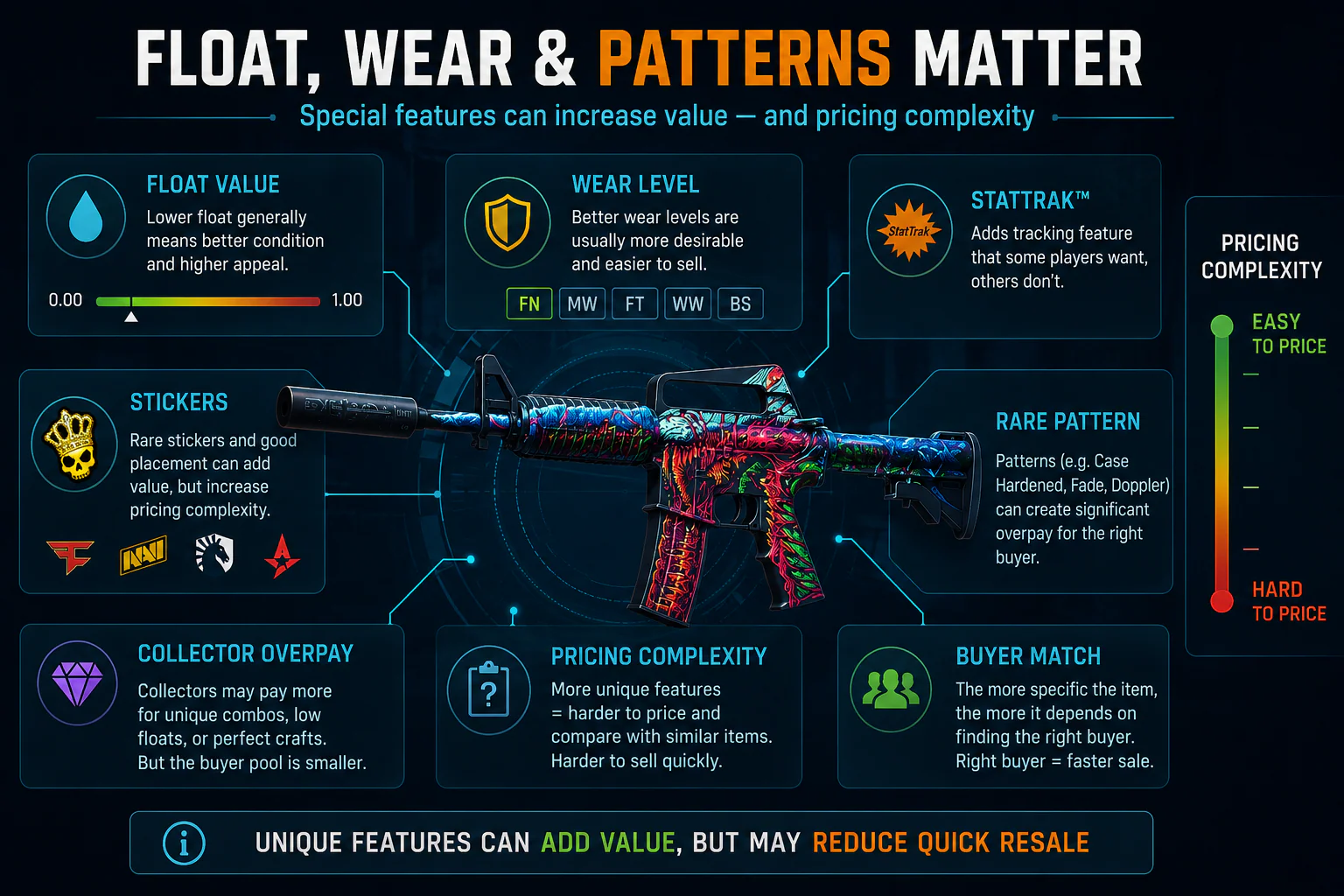
Modifiers can increase appeal, but they can also make pricing more complicated. StatTrak, stickers, crafts, and patterns may add value for the right buyer, but they do not always improve liquidity.
StatTrak
StatTrak tracks confirmed kills on a weapon skin. Some active players prefer StatTrak because it adds a personal progress element to the item. StatTrak versions may have higher prices than non-StatTrak versions, depending on the skin and demand.
However, StatTrak does not always make a skin easier to sell. Some collectors prefer non-StatTrak versions because they look cleaner or match collector preferences. Users should compare StatTrak and non-StatTrak demand before paying extra.
Stickers and crafts
Stickers can increase visual appeal and make a skin feel more personal. Rare stickers can also attract collectors, especially when placement and theme are strong.
However, sticker overpay can be difficult to price. The value of a sticker on a skin is not always equal to the sticker’s separate market price. Placement matters, wear matters, theme matters, and buyer preference matters.
Heavily customized crafts may need a specific buyer. A craft can make a skin more unique, but uniqueness can reduce liquidity if fewer buyers want that exact look. Before paying extra, users should compare similar crafts and understand whether the overpay is supported by real demand.
Patterns and special variants
Some skins have pattern-based value. Examples include Case Hardened patterns, Fade percentages, Doppler phases, Crimson Web web placement, and Marble Fade color balance.
Special patterns can attract overpay, but rare patterns may be harder to price. Pattern overpay depends on real buyer demand, not just rarity. A unique pattern does not automatically mean fast resale.
For pattern-based skins, users should avoid relying only on screenshots or seller claims. Similar sales, collector interest, and recognized pattern categories are more useful than vague statements about rarity.
Knives and Gloves: Liquid Status Items or Niche High-End Skins?
Knives often have broad demand because many players want a knife skin in their inventory. Popular knife models may be easier to trade than niche high-end items because more buyers recognize them and understand their price range.
However, not all knives are equally liquid. Model, finish, float value, pattern, color theme, and price all affect demand. A widely recognized knife model in a desirable finish may attract more buyers than a rare but unpopular combination.
Gloves can be expensive, but they are often more condition-sensitive than many weapon skins. Float and wear can strongly affect glove appearance, and buyers may be selective about clean knuckles, color balance, and visible wear. This can make glove pricing more complex.
For both knives and gloves, users should compare demand by model rather than assuming item price alone defines liquidity. A premium knife can sometimes be more liquid than a niche collector item, while a high-priced glove may need a buyer who understands its exact float, finish, and condition.
Case Drops and Liquidity: Why Possible Value Is Not Enough
CS2 case opening adds another liquidity layer because drops are random. A case drop may have a market price, but that does not mean it will be easy to sell quickly at that price.
When evaluating possible drops, users should consider both value and liquidity. Expensive headline rewards may attract attention, but they are not always the most liquid items. Lower-value popular skins may sometimes be easier to sell or trade because more buyers can afford them and understand their value.
Expected value calculations may not fully capture liquidity risk. A case may include items with listed market prices, but some drops may have wide spreads, weak demand, or limited buyer interest. Low-tier drops may include unwanted or low-demand skins that are harder to move.
Users should compare:
Drop chance
Market price
Item pool quality
Realistic demand
Spread and pricing clarity
Whether the item is easy to sell or trade
Chance4Skin can help users review case odds, drop chances, item pools, and EV-related information. This context can make case analysis more realistic, but case opening should still be treated as entertainment, not a reliable resale strategy.
Buying Skins Directly vs Opening Cases From a Liquidity Perspective
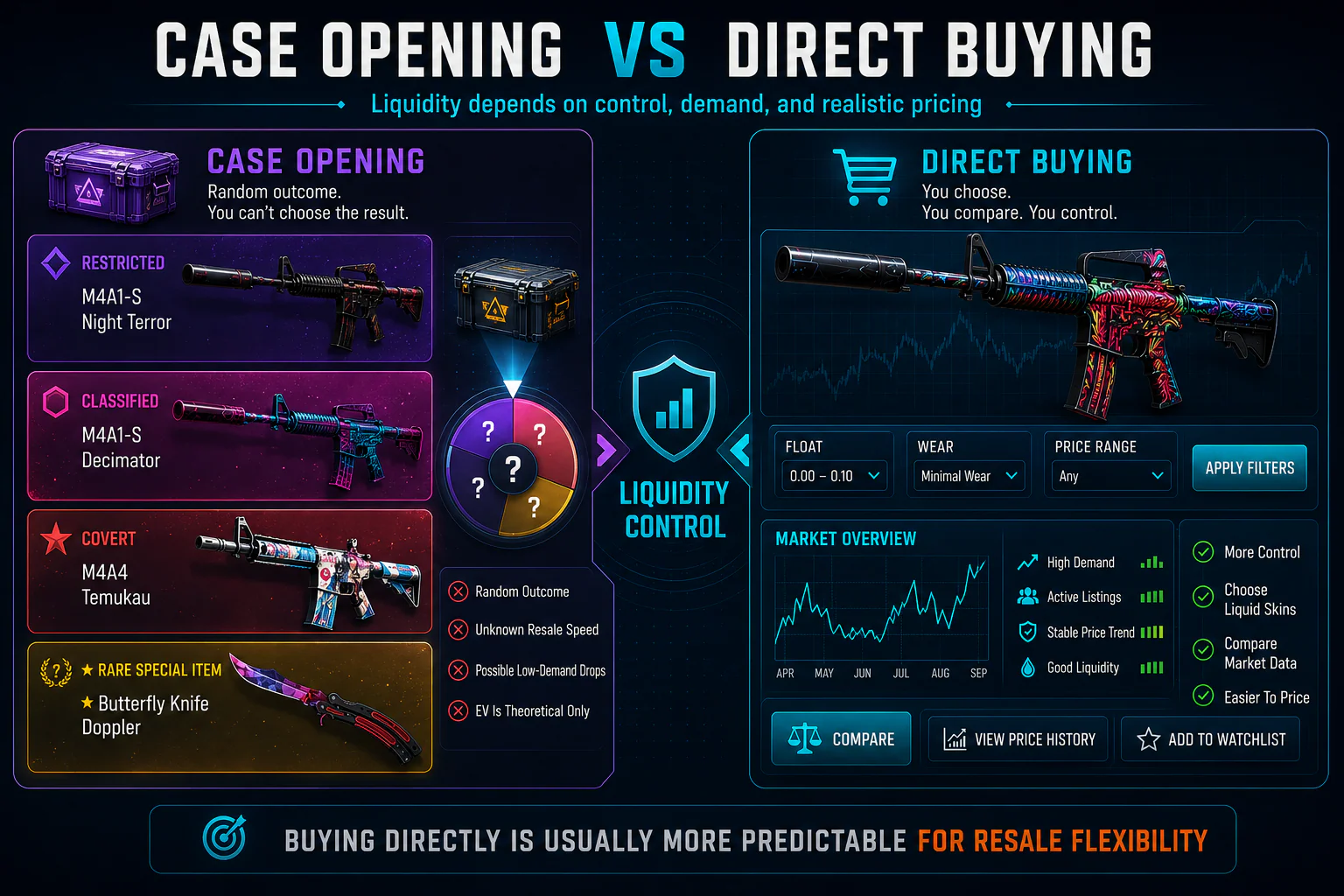
Buying skins directly gives users more control. They can choose the exact weapon, skin, float value, wear level, price range, and liquidity profile they want. They can also compare listings and price history where available before making a decision.
Case opening depends on random outcomes. A user may receive a desirable item, but they may also receive low-liquidity drops, low-tier skins, or items with weak demand. Even when a drop has market value, it may not be easy to sell at the listed price.
From a liquidity perspective, direct buying is usually more predictable for users who care about resale or trading flexibility. A user can intentionally choose liquid skins, avoid unclear crafts, and focus on items with stronger market demand.
Case opening can still be used for entertainment by users who understand the odds and risks. It should not be treated as a reliable method for building a liquid inventory.
How Liquidity Affects Expected Value and EV Ratio
Expected value, or EV, is a theoretical average based on possible outcomes and their estimated values. EV ratio compares this expected value against the cost of opening a case or pursuing a specific outcome.
Liquidity matters because EV calculations may rely on market prices that do not fully reflect real sellability. A skin with a listed price may not sell instantly at that price. If the spread is wide or buyer demand is weak, the practical value may be lower than the theoretical value suggests.
Low-liquidity items can make EV feel less realistic. For example, if a case contains rare high-value items that are hard to sell, the EV may look better on paper than it feels in practice. Users should treat EV as one tool, not a complete resale forecast.
Liquidity should be considered alongside:
Drop chance
Market price
Spread
Demand
Item pool quality
Ease of pricing
Chance4Skin can support this process by helping users compare skin data, case odds, market context, and EV-related information. The goal is not to predict profit, but to understand risk and value more clearly.
How to Evaluate CS2 Skin Liquidity Before Buying or Trading
To evaluate CS2 skin liquidity, look at the skin from both a market and buyer-demand perspective. The question is not only “What is this skin listed for?” but also “How easily could someone sell or trade this at a realistic price?”
Useful liquidity checks include:
Number of active listings
Recent sales activity where available
Popularity of the weapon
Popularity of the skin
Demand for the wear level
Price range and buyer affordability
Spread between listings and buyer offers
Number of similar skins on the market
Community demand
Whether the skin is easy to price
Whether overpay depends on rare stickers or patterns
A skin is usually easier to evaluate when there are many similar examples. It becomes harder when the item depends on unusual float value, rare stickers, rare patterns, or subjective visual appeal.
For trades, pricing clarity is especially important. If both users understand the skin value quickly, the trade may be easier to discuss. If the skin requires expert knowledge, the owner may need to explain the value and wait for a buyer who agrees.
High Liquidity vs Medium Liquidity vs Low Liquidity Skins
Liquidity Level | Common Signals | What It Means |
|---|---|---|
High liquidity | Popular weapon, recognizable skin, active market, reasonable spread | Easier to sell or trade |
Medium liquidity | Some demand, moderate listings, condition-dependent pricing | May sell with patience or fair pricing |
Low liquidity | Niche item, rare craft, wide spread, few buyers | May require discount, patience, or specialist buyer |
These are general signals, not guarantees. Market conditions can change, buyer interest can shift, and even a normally liquid skin may take longer to sell if it is overpriced. Liquidity should always be evaluated with current market context where available.
Common Mistakes When Judging Skin Liquidity
Beginners often confuse visible price with real market demand. A high listing can make a skin look valuable, but liquidity depends on whether buyers are actually willing to pay a realistic price.
Common mistakes include:
Assuming high price means high liquidity
Ignoring recent sales
Ignoring spread
Overpaying for stickers without understanding demand
Assuming rare always means easy to sell
Ignoring float and wear
Buying niche items without an exit plan
Judging value by screenshots alone
Treating case drops as guaranteed market value
Expecting instant resale at full listed price
The safest approach is to compare similar items, understand why a skin is priced the way it is, and avoid paying extra for features that are difficult to verify or explain.
Liquidity Checklists Before Buying, Trading, or Opening Cases
Checklist Before Buying or Trading a CS2 Skin
Is the weapon popular?
Is the skin recognizable?
Is there active market demand?
Are similar listings selling?
Is the spread reasonable?
Is the float value easy to understand?
Is the wear level desirable?
Is the price based on normal market value or special overpay?
Are stickers or patterns making the item harder to price?
Would a direct buyer understand the value quickly?
Could the skin require a specialist collector?
Is the user comfortable holding the skin longer if it does not sell quickly?
Checklist Before Opening a Case
Are possible drops easy to sell?
Are headline rewards actually liquid?
Are low-tier drops mostly unwanted skins?
Is the case item pool transparent?
Are case odds visible?
Does expected value consider current market prices?
Could some drops have wide spreads?
Would buying the target skin directly be more predictable?
Is the user treating case opening as entertainment, not a resale strategy?
How to Build a More Liquid CS2 Inventory
A more liquid CS2 inventory is usually built around skins that are easier to understand, easier to price, and appealing to a wider group of players. This does not mean every item must be common or basic. It means the owner should understand the demand behind each item.
Practical ways to improve inventory liquidity include:
Focus on popular weapons
Choose recognizable skins
Compare float and wear carefully
Avoid overpaying for unclear crafts
Consider demand before rarity
Avoid buying only because an item looks rare
Diversify across easier-to-price items where relevant
Keep personal preference separate from resale expectations
Avoid treating skins as guaranteed investments
Personal preference still matters. Many users buy skins because they enjoy the design, not because they plan to sell later. The key is to separate emotional value from market flexibility. A skin can be great for personal use while still being less liquid.
When Low-Liquidity Skins Can Still Make Sense
Low-liquidity skins are not automatically bad. They can make sense when the buyer understands why the item is niche and accepts that resale may take longer.
Collectors may want rare items, unusual crafts, older skins, or special patterns because they value uniqueness. Some users prefer skins that are not common, even if those skins are harder to trade. Others may buy for visual preference and have no immediate resale plan.
Low-liquidity skins can make sense when:
The user values the item personally
The buyer understands the pricing complexity
The skin has collector appeal
The user is comfortable holding it longer
The overpay is researched carefully
Resale speed is not the main goal
The issue is not low liquidity itself. The issue is buying a low-liquidity item while expecting it to behave like a highly liquid skin.
How Chance4Skin Can Help
Chance4Skin helps users explore CS2 skins, compare skin data, review case odds, understand drop chances, check market context, and think about expected value. This information can support better decisions when evaluating skin value, trading skins, or comparing CS2 case opening outcomes.
For liquidity research, users can use Chance4Skin to study how a skin fits into a broader item pool, how its rarity relates to possible drops, and how market value connects with case odds and EV-related information. This can help users think more clearly about whether a skin may be popular, valuable, hard to price, or risky to target through case opening.
Chance4Skin is most useful when treated as an educational and analytical resource. It can help users ask better questions before buying, trading, or opening cases, especially when liquidity, float value, wear level, rarity, and expected value all interact.
FAQ
What does CS2 skin liquidity mean?
CS2 skin liquidity means how easy it is to sell or trade a skin at a realistic market price. A liquid skin usually has active demand and can be priced more clearly.
Are expensive CS2 skins always liquid?
Expensive CS2 skins are not always liquid. Some high-value collector skins may take longer to sell because the buyer pool is smaller and the pricing requires more specialized knowledge.
Which CS2 skins are usually more liquid?
Skins for popular weapons such as AK-47, AWP, M4A1-S, M4A4, Desert Eagle, USP-S, and Glock-18 are often easier to sell, especially when the skin is recognizable and fairly priced. Liquidity still depends on condition, float value, market demand, and price.
Does float value affect liquidity?
Float value can affect liquidity because buyers often prefer cleaner skins or better-value float ranges. Very special float values can attract collectors, but they may also require the right buyer.
Do stickers make a skin easier or harder to sell?
Stickers can increase appeal, but they can also make pricing more complex. Rare or expensive sticker crafts may need a collector who understands the overpay and agrees with the craft’s value.
Are knives more liquid than weapon skins?
Popular knives can be liquid because many players want knife skins. Liquidity still depends on model, finish, float, pattern, condition, and price.
How does liquidity affect case opening?
A case drop may have market value but still be hard to sell quickly. Users should consider item pool quality, drop chance, market price, and liquidity before opening cases.
Is buying skins directly better for liquidity?
Buying directly gives users more control over choosing popular, easy-to-price skins. Case opening depends on random outcomes and may result in less liquid items.
Can Chance4Skin help evaluate skin liquidity?
Chance4Skin can help users review skin data, market context, case odds, drop chances, and EV-related information before buying skins or opening cases. This can make liquidity research more structured and easier to understand.
Written by
Team Chance4Skin


