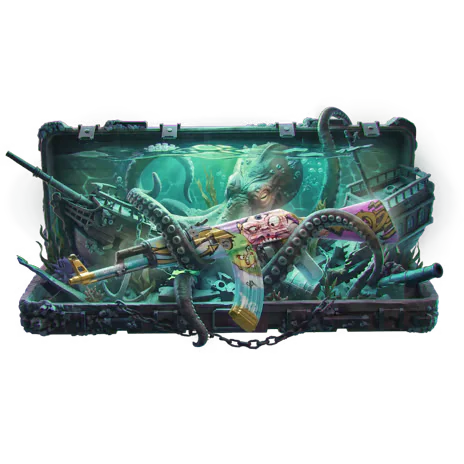



Case Overview
The Kraken case combines standard weapon skins with premium cosmetic categories across multiple wear conditions and market segments. Published odds show that some of the highest-value entries are assigned extremely small probability ranges, while more accessible items occupy much larger sections of the distribution. This produces a strongly asymmetric profile rather than a uniform item-value structure. The presence of items such as AWP Dragon Lore and premium special-item variants illustrates how the upper tail can differ materially from the central portion of the pool. Consequently, evaluating the case by its most valuable listed items alone provides limited information about typical outcomes.
Value and Risk Factors
Expected value is calculated from the complete probability-weighted distribution, not from maximum item value. In Kraken, very scarce premium outcomes may materially influence theoretical EV while remaining statistically uncommon observations. This increases variance and can create a substantial difference between expected value and the value associated with more frequently occurring items. Other variables include secondary-market liquidity, wear condition, collector demand, reference-value methodology and short-term price dispersion. A rigorous comparison should therefore measure EV alongside median outcome value, probability concentration and upper-tail contribution. Demand stability is particularly relevant because changes in premium-item valuations can alter the case's calculated EV more strongly than changes among lower-value outcomes.