
Rare CS2 Skins Drop Chances: Why They Are So Low
Published: 18.06.2026
Rare CS2 skins get attention because they combine design, value, scarcity, and collector appeal. Beginners often focus on knives, gloves, Covert skins, StatTrak versions, and expensive older CS:GO items before they understand how case odds work. That can create unrealistic expectations about what a case is likely to return.
The main thing to understand is that rare CS2 skins drop chances are usually low by design. CS2 case opening is built around item pools, rarity tiers, and probability. Common skins appear more often, while rare items appear much less often. A rare drop is possible, but users should not treat case opening as a reliable way to get one specific expensive skin.
This guide explains why rare drops are uncommon, how drop chance connects to market price, and how tools like Chance4Skin can help users review data before opening cases or buying skins directly.
What Makes a CS2 Skin Rare?
A CS2 skin can be rare for more than one reason. Rarity tiers are the most obvious factor: higher-tier skins are usually harder to obtain than lower-tier skins. Special categories, such as knives and gloves, are also treated as especially rare in many case systems.
Supply and demand matter too. A skin may feel rare because fewer copies are available, because collectors want it, or because it belongs to a popular weapon. Skins for frequently used rifles, pistols, and knives often receive more attention than skins for less common weapons.
Older CS:GO skins, special finishes, rare patterns, StatTrak versions, float value, and wear level can all affect rarity and price. A Factory New skin with a desirable float may be more valuable than the same skin in a worse condition. Rarity is not only about visual design; it also depends on scarcity, history, condition, and market demand.
How CS2 Case Drop Chances Work
Each CS2 case has an item pool. This is the list of possible skins and special items that can drop from that case. When a case is opened, the result is selected according to probability, not personal history or player preference.
Lower-tier items generally appear more often, while higher-tier items appear less often. A beginner may look at a case and focus on one target skin, but that skin is only one possible result. Even if the case contains a valuable item, the chance of receiving that exact item may be low.
Before opening a case, users should check visible odds, the full item pool, and the rarity structure. Chance4Skin can help users explore CS2 case odds, compare case odds, and understand drop chances in a clearer way.
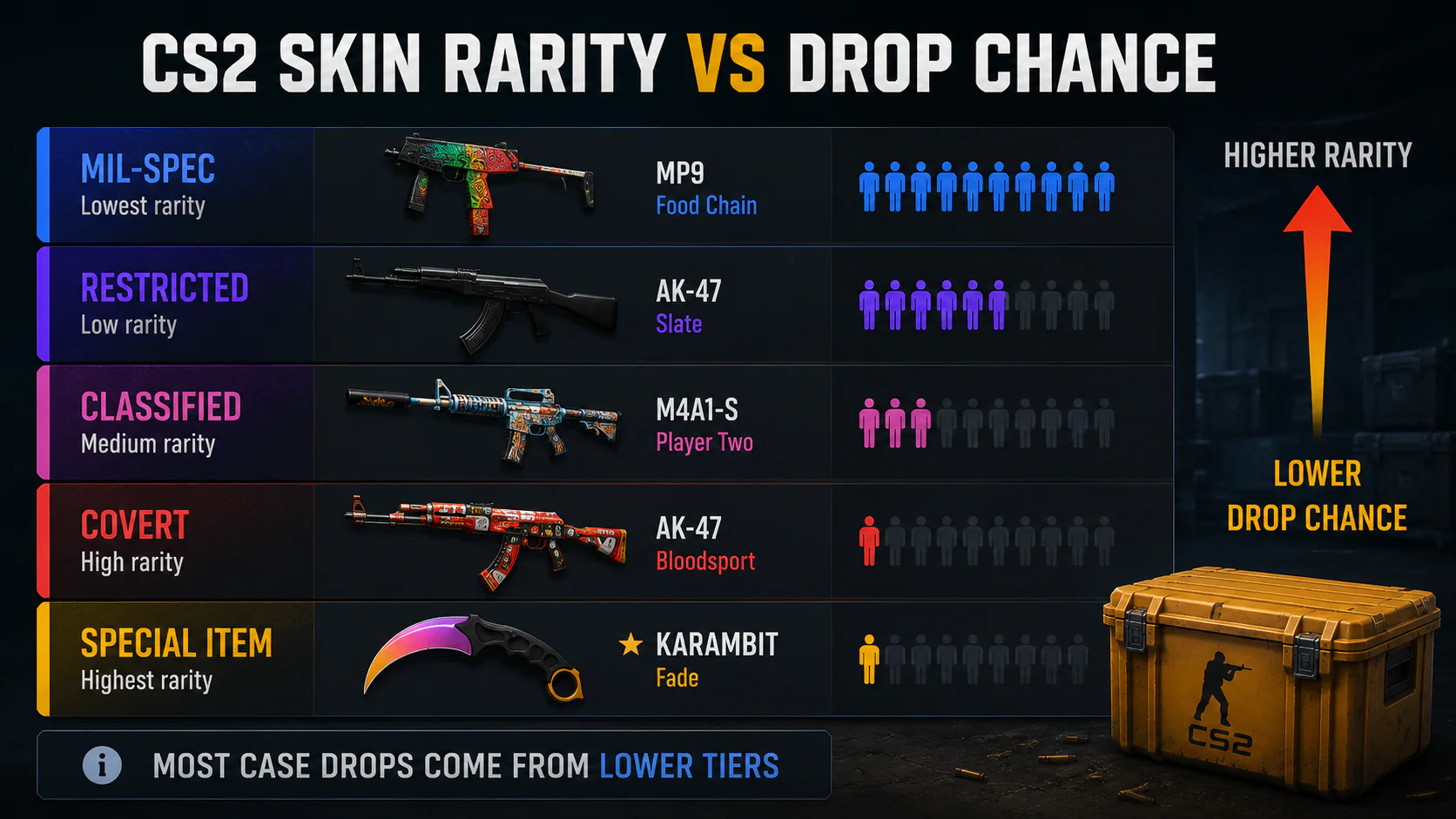
Why Rare CS2 Skins Drop Chances Are So Low
Rare CS2 skins drop chances are low because cases are structured around unequal rarity tiers. Common and mid-tier drops make up most results, while higher-tier skins and special items appear less frequently. This creates scarcity and separates ordinary drops from rare rewards.
Low supply can increase perceived value, especially when collectors and players want the same skin. Case design also affects reward distribution: the case is not built to give every item an equal chance. Rare drops are meant to be difficult to obtain.
A low probability does not mean a rare drop is “due” after losses. Each opening is random. If a user receives lower-tier skins many times, the next result is still independent and should not be treated as more likely to be rare.
The Role of Rarity Tiers
Rarity tiers help organize CS2 skins by scarcity. Lower-tier skins are more common and usually have higher drop rates. Higher-tier skins are more limited and usually have lower drop chances.
Covert skins are among the best-known high-tier weapon skins. Knives and gloves, where included, are often special rare rewards. Because these items are harder to obtain, they often attract more attention from players and collectors.
Higher rarity can affect market price, but it does not guarantee high value. Demand, weapon popularity, finish, float value, wear level, StatTrak status, and current market activity also matter. Rarity explains scarcity, while price depends on several factors together.
Why One Expensive Skin Does Not Define the Whole Case
Many users judge a case by its most expensive possible drop. This can be misleading. A case may contain an attractive rare reward, but most results may still come from lower-value parts of the item pool.
Promotional visuals and community discussion often highlight the most exciting skins. That can make the top reward seem more important than the rest of the case. In practice, the full item pool matters more than one headline item.
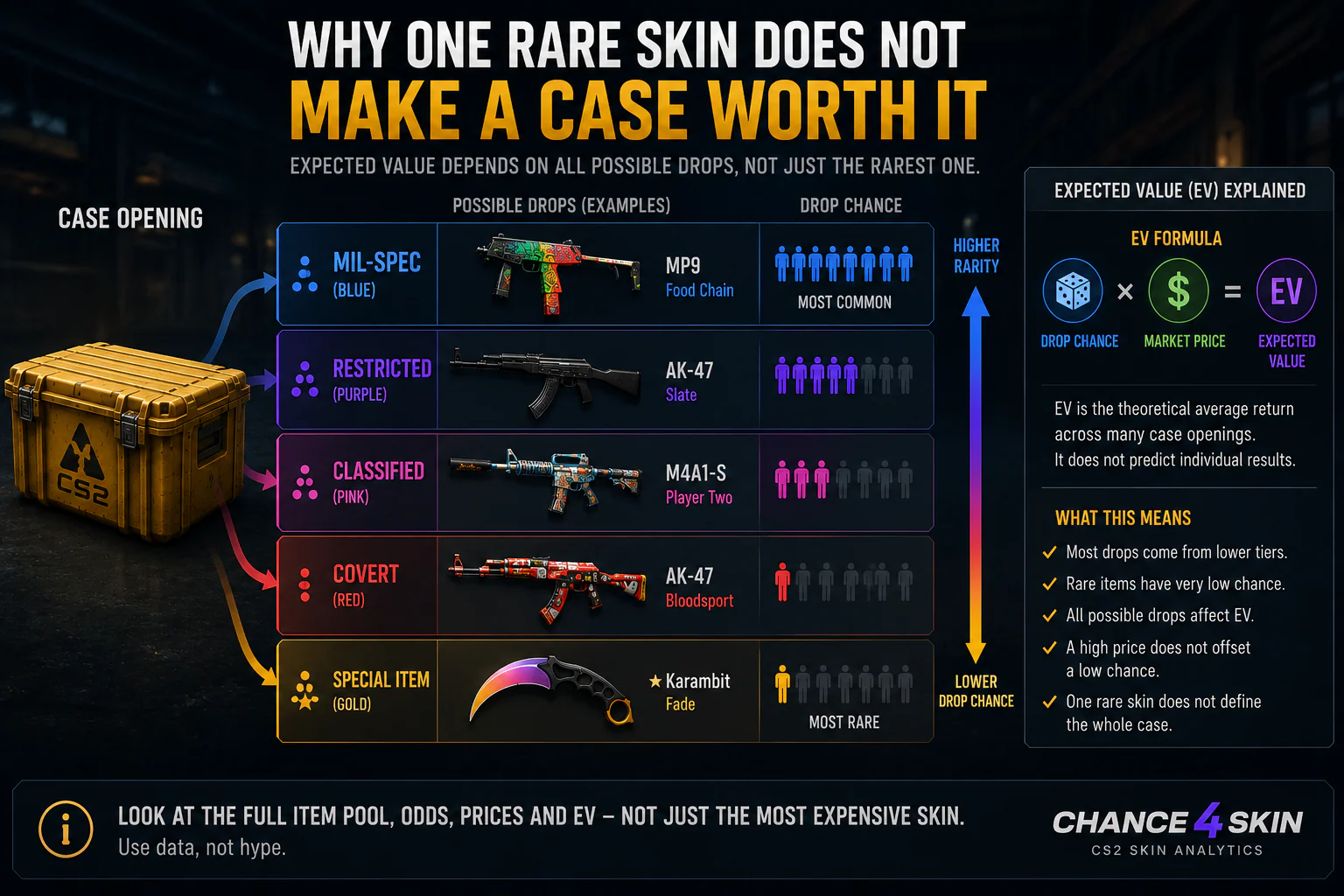
Expected value depends on all possible drops, not only the rarest skin. A valuable rare item may influence the theoretical average, but common outcomes still affect the result because they appear more often.
Drop Chance vs Market Price
Drop chance and market price are connected, but they are not the same. A low drop chance can reduce supply, and lower supply can support higher prices when demand is strong. Still, price also depends on player interest, weapon popularity, condition, and market activity.
Float value and wear level can change a skin’s value. Factory New, Minimal Wear, Field-Tested, Well-Worn, and Battle-Scarred versions may trade at different prices. StatTrak versions can also affect value, depending on the skin and demand.
Older CS:GO history can increase collector interest, especially when a skin is connected to older cases or memorable designs. However, rare does not always mean profitable. Prices can rise or fall, so users should check current market context instead of relying on assumptions.
Expected Value and Rare CS2 Skins
Expected value, or EV, is a theoretical average return based on possible outcomes and their probabilities. In case opening, EV considers the market value of possible drops and how often those drops are expected to appear.
Rare items may contribute heavily to EV because they can have high market prices. But common drops still matter because they appear more frequently. A case can contain valuable rare skins and still have weak average results if most likely outcomes are low in value.
EV does not predict individual results or guarantee rare skins. Users should not rely on rare drops to make a case “worth it.” Negative EV can still be common even when rare rewards are valuable. EV ratio, case price, fees, and current skin values should be reviewed carefully.
Why Chasing Rare Drops Is Risky
Chasing rare drops is risky because users may keep opening more cases after losses. These are common case opening mistakes beginners should avoid. They may feel that a rare item must appear soon because they have already spent money. This is the sunk cost fallacy.
Random outcomes do not remember previous openings. Past results do not improve future drop chances. Each case opening should be treated as a separate random event.
Emotional spending can also become a problem. A user may start with a small budget and continue because they want to recover losses or reach a specific skin. A safer approach is to set a fixed budget and treat CS2 case opening as entertainment, not profit.
Buying Rare CS2 Skins Directly vs Opening Cases
Buying CS2 skins directly is usually more predictable for users who want one specific item. The buyer can choose the exact skin, inspect float value, review wear level, compare prices, and decide whether the listed price makes sense.
Case opening depends on random outcomes. A user may open cases hoping for a specific rare skin and receive lower-tier items instead. The total cost of chasing one target skin through cases may become higher than the visible market price of buying it directly.
Direct buying also gives more control over StatTrak status, condition, and float. Rare skins may be expensive, but the price is visible before purchase. Case opening is less predictable when the goal is one specific rare item.
How Chance4Skin Can Help
Chance4Skin is a CS2 skin analytics and wiki-style platform. It helps users explore CS2 skins, review skin data, compare case odds, understand drop chances, check rarity, and evaluate market context.
For beginners, Chance4Skin can make case opening easier to understand. Instead of focusing only on the most expensive skin in a case, users can review the full item pool, rarity tiers, skin value, float value, wear level, and EV-related information.
This supports a more informed approach based on data rather than hype, assumptions, or emotional decisions.
Quick Checklist Before Chasing Rare Skins
Before trying to get rare CS2 skins, ask:
Do I know the drop chance?
Have I checked the full item pool?
Am I focusing only on the most expensive skin?
Do I understand the rarity tier?
Have I compared the case price with the skin’s market price?
Do I understand expected value?
Have I set a fixed budget?
Am I opening for entertainment, not profit?
Would buying directly be more predictable?
FAQ
Why are rare CS2 skins so hard to get?
Rare CS2 skins usually belong to higher rarity tiers or special item categories. These items have lower drop chances than common skins, so they appear much less often.
Do rare CS2 skins have fixed drop chances?
Drop chances depend on the case, item pool, rarity structure, and platform. Users should check visible case odds before opening instead of assuming every case has the same probabilities.
Does opening more cases increase my chance of getting a rare skin?
Opening more cases creates more random attempts, but past results do not make a rare drop “due.” It also increases spending and risk.
Are rare CS2 skins always expensive?
Not always. Price depends on demand, condition, float value, wear level, StatTrak status, supply, weapon popularity, and market activity.
Is it better to buy rare CS2 skins directly?
Buying directly is usually more predictable if the user wants one specific rare skin. Case opening depends on random outcomes and drop chance.
What is the difference between rarity and drop chance?
Rarity describes the item category or scarcity. Drop chance describes the probability of receiving that item or rarity tier from a case.
Can expected value predict rare drops?
Expected value estimates average theoretical return. It cannot predict individual case results or guarantee rare skins.
Can Chance4Skin help understand rare CS2 skins drop chances?
Yes. Chance4Skin can help users review CS2 skin data, case odds, drop chances, rarity, market context, skin value, and EV-related information.
Written by
Team Chance4Skin


