
Official CS2 Cases vs Third-Party Case Sites: Odds, Value and Risks Compared
Published: 27.06.2026
CS2 players have two broad ways to open cases: official CS2 cases connected to the game and Steam ecosystem, or third-party case-opening platforms that run their own custom systems. At first glance, both may look similar: a user pays to open a case, receives a random item, and hopes the result has meaningful skin value. In practice, official CS2 cases vs third-party case sites is a comparison between two very different models.
Official CS2 cases are tied to CS2 item collections, case keys, Steam Inventory, and the wider Steam Market context. Third-party CS2 case sites may use custom item pools, custom case odds, internal balances, bonuses, skin withdrawal rules, verification checks, and platform-specific account systems. These differences can affect not only the possible drops, but also the practical value of what a user receives.
Before spending money or skins, users should understand the case odds, drop chance, case cost, expected value, EV ratio, market price, withdrawal rules, bonus terms, KYC requirements, and platform risk. Case opening is random, and users can lose money or skin value. For anyone targeting a specific skin, float, wear level, pattern, sticker setup, or StatTrak version, buying directly may be more predictable than opening cases.
What Are Official CS2 Cases?
Official CS2 cases are cases connected directly to Counter-Strike 2 and the Steam ecosystem. They are part of the official CS2 skin economy, and opening one usually involves having the case itself and using a case key. The case contains an official item pool, typically linked to a specific collection or case release.
The result is random. A user does not choose the skin, wear level, float value, pattern, or StatTrak status. Official cases follow a rarity-based drop structure, where common outcomes are more likely than rare outcomes. The rarest items are the most difficult to receive, and opening an official case does not mean the user will receive a high-value item.
One reason official CS2 cases are familiar to many players is that the drops go into the user’s Steam Inventory. From there, items can be viewed, traded according to Steam rules, or listed on the Steam Market where available. This direct connection to Steam makes the system easier to understand for users who already play CS2 and use Steam regularly.
However, familiarity should not be confused with predictable value. Official CS2 case opening still involves random outcomes, case and key cost, market volatility, and the possibility of receiving an item worth less than the total opening cost. A player may open multiple cases and still not receive the item they wanted.
What Are Third-Party CS2 Case Sites?
Third-party CS2 case sites are independent platforms that offer case-opening experiences outside the official CS2 client. These sites may create their own cases, set their own case prices, design custom item pools, show platform-specific odds, offer bonuses, and use internal balance systems.
Unlike official cases, third-party cases are not limited to official case collections. A custom case may group skins by weapon, rarity, color, price range, collection, popularity, theme, or platform-defined category. Some platforms may display item-level probabilities, while others may provide less complete information. Rules vary significantly from site to site and can change over time.
A third-party platform may require users to deposit money, skins, or another supported balance type before opening cases. If a user receives an item or platform balance, withdrawal may depend on the site’s rules, available inventory, fees, minimum thresholds, verification checks, or trade restrictions. Some platforms may use bots or automated trade systems for skin withdrawals.
Third-party CS2 case sites should not be treated as one uniform category. A transparent platform with visible odds, clear withdrawal rules, readable terms, and reliable support is different from a site with vague rules, unclear ownership, or incomplete case information. Users should research any site before depositing and should follow local laws, platform rules, and age restrictions where applicable.
The Main Difference: Official Item Pools vs Custom Cases
The most important structural difference is the item pool. Official CS2 cases usually have defined item collections. A user can inspect the type of skins associated with that case and understand that the case is part of the official CS2 skin ecosystem.
Third-party case sites may use custom cases. These custom cases can include skins from different collections, weapon types, price ranges, rarity tiers, or themes. For example, a platform could create a case focused on AK-47 skins, red skins, low-cost skins, high-value skins, knives, gloves, or popular community items. The exact design depends on the platform.
This flexibility can make third-party cases more varied, but it can also make comparison harder. Two cases with similar names or similar visual promotion may have very different item pools and odds. A case graphic may highlight one expensive skin, but that does not mean the case is likely to drop that skin.
The low-value items in the pool matter as much as the headline reward. A case with one attractive top item and many low-value outcomes may still have weak practical value if the top item has a very small drop chance. Users should always inspect the full drop table instead of relying only on promotional images, case names, or the most expensive visible reward.
Case Odds: Official Structure vs Platform-Specific Odds
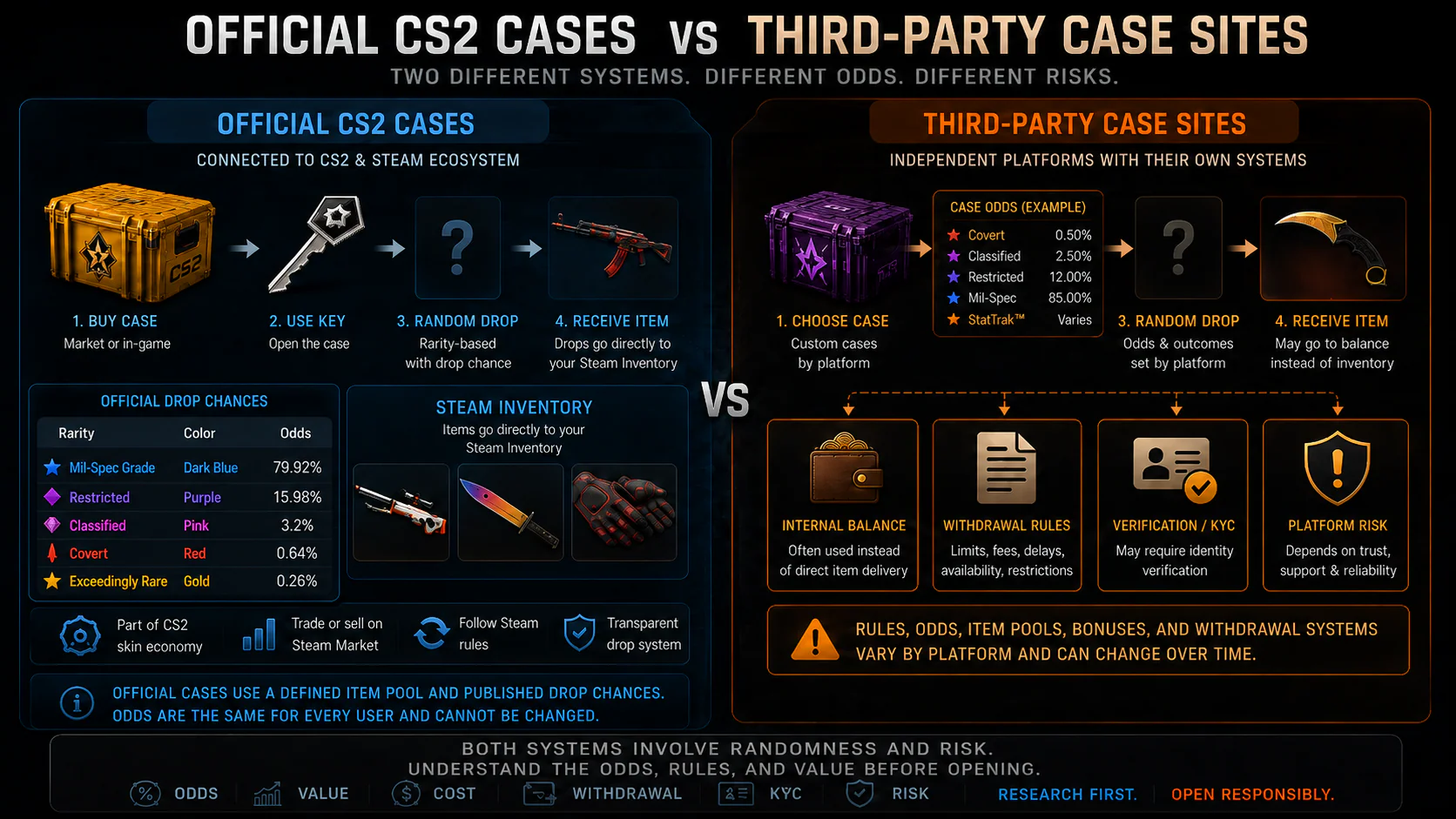
Case odds are central to any CS2 case odds comparison. Official CS2 cases follow a defined rarity-based structure. The practical meaning is simple: lower-rarity outcomes are more common, while rare outcomes are harder to receive. Exact drop chances should only be used when they are verified from reliable information, and users should avoid assuming that rare items are likely just because they appear in the case.
Third-party CS2 case sites may set their own case odds. These probabilities can vary by platform and by individual case. One platform may show item-level odds clearly, while another may show limited information or make the drop table difficult to evaluate. Visible odds are important because they allow users to compare the case cost, possible outcomes, and theoretical value more carefully.
Hidden or incomplete odds increase risk. Without clear probabilities, a user cannot reasonably estimate expected value or understand how much each possible outcome contributes to the case. Visual emphasis is not the same as probability. A valuable skin with a very low drop chance may contribute less practical value than it appears to at first glance.
Odds should always be reviewed together with item prices and case cost. A case can contain attractive skins but still have poor theoretical value if the likely outcomes are low-value items. Likewise, a lower-priced case is not automatically better if its item pool and odds are weak.
Price Transparency and Case Cost
Official case opening cost usually involves both the case price and the key cost. The case itself may be affected by market supply and demand, while the key is part of the official opening process. This means the full cost of opening should be considered, not just the visible case price.
Third-party cases may have platform-specific pricing. A site can set case prices based on its own item pool, internal pricing model, market assumptions, promotions, or balance system. Case prices may change over time, and the displayed cost may not always reflect what a user would receive after fees, restrictions, or withdrawal limits.
Cheap cases are not automatically better. A low-cost case can still have mostly low-value outcomes. Expensive cases are not automatically better either. A high-priced case may include premium-looking rewards, but the most desirable items may have very small drop chances.
Users should compare the case price with the full range of possible reward value, especially the common low-value outcomes. Repeated openings can increase total cost quickly, even when each individual case looks inexpensive. Setting a fixed budget before opening cases is a practical risk-control step, because random results can make it easy to spend more than intended.
Expected Value and EV Ratio Comparison
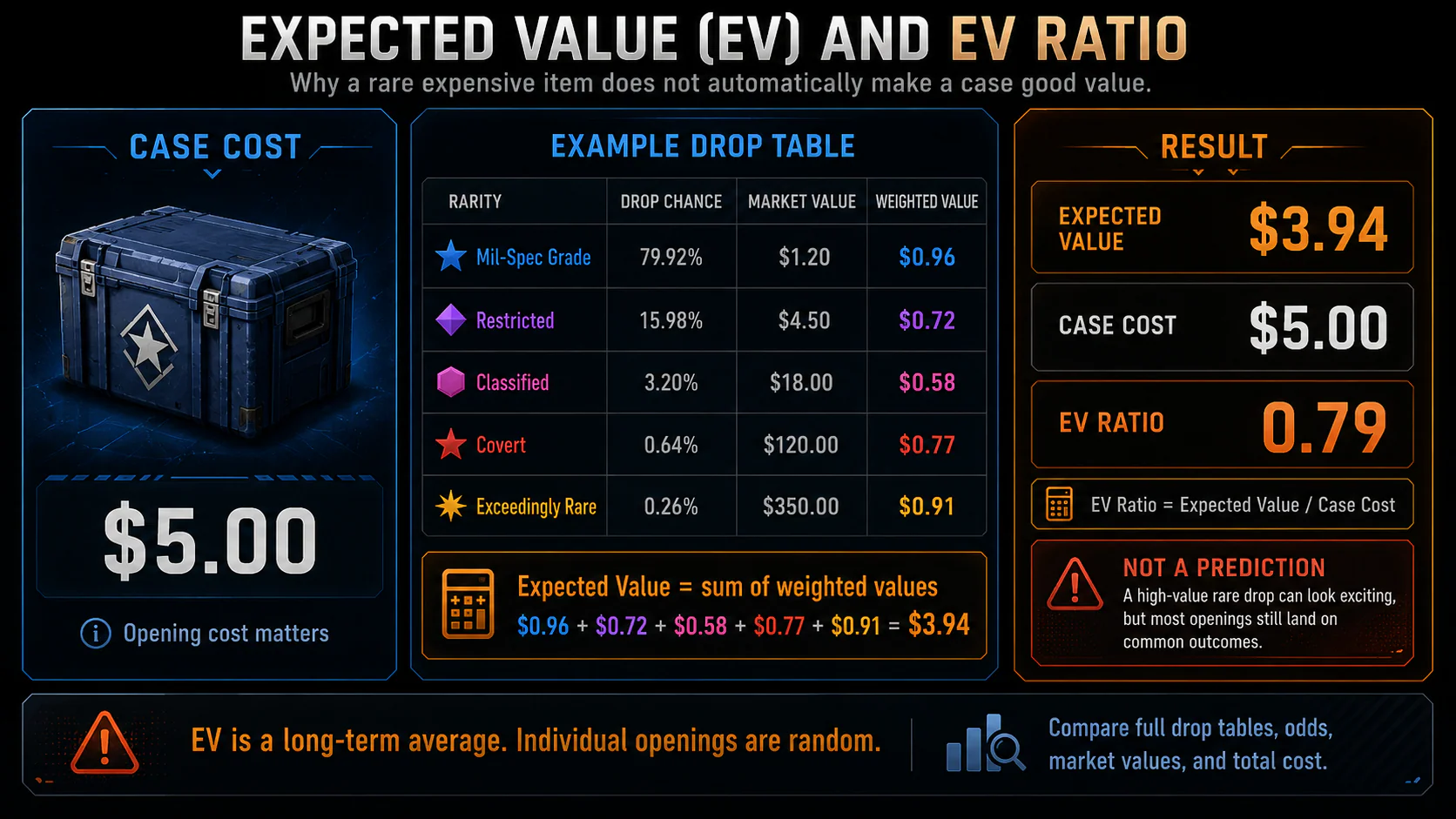
Expected value, often shortened to EV, is a theoretical average return calculated across many openings. In CS2 case opening, it generally depends on the possible items, their probabilities, and their market values. EV ratio compares that expected value with the cost of opening the case.
For example, imagine a case with many low-value outcomes and one rare expensive item. Even if the top item looks impressive, the case can still have low expected value if that item has a very small drop chance and most users are likely to receive lower-value skins. The headline reward does not define the case’s true theoretical value.
EV can help compare case options, but it does not predict an individual opening. A user can open a case with a better-looking EV ratio and still receive a low-value item. Another user can receive a rare item from a case with weak theoretical value. Random outcomes are not smoothed out in a small number of openings.
Both official CS2 cases and third-party cases can have poor EV. A case should not be chosen only because it contains one expensive possible reward. EV-related data also depends on accurate odds and current market prices. If odds are unclear, prices are stale, or market liquidity is weak, the EV estimate becomes less useful.
Practical value can differ from theoretical value. Fees, withdrawal restrictions, locked balances, unavailable listings, trade delays, or non-withdrawable bonus funds can affect what the user can actually receive. A case can look attractive visually while still having weak theoretical or practical value once all terms are considered.
Market Prices and Skin Value
Skin value is not determined by the skin name alone. CS2 skin market price can depend on rarity, demand, supply, float value, wear level, StatTrak status, stickers, pattern, phase, collection, and special variants where relevant. Two versions of the same skin can have very different values.
Float value affects the exact wear of a skin within its wear category. A Factory New skin with a very desirable float may be priced differently from another Factory New version of the same skin. Wear levels such as Factory New, Minimal Wear, Field-Tested, Well-Worn, and Battle-Scarred can also influence price significantly.
Some skins have pattern-based value differences. Certain knives, gloves, Doppler phases, Case Hardened patterns, sticker combinations, or rare visual traits may attract different market interest. StatTrak versions can also trade differently from non-StatTrak versions.
Users should compare platform-displayed value with market context. A displayed value is not always the same as a realistic sale value. Liquidity matters: a listed price does not necessarily mean the item will sell quickly at that price. When reviewing expected value, users should consider whether the displayed value is based on actual market demand or only a theoretical listing reference.
Withdrawals: Steam Inventory vs Third-Party Platform Rules
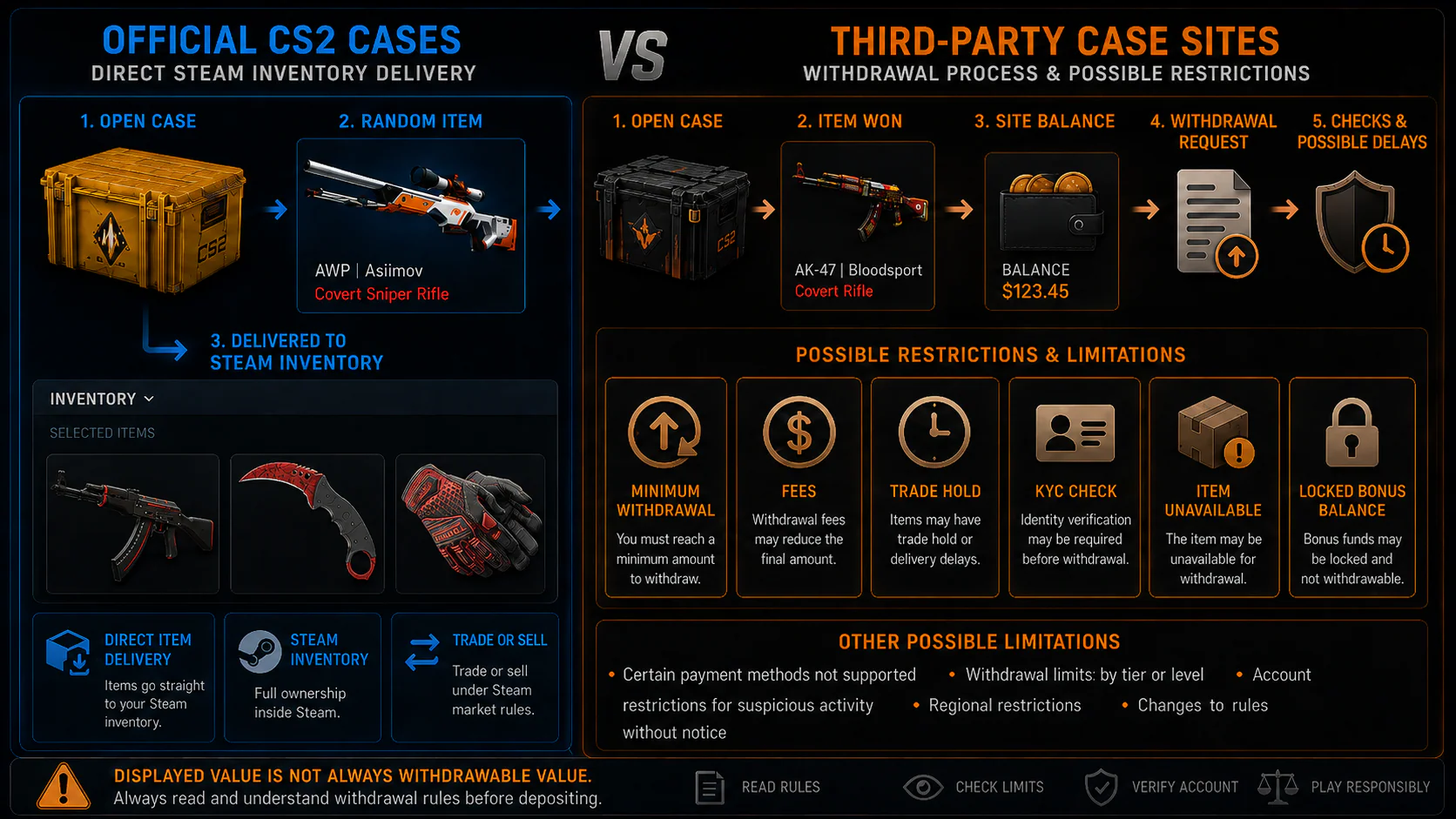
Official case drops go directly into the user’s Steam Inventory. That does not remove all risk, because the outcome is still random and market value can change, but the initial delivery model is clear within the Steam ecosystem.
Third-party platforms may use different withdrawal systems. A user may receive a skin directly, receive internal site balance, receive an item that must be withdrawn later, or need to exchange balance for available skins. Withdrawals may depend on platform inventory, bot systems, minimum withdrawal limits, fees, delays, trade holds, Steam-related restrictions, or verification checks.
This is why third-party CS2 case withdrawal rules matter. A displayed balance is not always the same as a withdrawn skin. Some balances may be locked, bonus-related, restricted, or subject to terms. Some skins may be temporarily unavailable for withdrawal even if they appear in a platform interface.
Before depositing on a third-party site, users should read the withdrawal rules carefully. They should check minimum limits, supported withdrawal methods, possible fees, timing, KYC requirements, account restrictions, and what happens if a selected skin is unavailable. The value of a drop is less practical if it cannot be withdrawn under clear and reasonable terms.
Bonuses and Promotions on Third-Party Case Sites
Third-party case sites may offer bonuses or promotions, such as deposit bonuses, free case offers, promo codes, cashback-style offers, or platform credits. These offers vary by site and may change over time. Users should not assume that a bonus has simple cash or skin value.
Bonus terms can affect real value. Some promotions may involve wagering requirements, locked bonus balance, time limits, withdrawal restrictions, maximum withdrawal caps, eligible cases, minimum deposit conditions, or other platform-specific rules. If the terms are unclear, the user may not understand what the bonus can actually be used for or withdrawn as.
Official CS2 cases do not usually work like third-party bonus systems. The official model is tied to case and key mechanics, not deposit promotions or bonus balances. This makes the comparison important: a third-party case may look attractive because of a promotion, but the practical value depends on the full terms.
Users should not deposit only because of a bonus. A promotion does not remove randomness, case-opening risks, withdrawal limitations, or the need to understand odds. Unclear bonus terms are a warning sign, especially when the offer is presented more prominently than the actual case odds, item pool, or withdrawal rules.
KYC and Account Verification
KYC means “Know Your Customer.” In practice, it refers to identity or account verification checks that some platforms may request. Third-party CS2 case sites may require verification for age checks, payment processing, withdrawals, fraud prevention, compliance, account security, or other platform-specific reasons.
KYC rules vary by platform and may change. Some sites may request verification before deposits, while others may request it before withdrawals or after certain account activity. Hidden or unclear KYC requirements can frustrate users if they only discover them after depositing or receiving platform balance.
Privacy matters. Uploading documents to a platform creates data-handling risk, so users should review the site’s privacy policy, company information, data retention practices where available, and general reputation before submitting sensitive information. Users should not upload documents to a platform they do not trust.
Users should not try to bypass KYC, platform rules, payment checks, geo-restrictions, or verification processes. Instead, they should understand the rules before using a platform and avoid sites whose requirements they are not comfortable with.
Trust Signals and Platform Risk
Third-party platform risk is one of the biggest differences in the official CS2 cases vs third-party case sites comparison. Official cases are part of the CS2 and Steam ecosystem, while third-party platforms require users to evaluate an independent operator.
Useful trust signals include visible case odds, clear withdrawal rules, readable bonus terms, company information, terms of service, privacy policy, support channels, responsible-use information, and transparent explanations of fees, limits, and account restrictions. Recent user reviews and community reputation can also provide context, although reviews should be evaluated carefully because individual experiences can vary.
Risk signals include unclear ownership, vague contact details, incomplete odds, unrealistic profit claims, pressure-based promotions, confusing bonus conditions, repeated withdrawal complaints, poor support visibility, and terms that are difficult to find or understand. These signs do not automatically prove wrongdoing, but they do increase the need for caution.
A transparent site and an unclear site should not be treated the same. Users should compare the full platform experience, not only the case graphics or advertised rewards. Case-opening risks come from both random outcomes and the system used to price, deliver, restrict, or withdraw value.
Official CS2 Cases: Main Pros and Cons
Official CS2 cases have several advantages. They are familiar to many players, connected to the Steam ecosystem, and tied to official item collections. Drops appear in the user’s Steam Inventory, so the user does not need to rely on a separate third-party withdrawal system for the initial drop.
Official cases also fit into the broader CS2 skin economy. Users can view items in Steam Inventory and compare market context through Steam and other skin data resources. For beginners, this familiarity may make the basic process easier to understand.
The downsides are still important. Official case opening is random, and rare items have low drop chances. Users must consider the case and key cost, and the expected value may be negative. Opening a case gives no control over the exact skin, float value, wear level, pattern, sticker setup, or StatTrak status.
Market price can also move after opening. A user who keeps opening cases to get one target skin may spend more than the cost of buying that skin directly. Official cases may be familiar, but they still involve uncertainty and financial risk.
Third-Party Case Sites: Main Pros and Cons
Third-party CS2 case sites can offer more variety than official cases. They may provide custom case themes, different item pools, lower-cost cases, higher-cost cases, weapon-focused cases, rarity-focused cases, or filters by theme, value range, or popularity depending on the platform. Some transparent platforms may show item-level odds, which can help users evaluate drop chance more directly.
Platform-specific tools or promotions may also exist, although these should be reviewed carefully. A custom case can be interesting for users who understand the odds, item pool, price, and withdrawal model behind it.
The drawbacks are significant. Third-party sites introduce platform trust risk, withdrawal rules, bonus restrictions, possible KYC requirements, support variability, and platform-specific account rules. Odds may be unclear on some sites, and custom item pools can make true value harder to compare.
Displayed balance may not equal withdrawable value. Platform rules can change, skin availability may vary, and withdrawal fees or delays can affect practical value. Third-party case opening should be evaluated site by site rather than treated as one simple category.
Official CS2 Cases vs Third-Party Case Sites: Comparison Table
Factor | Official CS2 Cases | Third-Party Case Sites |
|---|---|---|
Item pool | Official case collections connected to CS2 | Custom item pools set by each platform |
Case odds | Rarity-based structure; exact figures should be verified before use | Platform-specific odds that may vary by case |
Price structure | Usually case price plus key cost | Site-defined pricing, sometimes affected by promotions or internal balance |
Expected value | Theoretical and dependent on odds, case cost, and market prices | Theoretical and dependent on odds, prices, fees, and withdrawal value |
EV ratio comparison | Can be compared if reliable odds and prices are available | Can be compared only when odds, pricing, and withdrawal terms are clear |
Skin delivery | Drop appears in Steam Inventory | May use internal balance, bots, or platform withdrawal systems |
Withdrawals | No separate third-party withdrawal system for the initial drop | Rules may include limits, fees, delays, availability, or verification |
Bonuses | Not typically based on deposit bonus systems | May include bonuses with restrictions or conditions |
KYC | Generally tied to Steam account and marketplace rules | May require platform-specific verification |
Platform trust | Based on CS2 and Steam ecosystem | Requires independent trust checks |
Transparency | Official case contents are easier to identify within the CS2 context | Varies by site; full odds and terms are important |
Best for beginners | More familiar for users already using Steam | Requires more research before depositing |
Risk level | Random outcome and market-value risk | Random outcome plus platform, withdrawal, bonus, and account-rule risk |
Which Option Is Better for Beginners?
For beginners, the best starting point is not choosing a side immediately. It is learning how odds, item pools, skin value, float market price, and expected value work. The official CS2 cases vs third-party case sites decision becomes easier once the user understands what is being compared.
Official cases may feel more familiar because they are connected to CS2 and Steam Inventory. Third-party sites require more trust checks because they may use custom cases, internal balances, bonuses, KYC rules, and separate withdrawal systems. Beginners should avoid any case option with unclear odds, vague withdrawal rules, or unrealistic promotional language.
No option removes randomness or risk. Users who want one exact skin may be better off buying directly instead of opening cases. Anyone who chooses to open cases should set a fixed entertainment budget, avoid chasing losses, and understand that a case opening is not a reliable way to obtain a specific item.
When Official CS2 Cases May Make More Sense
Official CS2 cases may make more sense for users who prefer the Steam ecosystem and want drops delivered directly to Steam Inventory. They may also appeal to users who like official case collections and understand how CS2 case and key mechanics work.
They can be easier to understand for players who do not want to evaluate third-party withdrawal systems, bonus terms, or platform-specific account rules. The process is familiar: obtain a case, use a key, receive a random official drop.
This does not mean official cases are always better. Users still need to accept random outcomes, rare drop chances, possible negative expected value, and lack of control over the exact item received. Official cases may suit users who value ecosystem familiarity, but they do not remove case-opening risk.
When Third-Party Case Sites May Make More Sense
Third-party case sites may make more sense for users who understand platform-specific risks and are willing to evaluate each site carefully. A user may prefer custom case themes, visible item-level odds on transparent platforms, or cases grouped by weapon, value range, rarity, or style.
They may also appeal to users who compare EV-related data carefully and treat case opening as entertainment rather than a way to obtain a target item predictably. In this context, the user should review the full item pool, odds, case cost, bonus terms, withdrawal rules, KYC requirements, and platform reputation before depositing.
This does not mean third-party case sites are always better or worse. The quality of information, withdrawal clarity, support, platform reputation, and terms matter heavily. A user should not assume that a custom case is good value because it looks exciting or includes expensive possible rewards.
When Buying Skins Directly May Be Better Than Both
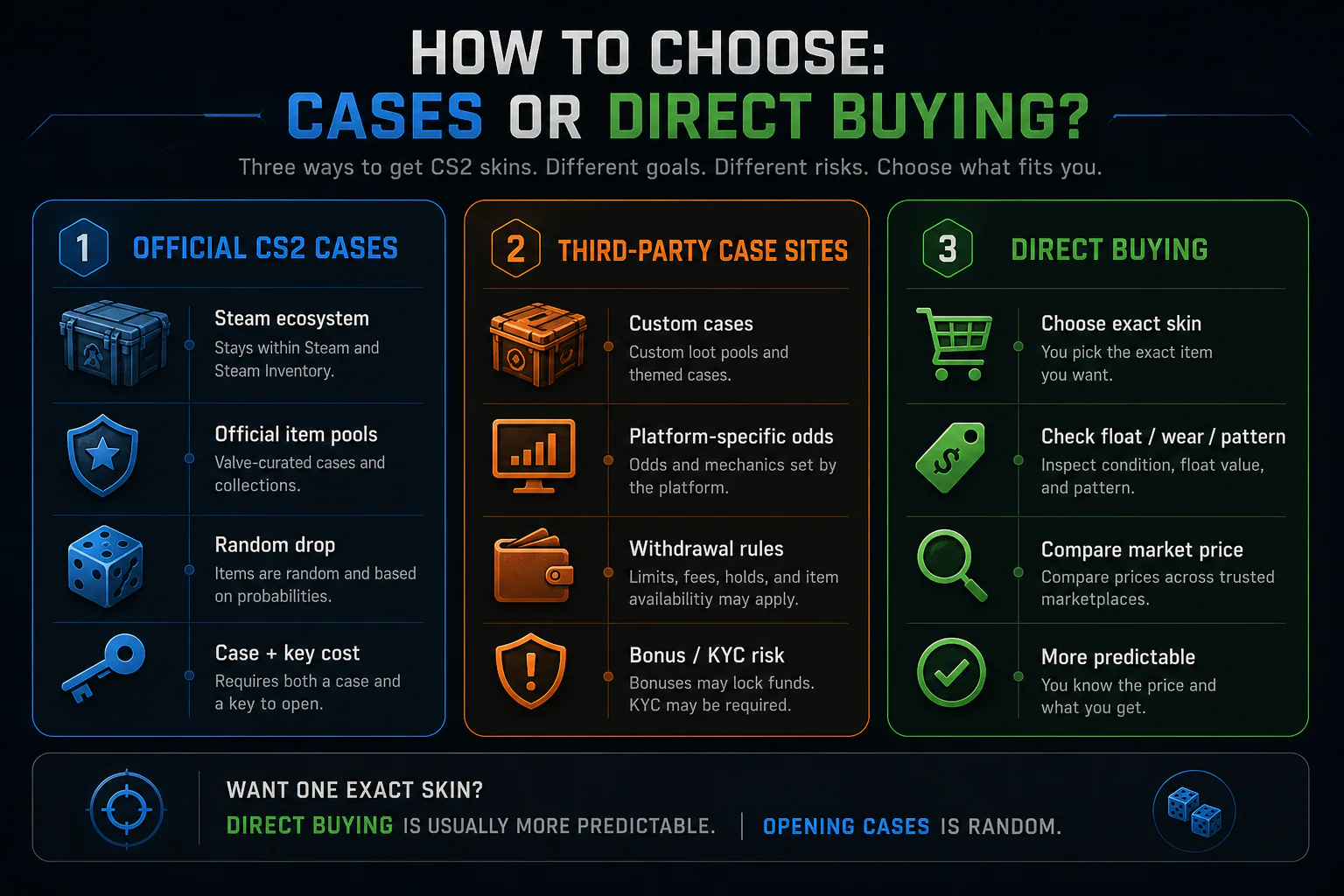
Buying skins directly may be more predictable than opening official cases or using third-party case sites, especially when the user wants one exact CS2 skin. Case opening depends on random drop chance, while direct buying allows the user to choose the item more precisely.
Direct buying is especially relevant for users who care about float value, wear level, StatTrak, pattern, phase, sticker combination, collection version, or other specific traits. A user looking for one particular AK-47, knife, glove, or rare pattern may find that opening cases creates more uncertainty and potentially more total cost.
Buying directly still requires caution. Users should compare market prices, check liquidity, review marketplace rules, understand fees, and verify item details before purchasing. However, it avoids the random drop chance involved in case opening and gives the user more control over the exact item selected.
Common Mistakes When Comparing Official and Third-Party Cases
A common mistake is assuming official cases are always better because they are connected to CS2. Another mistake is assuming third-party cases are always better because they may show custom rewards, bonuses, or themed item pools. Both assumptions oversimplify the comparison.
Many users focus only on top rewards while ignoring odds, low-value outcomes, and expected value. A case with an expensive possible item can still have weak theoretical value if that item has a very small drop chance. Ignoring EV, float, wear, StatTrak, stickers, and patterns can also lead to poor comparisons.
Third-party-specific mistakes include ignoring withdrawal rules, accepting bonuses without reading terms, confusing displayed value with withdrawable value, and failing to check recent user reviews or platform reputation. Users should also avoid chasing losses or treating case opening as an investment strategy.
The best comparison looks at the full item pool, case odds, market prices, case cost, withdrawal model, bonus restrictions, KYC requirements, and trust signals. A case should not be judged only by its name, graphics, or most expensive possible reward.
How to Compare Both Options More Carefully
A careful case comparison should review both theoretical value and practical risk. Before opening official CS2 cases or using third-party CS2 case sites, users should check:
The full item pool, not only the featured rewards
Visible case odds and item-level drop chance where available
Case price, including key cost or platform cost
Current skin market prices and realistic liquidity
Float value, wear level, StatTrak status, stickers, patterns, phases, and special variants
Expected value and EV ratio, while remembering that EV does not predict one opening
Whether market prices used in EV data are current and realistic
Withdrawal rules, minimum limits, fees, delays, and skin availability
Bonus terms, including locked balance, time limits, and withdrawal restrictions
KYC or account verification requirements
Platform reputation, recent reviews, support channels, and company information
Terms of service and privacy policy
Whether the site clearly explains fees, account limits, and restrictions
Warning signs such as unclear odds or unrealistic profit claims
A fixed budget before opening cases
Whether direct buying is more suitable for a target skin
Users should not chase losses. If the goal is one specific skin, direct buying is usually more predictable than repeated case openings.
How Chance4Skin Can Help
Chance4Skin is a CS2 skin analytics and wiki-style platform built around skin data, case odds, drop chances, market context, and case comparison. It can help users explore CS2 skins, understand skin value, compare case-opening options, and review EV-related information before deciding how to approach a case.
For users comparing official CS2 cases and third-party CS2 case sites, Chance4Skin can support more careful research. Users can look at skin data, rarity, market price context, float value, wear levels, and drop-chance information instead of judging a case only by its visual design or headline reward.
Chance4Skin can also help users think about CS2 case expected value and CS2 EV ratio more clearly. These metrics are useful for education and comparison, but they do not predict individual drops. No analytics tool can remove randomness, control future prices, or ensure a specific case-opening result.
Used carefully, skin analytics can help users ask better questions: What is actually inside the case? How likely are the lower-value outcomes? Does the displayed skin value match market context? Are withdrawals and platform terms clear? Those questions matter whether the user is opening official CS2 cases, reviewing third-party case sites, or deciding to buy a skin directly.
FAQ
What is the difference between official CS2 cases and third-party case sites?
Official CS2 cases are connected to the CS2 and Steam ecosystem, while third-party case sites are independent platforms. The official CS2 cases vs third-party case sites comparison includes different item pools, odds, rules, balances, withdrawal systems, bonuses, and platform risks.
Are official CS2 cases safer than third-party case sites?
Official cases avoid some third-party platform risks because drops go directly into Steam Inventory. However, they still involve random outcomes, low rare-item chances, case and key cost, and possible negative expected value. Third-party sites require extra checks around odds, withdrawals, bonuses, account rules, KYC, and trust.
Do third-party case sites have the same odds as official CS2 cases?
Not necessarily. Third-party sites may use custom cases and platform-specific odds that differ by case and by platform. Users should check each case’s visible probabilities and full item pool before opening.
Why do withdrawal rules matter on third-party case sites?
Withdrawal rules affect whether and how users can receive skins or value from the platform. Users should check minimum limits, fees, delays, KYC requirements, locked balances, and skin availability before depositing. A displayed balance is not always the same as a withdrawn skin.
Are bonuses on third-party CS2 case sites worth it?
Bonuses can have wagering requirements, locked balances, time limits, withdrawal caps, or withdrawal restrictions. A bonus may look useful but have limited practical value after the terms are applied. Users should read the full terms before accepting any promotion.
Is expected value useful for comparing official and third-party cases?
Expected value can help compare theoretical average return across many openings. It does not guarantee individual results. EV depends on accurate odds, case prices, skin market prices, and practical withdrawal value.
What is an EV ratio in CS2 case opening?
An EV ratio compares a case’s theoretical expected value with the cost of opening it. A higher EV ratio may look better in theory, but it does not remove randomness, fees, price changes, or withdrawal limitations. It should be used as one comparison tool, not as a prediction.
Should I use official cases or third-party case sites to get one specific skin?
If you want one exact skin, buying directly is usually more predictable. Case opening depends on random outcomes and drop chance. This is especially important if you care about float value, wear level, StatTrak, pattern, phase, or sticker combination.
Can third-party case sites be legit?
Some third-party sites may operate transparently, but users should still evaluate them carefully. Check visible odds, withdrawal rules, bonus terms, support, reputation, company information, privacy policy, and trust signals before depositing. Transparency can reduce uncertainty, but it does not remove all risk.
What should beginners check before opening any CS2 case?
Beginners should check odds, item pool, case price, expected value, market price, withdrawal rules, bonus terms, KYC requirements, platform reputation, and their own budget. They should also understand float value, wear levels, StatTrak, stickers, and patterns before judging skin value. Case opening should not be treated as a predictable way to get a specific item.
Can Chance4Skin help compare official and third-party case options?
Chance4Skin can help users understand CS2 skins, case odds, drop chances, market context, float value, wear levels, and EV-related data before making decisions. It can support more careful comparison between official cases, third-party case sites, and direct buying. No analytics tool can predict an individual case-opening result.
Written by
Team Chance4Skin


