
CS2 Case Opening Checklist for Beginners
Published: 07.06.2026
CS2 case opening can be entertaining, but beginners often start before checking the basic data. They may focus on one expensive headline skin, ignore the full item pool, skip case odds, or miss bonus terms and withdrawal rules. A practical CS2 case opening checklist helps you pause before spending money or skins.
Before a session, review case odds, drop chance, price, expected value, EV ratio, budget, withdrawal rules, bonus terms, and current market value of possible drops. These checks do not make outcomes predictable. They simply reduce avoidable mistakes and help you compare alternatives more calmly.
Responsible-use note: CS2 case opening depends on random outcomes. Treat spending as entertainment, not as an investment or income strategy. A checklist can improve preparation, but it cannot remove risk or guarantee results.
Why You Need a Checklist Before Opening CS2 Cases
Case opening is random. Even when the odds are visible, a single opening can produce any item in the pool. Rare CS2 skins usually have lower drop chances, while common items appear more often. This means a case can advertise attractive rewards while the most likely drop may be much lower in value.
Preparation also matters because the total cost of a session is easy to underestimate. One case may look inexpensive, but repeated openings can quickly exceed the amount you planned to spend. Checking case price, key rewards, skin value, and market price comparison is better than making decisions while the session is already underway.
A checklist also helps with practical risks: unclear bonus terms, withdrawal limits, locked balances, emotional spending, and chasing losses. Deciding your limits in advance gives you a clear stopping point before excitement or frustration affects judgment.
Check #1: Are the Case Odds Visible?
Case odds are the probabilities attached to possible outcomes in a case. Drop chance means the probability of receiving a specific item, rarity tier, or reward type.
Visible odds are important because they help you understand risk. If a case does not clearly show item probabilities or rare item chance, treat that as a warning sign. Without odds, it is difficult to compare cases or estimate expected value.
Visible odds do not make a result predictable. They only show the probability structure behind the case. A low-probability rare skin can still be possible, but it should not be treated as likely.
Check #2: Is the Full Item Pool Clear?
The item pool is the full list of possible drops. Beginners often look only at the most expensive skin shown in promotional visuals, but one expensive reward does not define the whole case.
Review common low-value items, mid-tier drops, rare high-value items, and the likely outcomes. If most of the pool contains skins with low market value, that matters more than one eye-catching top item.
The full item pool is especially important for case comparison. A useful beginner case opening guide focuses on what is likely to drop, not only on the best possible result.
Check #3: What Is the Case Price?
Case price is the cost of one opening. It becomes more important when openings are repeated.
Before starting, calculate the total session cost. Five, ten, or twenty openings can change the real budget impact. An expensive case is not automatically better, and a cheap case is not automatically safer. The question is whether the price makes sense compared with the possible drops and your entertainment budget.
Check #4: What Is the Expected Value or EV Ratio?
Expected value, or EV, is a theoretical average return based on possible outcomes, their values, and their probabilities. EV ratio compares that expected value with the case price.
EV can help compare cases because it combines odds and skin values into one analytical view. However, EV does not predict one opening. A case with a more favorable EV ratio can still produce a low-value item, and EV should never be read as a profit promise.
EV also changes when skin prices, case prices, demand, rarity premiums, or liquidity change. Current data matters. Old EV numbers may no longer reflect the present market.
Check #5: Have You Compared Skin Market Prices?
Skin value depends on more than the skin name. Market price can vary because of condition, float value, wear level, StatTrak status, stickers, rarity, liquidity, and demand.
Float value is a numerical value that helps determine a skin's condition. Wear level is the visible condition category, such as Factory New, Minimal Wear, Field-Tested, Well-Worn, or Battle-Scarred. Two versions of the same skin can have very different prices.
StatTrak versions may be priced differently from standard versions. Stickers can affect value in some cases, but not every sticker combination creates demand. Promotional screenshots may show attractive versions of skins, but they may not reflect realistic market prices.
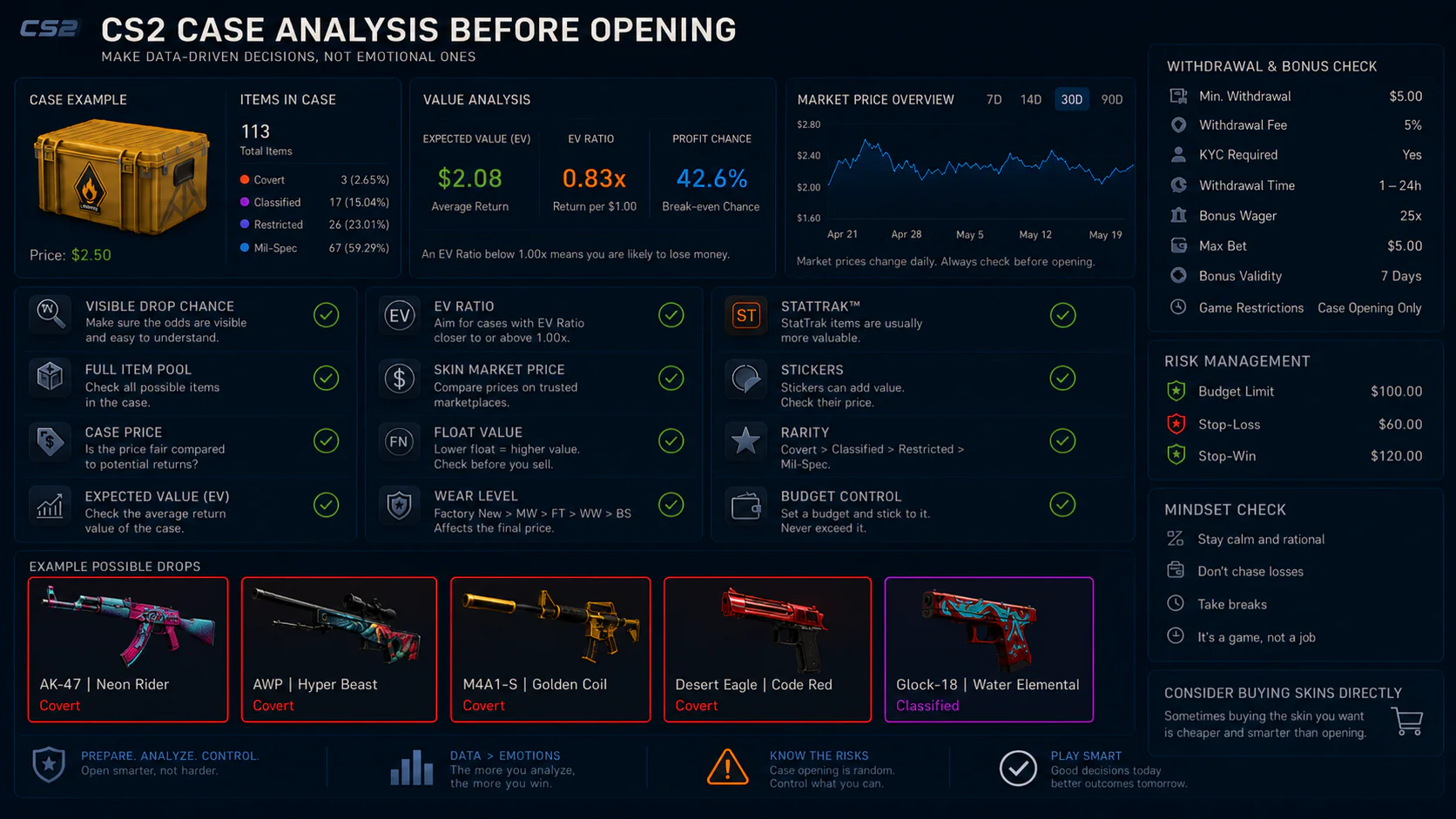
Check #6: Do You Have a Fixed Budget?
A bankroll is the amount set aside for a session. For CS2 case opening, treat this as an entertainment budget, not as money expected to return.
Set the amount before opening and avoid extra deposits after losses. Tracking session spending helps keep the cost visible. A fixed budget is part of risk control, but it does not improve odds or make results safer.
Only spend an amount you can lose without affecting bills, savings, or essential expenses.
Check #7: Have You Set Stop-Loss and Stop-Win Limits?
A stop-loss is the maximum loss point where the session ends. A stop-win is a point where you stop after a positive result instead of continuing until the result changes.
These limits reduce emotional decisions. Without a stop-loss, users may chase losses by opening more cases to recover. Without a stop-win, a positive result can still lead to spending.
Past drops do not affect future probabilities. A bad result does not make a good result due, and a good result does not make the next opening safer.
Check #8: Are Bonus Terms Clear?
Bonuses can change how a session works. Deposit match bonuses, free case offers, promotional balances, or reward credits may include wagering requirements, locked balances, withdrawal restrictions, time limits, or eligibility conditions.
Do not treat bonuses as free value without reading the rules. If terms are hard to find or unclear, the session becomes harder to evaluate. Clear bonus terms are part of basic risk control.
Check #9: Are Withdrawal Rules Clear?
Withdrawal rules should be checked before depositing or opening cases. A drop is less useful if it cannot be withdrawn, sold, traded, or used as expected.
Review minimum withdrawal limits, fees, skin availability, possible KYC requirements, delays, locked balances, and regional restrictions where relevant. Some platforms may treat cash balance, bonus balance, and skin withdrawals differently.
Check #10: Are You Opening for Entertainment or Trying to Get One Exact Skin?
Opening for entertainment is different from trying to get one specific CS2 skin. If your goal is an exact skin, wear level, float range, or StatTrak version, buying skins directly is usually more predictable.
Case opening depends on random outcomes and drop chance. A target skin may be possible, but that does not mean it is a practical route to ownership. Decide the goal before opening, then compare the case route with buying directly.
Check #11: Are You Emotionally Ready to Stop?
Emotional control matters as much as odds and EV. Wins can create excitement, and losses can create frustration. Both can lead to rushed decisions.
If you feel pressured to continue, increase deposits, recover losses, or ignore your limits, step away. Random outcomes do not respond to confidence, frustration, or momentum. A checklist only helps if you are willing to follow it when the session becomes emotional.
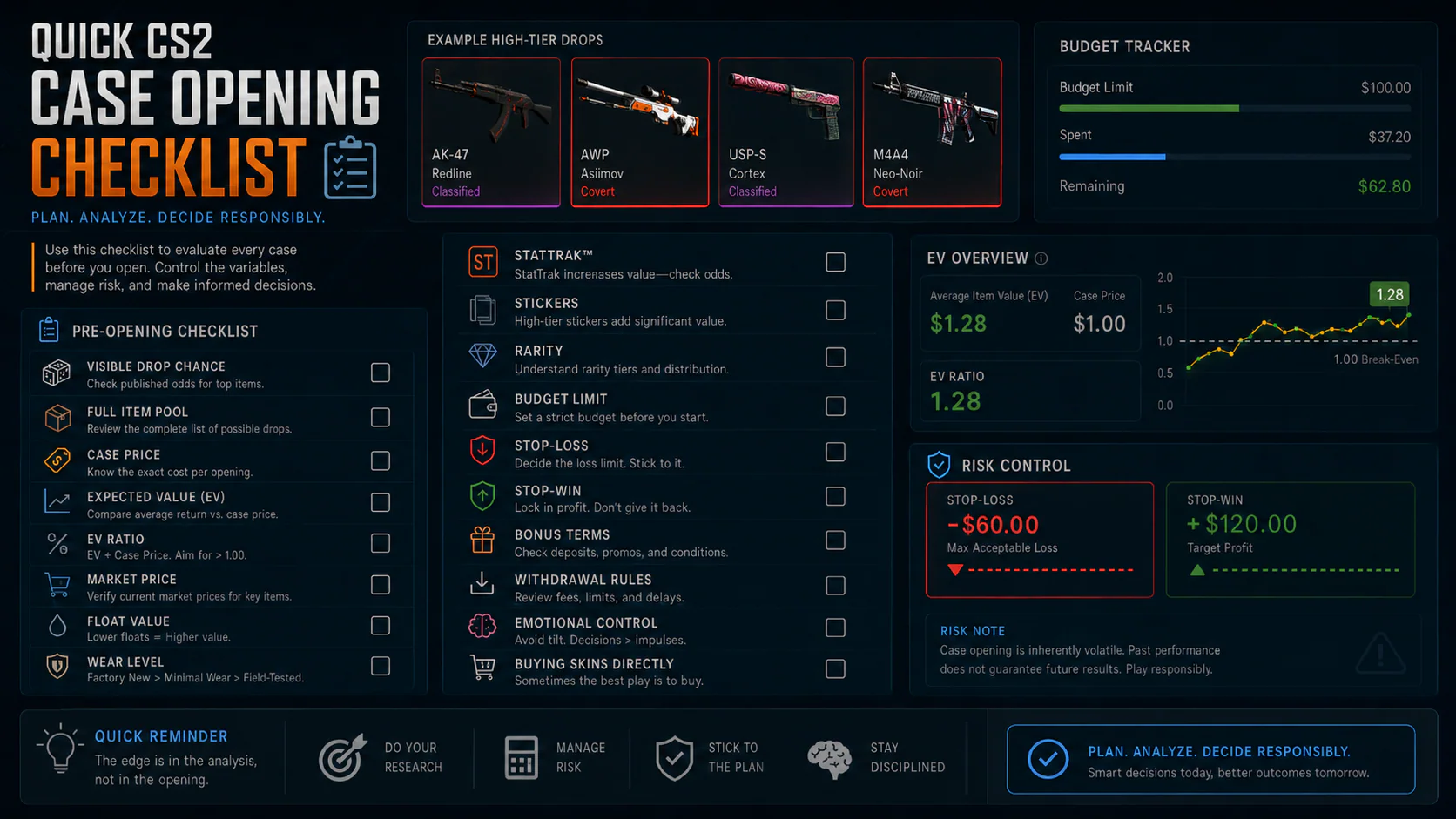
Quick CS2 Case Opening Checklist
Use this compact CS2 case opening checklist before starting a session:
Are the case odds visible?
Do I understand the drop chance?
Have I reviewed the full item pool?
Do I know the case price?
Have I checked expected value or EV ratio?
Have I compared skin market prices?
Do I understand float value and wear level differences?
Do I understand StatTrak, stickers, rarity, and condition differences?
Do I have a fixed budget?
Have I set stop-loss and stop-win limits?
Have I read bonus terms?
Have I checked withdrawal rules?
Am I opening for entertainment, not profit?
Would buying skins directly be more predictable?
Am I calm enough to stop when I reach my limit?
How Chance4Skin Can Help
Chance4Skin is a CS2 skin analytics and wiki-style platform. It helps users explore CS2 skins, compare case odds, understand drop chances, review market context, check skin data, and think about EV-related information before opening cases or buying skins.
This is useful for beginners who want to compare cases with data instead of relying only on visuals. It can also help explain float value, wear level, rarity, and market price factors.
Users can also read CS2 Case Opening Strategy: Bankroll, EV Ratio and Risk Control for Beginners and CS2 Case Opening Mistakes Beginners Should Avoid for deeper preparation.
FAQ
What should I check before opening CS2 cases?
Check case odds, drop chance, item pool, case price, expected value, EV ratio, budget, bonus terms, withdrawal rules, and skin market prices. A CS2 case opening checklist helps organize these checks before spending money or skins.
Why are case odds important before opening?
Case odds show the probability of receiving each item or reward type. Without odds, it is difficult to understand risk, drop chance, or expected value.
Should I set a budget before opening CS2 cases?
Yes. Set a fixed entertainment budget before opening and avoid extra deposits after losses. Budget limits are part of risk control, not a way to improve drop chances.
What is a stop-loss limit in CS2 case opening?
A stop-loss limit is the maximum amount you decide you are willing to lose in a session. It should be set before opening, not during emotional decisions.
Should I accept CS2 case site bonuses?
Only consider bonuses after reading the terms. Bonuses may include wagering requirements, locked balances, withdrawal restrictions, time limits, or eligibility rules.
Is buying CS2 skins directly better than opening cases?
Buying directly is usually more predictable if you want one specific skin. CS2 case opening depends on random outcomes and drop chance.
Can a checklist make CS2 case opening safe?
A checklist can reduce avoidable mistakes, but it cannot remove risk or guarantee results. Case opening still depends on random outcomes.
Can Chance4Skin help before opening cases?
Chance4Skin can help users understand CS2 skin, case odds, drop chances, market context, and EV-related information before making decisions.
Written by
Team Chance4Skin


