
CS2 Trade-Up Contract Value Guide: Inputs, Float, Outcomes and Market Risk
Published: 17.07.2026
Updated: 20.07.2026
A standard CS2 trade-up contract looks simple: exchange ten eligible skins for one item from the next rarity tier. That summary is accurate for ordinary weapon-skin contracts, but it is not enough to judge trade-up value. A useful analysis must also account for input eligibility, rarity, represented collections, output probability, float value, wear condition, StatTrak status, executable market prices, fees, spreads, and market liquidity. Current rules also include a separate five-Covert path for knives or gloves, so users should verify the contract type before calculating anything.
This CS2 trade-up contract value guide presents an educational framework rather than a list of supposedly profitable CS2 trade-ups. It explains how to map the complete outcome pool, estimate each result’s condition and realistic sale value, calculate expected value, and identify downside or execution risk. The final question is not merely whether one attractive output exists. It is whether the full contract, after realistic costs and uncertain outcomes, compares sensibly with buying the desired skin directly.
What Is a CS2 Trade-Up Contract and How Does It Work?
A standard Trade Up Contract exchanges ten eligible weapon finishes of the same rarity for one eligible weapon finish from the next rarity tier. The inputs may represent one collection or several collections, and those represented collections define the potential output pool. The user normally cannot choose the exact result. Two contracts with the same rarity can therefore have very different probabilities, output floats, costs, and risk profiles. Steam Support describes the standard rule as ten normal or StatTrak skins of one rarity producing one skin of the next rarity from a represented collection.
The normal weapon progression is Consumer Grade, Industrial Grade, Mil-Spec, Restricted, Classified, and Covert. Standard ten-item contracts can use eligible inputs from Consumer Grade through Classified, with Covert as the highest standard weapon-skin output. Since Valve’s October 22, 2025 update, a separate contract can exchange five regular Covert skins for a regular knife or gloves, or five StatTrak Covert skins for a StatTrak knife.
The basic process is:
Select the required number of eligible inputs.
Verify rarity, collection, item type, StatTrak status, and current trade restrictions.
Review every possible output before confirming.
Confirm the contract in the game client.
Receive the result and evaluate its float, wear, and marketability.
Only eligible weapon finishes can be used. Knives, gloves, Contraband skins, and non-skin inventory items are not ordinary inputs. A skin is also unavailable when its collection has no valid next-tier result for that contract. Normal and StatTrak inputs cannot be mixed. Souvenir skins are now permitted alongside normal-quality inputs, but their Souvenir attributes are removed and the output is a normal item rather than a Souvenir item.
Trade-Up Inputs: Rarity, Collection, Price and StatTrak
Every input performs several jobs at once. Its rarity determines the target tier; its collection adds weight to an output pool; its current float affects the calculated output condition; and its purchase price contributes to total contract cost. Eligibility, availability, and liquidity determine whether the theoretical contract can actually be assembled at the assumed figures.
Cheap trade-up inputs are not automatically efficient. A low price may come with weak outputs, an unfavorable float range, or insufficient supply at the target condition. Expensive inputs require stronger outcome logic because they raise the break-even value. Use the executable price for the exact item and float, not a stale median or isolated listing.
Low-float inputs can carry substantial premiums, so generic wear prices may understate the CS2 trade-up input cost. Availability can also deteriorate while sourcing: later inputs may require higher bids, another marketplace, or more time, while illiquid buy orders may remain unfilled.
One substitution can change collection weight, adjusted average float, cost, or eligibility. Recalculate the contract after replacing any input. A simple input sheet should record collection, exact float range, normalized float, executable price, and marketplace for all required skins.
StatTrak trade-ups form a separate system. All inputs must be StatTrak to produce a StatTrak result; StatTrak and non-StatTrak skins cannot be mixed. StatTrak inputs and outputs therefore need their own prices, spreads, volume checks, and outcome map. A higher StatTrak listing price does not by itself improve trade-up value: the inputs may carry an even larger premium, the buyer pool may be narrower, and some special-item collections have no valid StatTrak glove outcome.
Collections, Outcome Pools and Probability Weighting
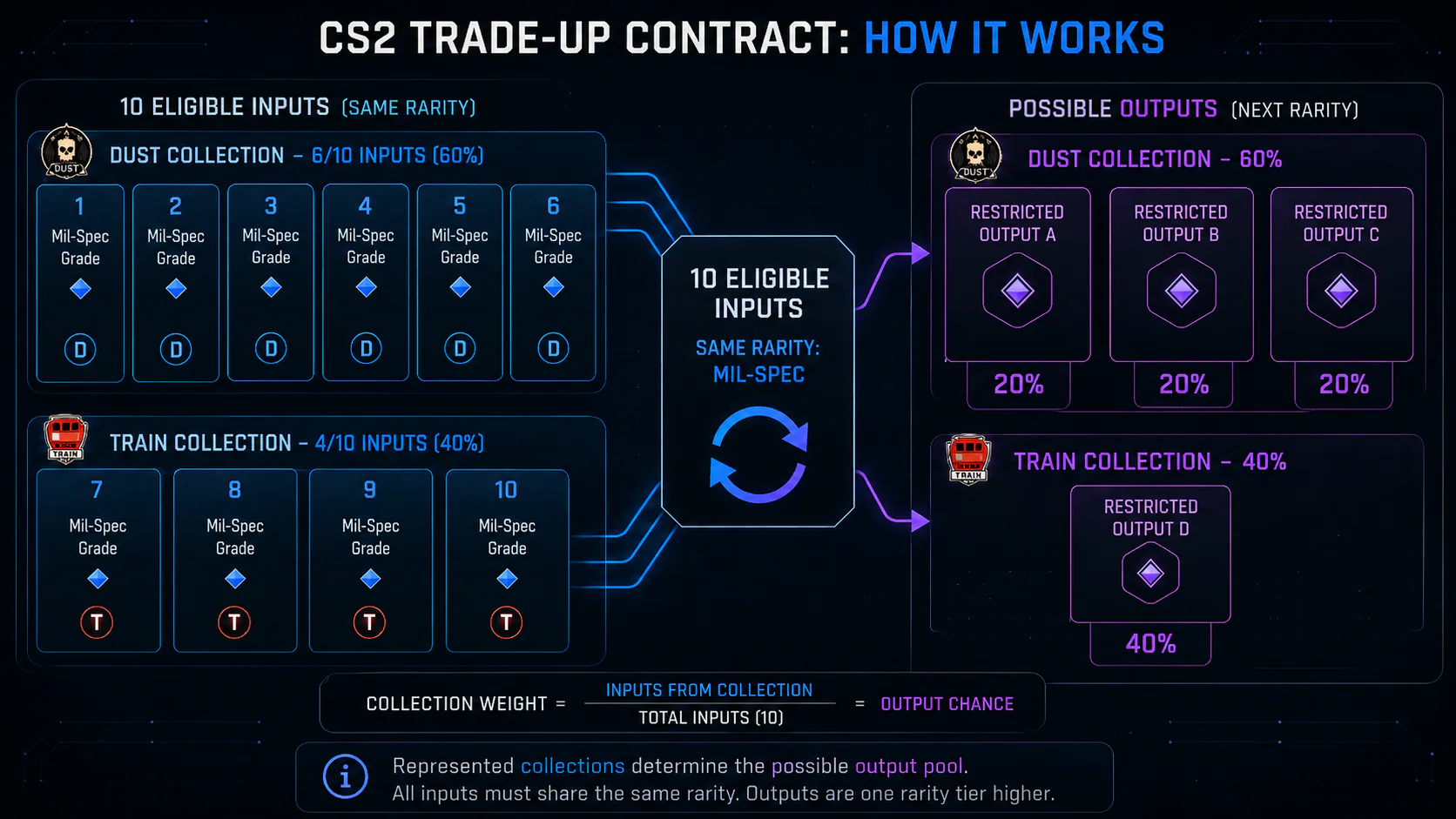
The collection system is the core of trade-up probability. Each eligible input contributes weight to its own collection. With a standard ten-input contract, a collection represented by four inputs receives 4/10, or 40%, of the contract’s collection probability. If that collection has two eligible skins at the next rarity, its 40% share is divided between those two outcomes, giving 20% to each under the general framework.
Let:
n = total inputs in the contract;
mc = inputs from collection c;
kc = eligible next-tier outputs in collection c.
Then the general collection probability is:
Collection probability = mc ÷ n
And the probability of one eligible output in that collection is:
Individual output probability = mc ÷ (n × kc)
Current specialist calculators describe the system as equal contribution from each input, with the represented collection’s share divided across its eligible outputs. Users should still verify special five-Covert knife or glove pools in a current calculator because case-linked special-item pools can contain many models and finishes.
A practical probability workflow is:
Identify every collection represented by the inputs.
List every eligible next-tier output from each collection.
Calculate each collection’s share from its input count.
Divide each collection’s share among its eligible outputs.
Confirm that all individual probabilities total 100%.
Consider a fictional ten-input structure with six skins from Collection A and four skins from Collection B. Collection A has three eligible outputs; Collection B has one. Collection A receives 60%, so each of its outputs receives 20%. Collection B receives 40%, and its sole output receives the full 40%. Collection A keeps its total share, but that share is divided among more results.
One expensive output cannot define the contract. Its probability may be small while weaker results absorb most of the distribution. Adding one cheap input from another collection can reduce the desired collection’s share and add new outcomes. Evaluate the complete distribution, not a headline result.
Float Value, Output Float and Wear Conditions
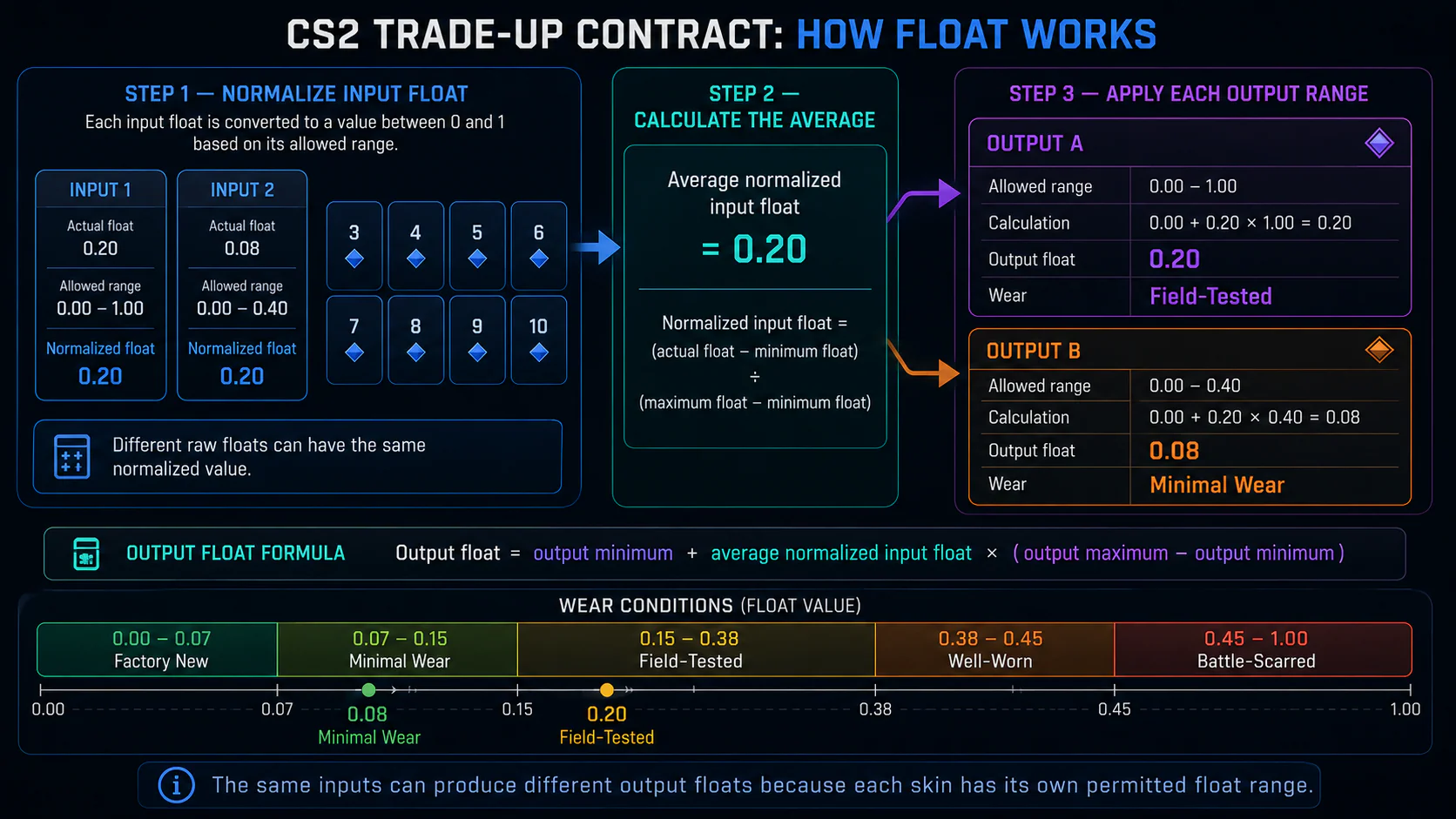
Float value is the skin’s numerical condition value. Lower values generally represent less wear, but each finish has its own permitted range. Current mechanics normalize every input float within that skin’s range, average the normalized values, and map the average into each possible output’s range. Thus, raw 0.20 floats from 0.00–0.40 and 0.00–1.00 skins contribute different adjusted values.
For each input:
Normalized input float = (actual input float − input minimum float) ÷ (input maximum float − input minimum float)
The contract’s average input float is therefore the average normalized value, not automatically the raw mean used in older guides. With full 0.00–1.00 input ranges, both averages match.
The output calculation is:
Output float = output minimum float + average input float × (output maximum float − output minimum float)
Here:
average input float is the average normalized trade-up float of the ten standard inputs, or five Covert inputs in the special contract;
output minimum float is the lowest permitted float for the selected output;
output maximum float is its highest permitted float;
calculated output float is the resulting condition value for that specific item.
Calculate every output separately because ranges differ. The same normalized average might produce 0.04 on a 0.00–0.10 item and 0.40 on a 0.00–1.00 item, creating different wear and value.
The standard wear thresholds are:
Factory New: 0.00 to below 0.07
Minimal Wear: 0.07 to below 0.15
Field-Tested: 0.15 to below 0.38
Well-Worn: 0.38 to below 0.45
Battle-Scarred: 0.45 to 1.00
Restricted ranges make some conditions impossible: a 0.10 minimum excludes Factory New, while a maximum below 0.15 excludes Field-Tested and worse. Near a wear boundary, even a small input-float difference may change the output category. Wear can change value and liquidity, but low adjusted input float only improves the condition of the uncertain output selected. Verify every output’s current minimum and maximum before relying on the model.
CS2 Trade-Up Contract Value Guide: Cost, Expected Value and Market Risk
Total input cost
Begin with the cost of assembling the contract, not the most expensive possible result. Add the executable price of every required input: the amount at which the exact skin, StatTrak status, and float can realistically be acquired now. An old sale, an unfilled buy order, or one isolated low listing is not a dependable cost basis.
Instant buys may cost more but reduce sourcing risk; buy orders may lower the modelled price but create uncertain or partial fills. Fees can apply on purchase, sale, withdrawal, or conversion. Steam wallet and cash-market values are not equivalent, so cross-market figures require adjustment.
Cost Factor | Why It Matters | What to Check |
|---|---|---|
Input skin price | Small differences multiply across ten items | Current executable purchase price |
Quantity needed | Ten matching inputs must be sourced | Availability at the assumed price |
Marketplace fees | Fees reduce retained value | Buyer, seller, and withdrawal fees |
Buy-order spread | Listings and bids may differ sharply | Current bid-ask spread |
Low-float premium | Target float may cost above market | Actual premium for the required float |
StatTrak premium | StatTrak has a separate cost structure | StatTrak prices and availability |
Currency conversion | Conversion can increase effective cost | Final cost in the user’s currency |
Sourcing time | Suitable inputs may be slow to find | Volume and order availability |
Direct buying | Provides a certainty benchmark | Exact target skin market price |
Prices may move while the contract is being sourced, and later inputs may cost more than the first ones. The analysis should also include the direct-buying alternative. When the goal is one exact output, its current purchase price is the certainty benchmark for the full uncertain contract cost.
Expected value
Expected value combines all outcomes into one probability-weighted average:
Expected value = Σ(outcome value × outcome probability)
To calculate CS2 trade-up expected value:
List every output.
Assign its verified probability.
Estimate a realistic sale value for its calculated wear and version.
Multiply value by probability.
Add the weighted values.
Subtract total input cost.
Deduct selling and execution costs.
An outcome with a 20% probability and a realistic net value of $30 contributes $6 to EV, not $30. The final figure is a long-run analytical average under the model’s assumptions; it does not predict the next contract. A single trade-up can still return the lowest-value item.
EV is sensitive to price and cost choices. A contract may appear positive using displayed listings yet turn negative after sale discounts, fees, low-float premiums, or updated input prices. Expected value is therefore a time-stamped estimate, not a permanent characteristic of a contract.
Realistic sale value and liquidity
A listing is an asking price, not proof of realizable value. For each output, compare the lowest credible listing, highest buy order, completed sales, spread, recent volume, and order-book depth. Steam Market and third-party prices can differ because their fees, cash-out options, users, and inventory differ.
The appropriate value depends on the intended exit. A patient seller may list and wait; a fast seller may need to accept a bid or undercut competitors. Rare or expensive items can remain illiquid when there are few buyers or a wide spread. Pattern, stickers, unusually low float, and StatTrak status may narrow the buyer pool further.
Use fast-sale, base, and patient-listing scenarios. A contract that only works in the optimistic case may mainly be pricing liquidity risk.
Downside and execution risk
Input prices can rise during sourcing, buy orders can remain unfilled, and suitable floats can disappear. Calculation errors include using obsolete probability rules, applying the old raw-average float method, mapping the wrong collection, or including an ineligible skin.
After completion, prices may fall, fees may erase the margin, and the result may require a discount. Ask how much can be lost, how likely weak outcomes are, and how readily each item can be sold.
Trade-Ups vs Case Opening and Direct Buying
Method | What the User Controls | Main Uncertainty | Best Fit |
|---|---|---|---|
Trade-up contract | Inputs, collections, average float, contract structure | Exact output and market value | Users who want to analyze a limited outcome pool |
Case opening | Choice of case and key purchase | Rarity and exact item drop | Users who understand case odds and accept broad randomness |
Direct buying | Exact skin, wear, float, StatTrak, and stickers | Future market price | Users who want one specific item |
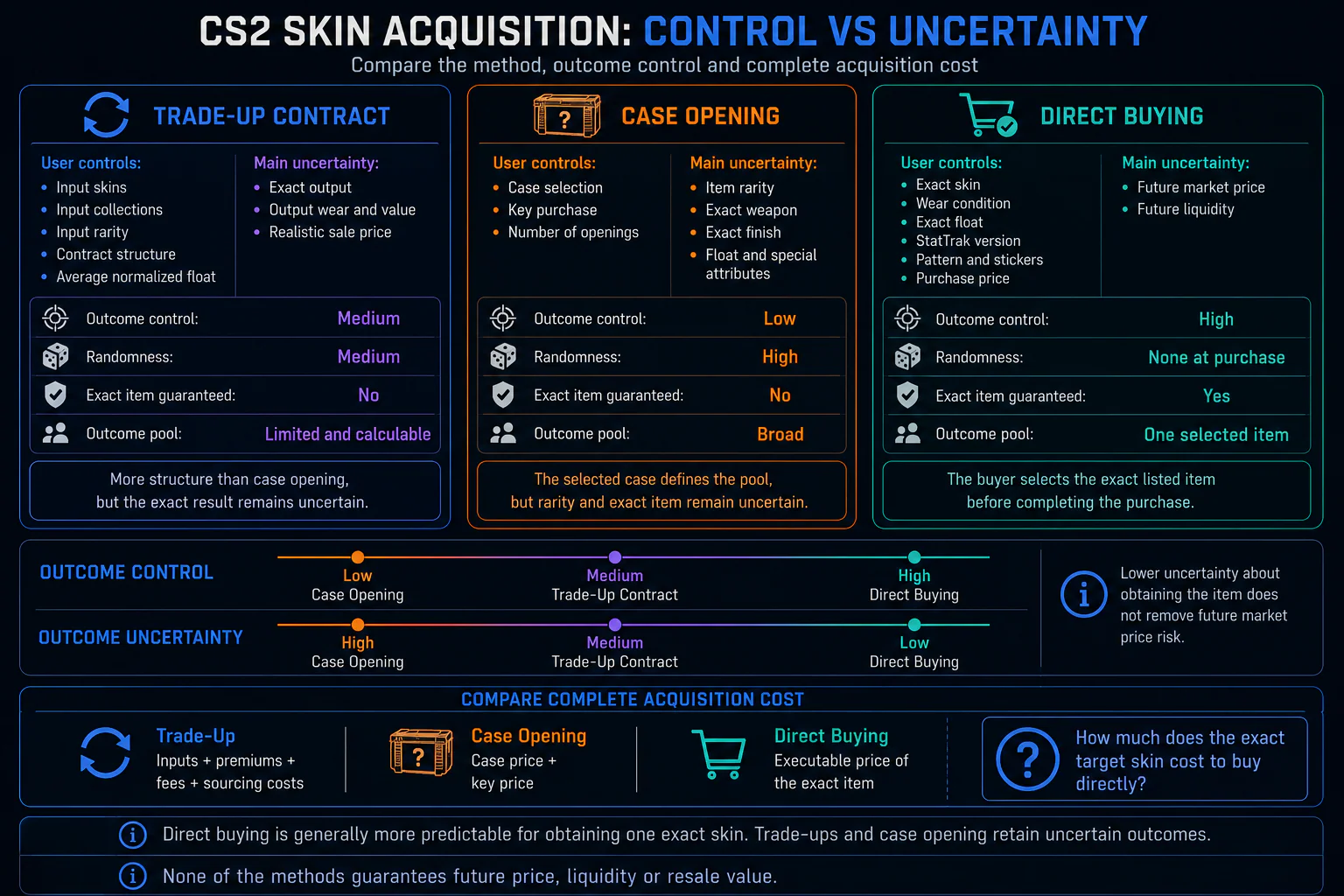
Trade-ups provide more structural control than case opening because the user chooses inputs, collections, and float characteristics. Both methods still contain uncertain outcomes, and neither guarantees that the received item will match the user’s preferred skin or market value.
Direct buying is generally more predictable for obtaining one exact item because the buyer can inspect the specific float, wear, StatTrak status, pattern, and stickers before paying. Trade-up contracts vs buying skins directly should therefore be compared using the complete contract cost, realistic output distribution, and current price of the exact target, not only the chance of receiving it. Chance4Skin’s existing comparison also emphasizes the greater item-level control available through direct purchase.
How to Evaluate a Trade-Up Before Using It
Use the following workflow as a research framework, not as a recommendation to complete a contract:
Confirm that all inputs are eligible. Check the live in-game contract interface and current Valve rules.
Select the input and target rarity tier. Distinguish a standard ten-item weapon contract from a five-Covert special-item contract.
Identify every represented collection. Record the exact collection for each input.
List every eligible output. Do not omit low-value or illiquid results.
Calculate collection and individual-output probabilities. Confirm the total is 100%.
Verify the float range of every output. Use current item data.
Calculate average input float. Normalize each input to its own permitted range first.
Estimate output float and wear for each result. Apply the output-specific range.
Calculate realistic input cost. Use executable prices for all required quantities.
Check realistic output sale values. Review bids, listings, and completed sales.
Include fees, spreads, conversion, and premiums. Keep Steam and cash-market values comparable.
Calculate expected value. Use net values rather than headline prices.
Review downside outcomes. Measure the loss attached to weaker results.
Check liquidity. Assess volume, spread, and depth for every output.
Compare with direct buying. Price the exact target skin and condition.
Decide whether the uncertainty is acceptable. Treat that as a personal acquisition decision, not a guaranteed return calculation.
Trade-Up Checklist and Common Beginner Mistakes
Review Factor | Why It Matters | What Users Should Check |
|---|---|---|
Input rarity | Determines the next output tier | All ten inputs match |
Input collection | Determines represented output collections | Exact collection of each input |
Input eligibility | Some items cannot be used | Current contract rules |
Input price | Sets total contract cost | Executable purchase price |
Input float | Influences output float | Exact float of every input |
StatTrak status | Changes eligibility and value | Current StatTrak rules |
Possible outputs | Defines the complete risk pool | Every eligible next-tier item |
Output probability | Determines expected-value weighting | Collection and per-item probability |
Output float range | Changes the final calculated float | Minimum and maximum float |
Expected wear | Can materially affect value | Wear for every output |
Realistic sale value | Listing price may not be executable | Buy orders and recent sales |
Fees and spreads | Reduce retained value | Full transaction costs |
Liquidity | Determines how easily an item may sell | Volume, spread, and order depth |
Price age | Old data can invalidate the model | Timestamp of price observations |
Direct-buy alternative | Provides a certainty benchmark | Exact target skin price |
Downside risk | Shows the weaker possible results | Lowest-value outcomes |
Using outdated prices can turn a once-valid model into a misleading one. Failing to verify eligibility can make the planned contract impossible. Ignoring restricted input and output ranges can produce the wrong wear estimate. Focusing only on the best output hides most of the risk distribution. Treating listings as guaranteed sales overstates realizable value. Forgetting fees can erase a narrow apparent margin. Misunderstanding mixed collections produces incorrect probabilities. Overpaying for low-float inputs raises the break-even point. Assuming StatTrak is always better ignores higher input cost and thinner demand. Copying old “profitable trade-up” examples imports stale rules and prices. Chasing losses adds new exposure without changing past outcomes. Ignoring direct buying removes the clearest certainty benchmark.
Simplified Trade-Up Calculation Example
Simplified educational example, not a live trade-up recommendation.
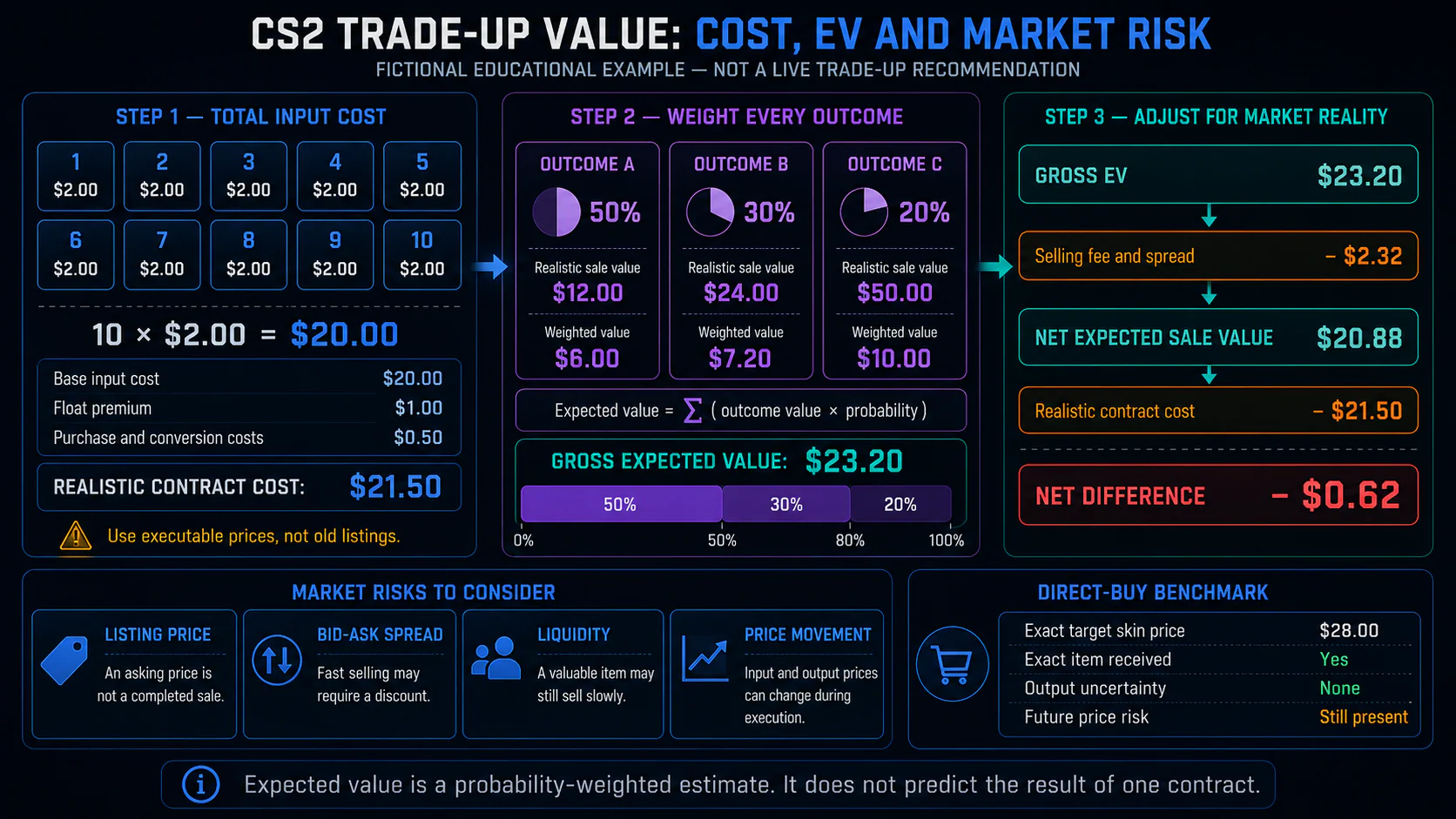
Assume ten fictional eligible inputs cost $2 each. Total input cost is therefore:
10 × $2 = $20
Assume the mapped contract has three possible outputs:
Output A: 50% probability, realistic sale value $12
Output B: 30% probability, realistic sale value $24
Output C: 20% probability, realistic sale value $50
The weighted values are:
Output A: $12 × 0.50 = $6.00
Output B: $24 × 0.30 = $7.20
Output C: $50 × 0.20 = $10.00
Total expected value is:
$6.00 + $7.20 + $10.00 = $23.20
Before selling costs, expected value minus input cost is:
$23.20 − $20.00 = $3.20
Now assume a hypothetical 10% effective selling fee or required sale-price discount. Net expected sale value becomes $20.88, leaving only $0.88 above the input cost. If Output C is weakly liquid and realistically requires a larger discount, the model could fall below $20 and become negative.
This example is not based on a live skin market opportunity. Expected value does not guarantee one contract’s result. The user can still receive the $12 output and realize an $8 loss before fees. Live CS2 skin prices, float premiums, spreads, fees, and liquidity can change every part of the calculation.
How Chance4Skin Can Help
Chance4Skin publishes educational guides on CS2 skin value, rarity, float, wear, liquidity, case odds, direct buying, and market risk. Readers can use that coverage to understand the inputs behind a valuation model and recognize when a displayed price or expected-value figure needs more context. The material can reduce basic valuation errors but cannot guarantee profit, drops, sale prices, or market outcomes. Verify current eligibility, collections, float ranges, executable prices, fees, and liquidity before deciding.
FAQ
What is a CS2 trade-up contract?
A CS2 trade-up contract exchanges ten eligible weapon skins of the same rarity for one eligible item from the next rarity tier, with a separate five-Covert route for knives or gloves. The possible result depends on the collections represented by the inputs and the current eligibility rules.
Can CS2 trade-up contracts be profitable?
Some contracts may show positive expected value under a specific set of current assumptions, but profit is never guaranteed. Input prices, fees, float premiums, output liquidity, sourcing cost, and the random result can all change the realized outcome, sometimes before the contract is even assembled.
How does float affect trade-ups?
Current mechanics normalize each input float within that skin’s permitted range, average those adjusted values, and map the result into each possible output’s range. Every output must be checked separately because different minimum and maximum floats can create different calculated conditions from the same inputs.
Do trade-ups guarantee a specific skin?
Most trade-ups have several possible outputs, so they do not guarantee one skin. A specific result is only certain when verified current mechanics produce a single eligible outcome, and users should not assume that without mapping every represented collection and the complete output pool.
What is expected value in a CS2 trade-up?
Expected value is the probability-weighted average of all possible output values after applying realistic assumptions. In a CS2 trade-up contract value guide, EV is an analytical comparison tool, not a prediction or guarantee of what one individual contract will return.
Should I use trade-ups or buy skins directly?
Direct buying is generally more predictable when the goal is a specific skin, wear, float, StatTrak version, pattern, or sticker craft. Trade-ups involve outcome and market uncertainty, so users should compare their complete net cost with the current price of buying the desired item directly.
Written by
Team Chance4Skin


