
Cheap CS2 Cases vs Expensive CS2 Cases: Which Are Better Value?
Published: 21.06.2026
Comparing cheap CS2 cases vs expensive CS2 cases is not as simple as choosing the lowest price or assuming the highest-priced case has the best rewards. Many CS2 players look at expensive cases and expect stronger value because they may include rare skins, premium finishes, knives, gloves, or other high-value items. Other players prefer cheap CS2 cases because the entry cost is lower and the same budget can cover more openings.
The real comparison is more complicated. Case value depends on the case price, case odds, drop chance, item pool, expected value, EV ratio, skin market price, float value, wear level, platform rules, and personal risk tolerance. A case can look attractive because of one headline reward while still having weak value across its full reward pool. A cheap case can feel safer because each opening costs less, but repeated openings can add up quickly.
Neither cheap nor expensive CS2 cases are automatically better. A careful case comparison should focus on probabilities, reward distribution, current market context, and whether the user is opening for entertainment rather than expecting reliable returns.
What Makes a CS2 Case Cheap or Expensive?
A CS2 case is usually considered “cheap” or “expensive” based on the cost required to open it. That cost may come from a platform’s listed case price, an official case-and-key structure, or a third-party case opening format where the platform sets its own pricing. However, the opening cost is only one part of the value equation.
Several factors can influence case price:
Case opening cost: The direct price paid to open the case.
Item pool value: The combined market context of all possible rewards.
Rarity of possible drops: Cases with rare knives, gloves, Covert skins, or premium rewards may be priced higher.
Platform pricing: Third-party platforms may price cases differently based on their own rules, fees, availability, and margin.
Market demand: Popular skins or themes can increase interest in a case.
Special themes: Some cases are built around certain finishes, collections, weapon types, or premium-looking rewards.
Case popularity: A case that becomes popular with players or content creators may receive more attention, even if its value is not objectively stronger.
Price alone does not determine value. A cheap case can have a weak item pool and poor odds. An expensive case can contain attractive rewards but still return below its cost in many outcomes. To compare cases properly, users need to look beyond the opening price and examine the full structure behind the case.
The Basic Difference Between Cheap and Expensive CS2 Cases
Cheap CS2 cases usually have a lower entry cost. This means a player can open more cases with the same budget compared with an expensive case. For beginners, this can make cheap cases feel more approachable because each individual opening carries a smaller cost.
Expensive CS2 cases usually have higher potential reward values. They may include more valuable skins, rarer item categories, or more attractive headline rewards. This can make them appealing to users who are interested in higher-value possible outcomes and understand that those outcomes may have low drop chances.
The key difference is not just price. It is the relationship between price, odds, and item pool. A cheap case can still have poor case odds if most of its rewards are low-value items. An expensive case can still have poor expected value if the rare rewards are difficult to hit and the common drops are worth much less than the opening cost.
User goals also matter. Someone opening cases for casual entertainment with a small budget may evaluate value differently from someone comparing EV ratio across multiple cases. Risk per opening differs as well. A few expensive openings can use a budget quickly, while many cheap openings can quietly build into the same total cost.
Case Price vs Item Pool Value
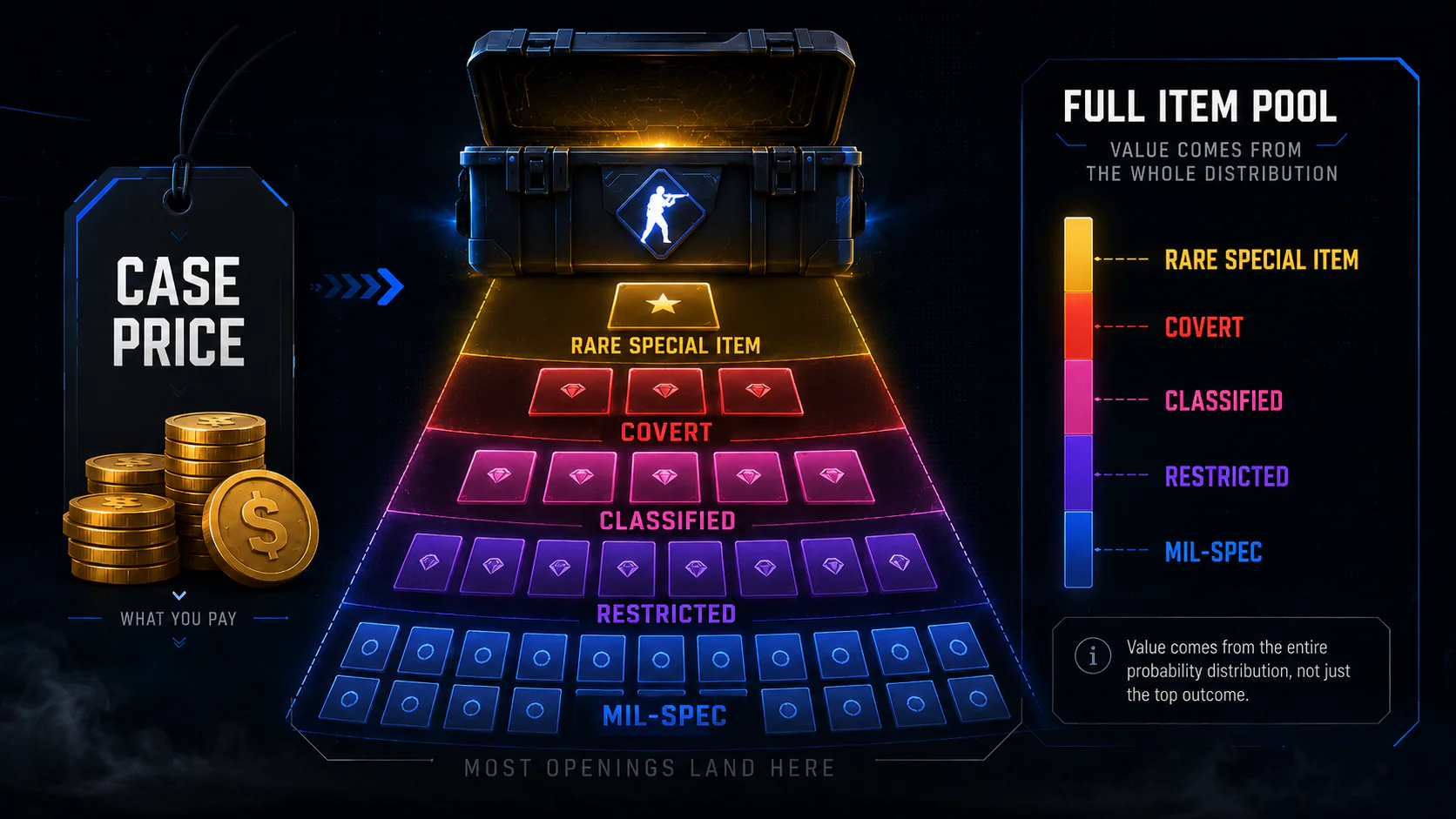
The item pool is one of the most important parts of CS2 case comparison. It represents the full set of possible rewards inside a case, not just the most exciting skin shown on the case image.
A case may include:
Common low-value drops
Mid-tier skins
Rare high-value skins
Special item categories
Different wear levels
StatTrak versions, where applicable
Rewards with very different market prices
A common mistake is judging a case by its best possible reward. One expensive skin does not automatically make the whole case good value. If the probability of receiving that skin is very low, most openings may still result in lower-value items.
The better question is: what does the full reward distribution look like? If most of the item pool is made up of rewards worth much less than the case price, the case may have weak value even if the top reward is impressive. Likewise, a cheaper case with a modest but more balanced item pool may sometimes compare more favorably than a case built around a single rare jackpot-style item.
Visual appeal can also be misleading. A case may show attractive skins prominently, but the full item pool determines the actual value structure. Users should review the complete reward list before opening, especially when comparing cheap vs expensive CS2 case value.
How Case Odds Affect Value
Case odds describe the probability of receiving each reward or reward category. They are central to understanding value because even a valuable item has limited practical impact if its drop chance is extremely low.
When comparing CS2 cases, users should consider:
The probability of common drops
The drop chance for rare skins
The probability of mid-tier items
Whether premium rewards are realistically obtainable
Whether odds are shown clearly
Whether odds differ between platforms
Lower-cost cases can still be risky. A cheap case may have a low opening price, but if most outcomes are low-value items, the expected result may still be poor. Expensive cases can also have low rare-item odds, meaning the higher case price does not necessarily translate into a better chance of receiving a valuable item.
Visible odds matter because they allow users to compare cases more carefully. Hidden odds make it difficult to calculate expected value, estimate EV ratio, or understand whether a case is priced fairly relative to its item pool. If a platform does not clearly disclose odds, users should be cautious and avoid assuming that a case is better simply because it looks attractive.
Expected Value: The Main Metric Behind Case Value
Expected value, often shortened to EV, is a theoretical average return based on item probabilities and item values. It helps users compare the relationship between case price, drop chance, and potential rewards.
A simplified expected value calculation considers:
The price of the case
The market price of each possible reward
The probability of receiving each reward
The weighted average value of all outcomes
For example, if a hypothetical case costs X and its weighted average reward value is Y, the EV would be Y. This does not mean every opening returns Y. It means that, over a very large number of theoretical openings, the average reward value would trend toward that weighted value if the odds and prices stayed the same.
This example is only conceptual. It is not real live market data, and it should not be treated as a prediction for any specific case.
EV is useful because it creates a more analytical way to compare cheap and expensive CS2 cases. However, EV does not guarantee individual results. A user can open a case with a better theoretical EV and still receive a low-value item. Another user can open a case with weak EV and still hit a rare drop. Random outcomes can differ significantly from averages, especially in short sessions.
Negative EV can happen in both cheap and expensive cases. A case may cost more to open than its average theoretical reward value. This is why EV should be used as a comparison metric, not a profit promise. Case opening should be treated as entertainment with risk, not as a reliable way to make money.
EV Ratio: Comparing Cases With Different Prices
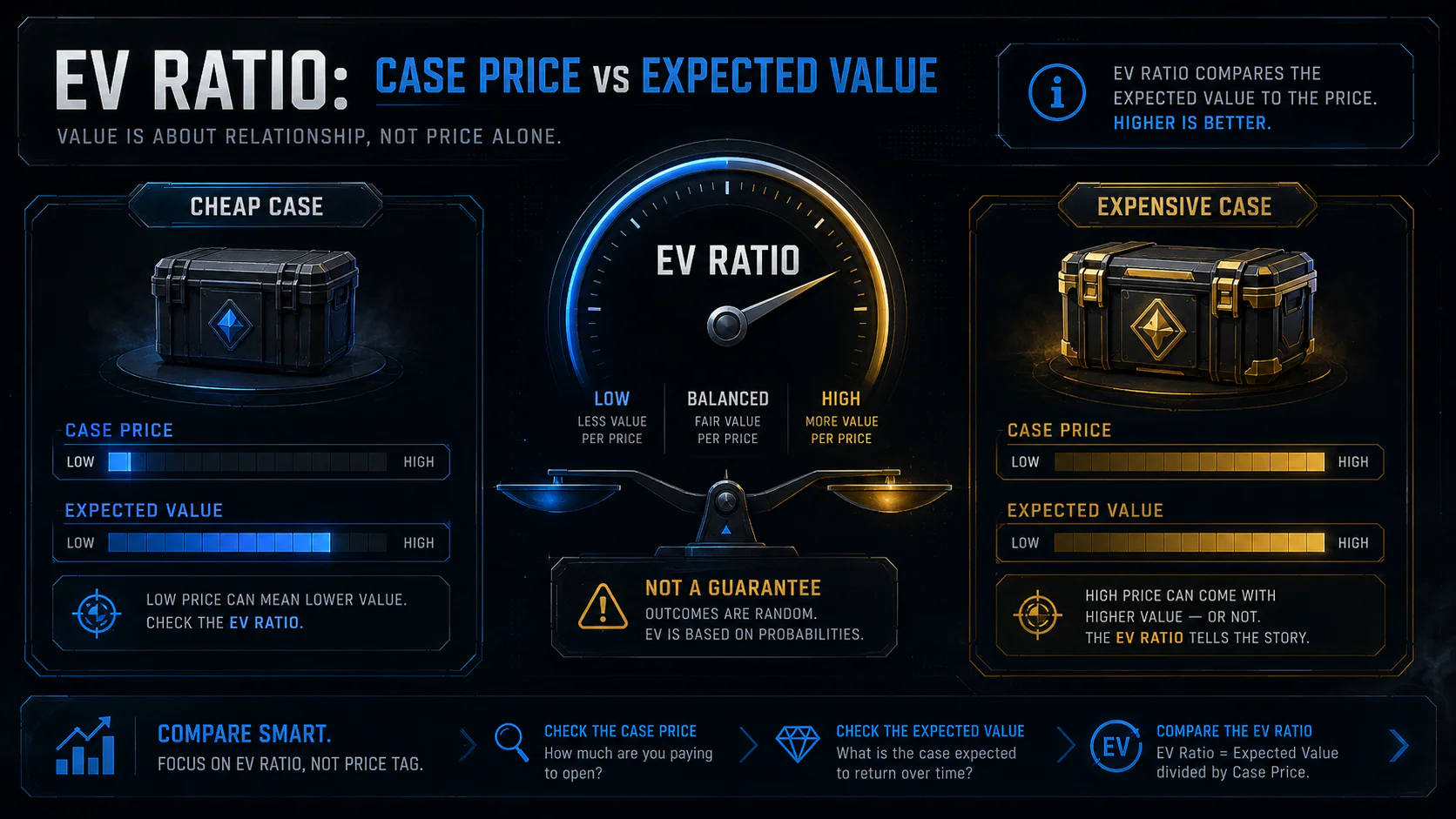
EV ratio compares expected value with case price. It helps normalize case comparison when one case is cheap and another is expensive.
A simple way to think about EV ratio is:
EV shows the theoretical average reward value.
Case price shows the cost to open the case.
EV ratio compares the two.
This matters because a cheap case and an expensive case can have very different prices. Looking only at raw expected value may not show which case is more efficient relative to cost. EV ratio helps users compare cases across price levels more fairly.
A higher EV ratio may suggest better theoretical value, but it does not remove risk. A case can have a stronger EV ratio and still produce a poor result in a single opening. It can also have high volatility if much of its value comes from rare drops.
EV ratio should be used alongside other factors, including case odds, item pool depth, market price stability, float value, wear level distribution, and platform withdrawal rules. It is a helpful lens, not a complete decision-making system.
Why Expensive Cases Are Not Always Better
Expensive cases often look appealing because they may include valuable rare drops. The top rewards may be visually impressive, scarce, or associated with high market prices. This can create the impression that expensive cases are automatically better.
That assumption is risky.
The rarest drops in expensive CS2 cases may have very low probabilities. Many outcomes may still be worth less than the opening cost. If the case price is high, each unfavorable result has a larger impact on the user’s budget. A short run of poor results can drain a budget quickly.
Promotional visuals can also overemphasize top rewards. A case image may highlight the most desirable skins, but those skins may represent only a small part of the actual probability distribution. The common drops matter just as much for expected value because they are the outcomes users are most likely to receive.
Expensive does not mean safer, more predictable, or more profitable. It only means the opening cost is higher. Whether the case offers better value depends on the odds, item pool, EV-related data, platform rules, and the user’s risk tolerance.
Why Cheap Cases Are Not Always Safer
Cheap cases can feel safer because the cost per opening is lower. For beginners, that lower entry cost may seem less intimidating than opening expensive cases. However, low price does not remove randomness.
A cheap case may include mostly low-value rewards. If the item pool is weak and the odds heavily favor the common outcomes, the case can still have poor expected value. The lower price may simply reflect the lower average value of the rewards.
Cheap cases also create a different behavioral risk. Because each opening feels inexpensive, users may open more of them. Many small openings can become a large total cost. This is especially important for users who do not set a fixed budget before starting.
A cheap case is not automatically better value, and it is not automatically safe. It may be more suitable for smaller entertainment budgets, but it still requires the same careful review of odds, item pool, EV ratio, and platform rules.
Volatility: How Results Differ Between Cheap and Expensive Cases
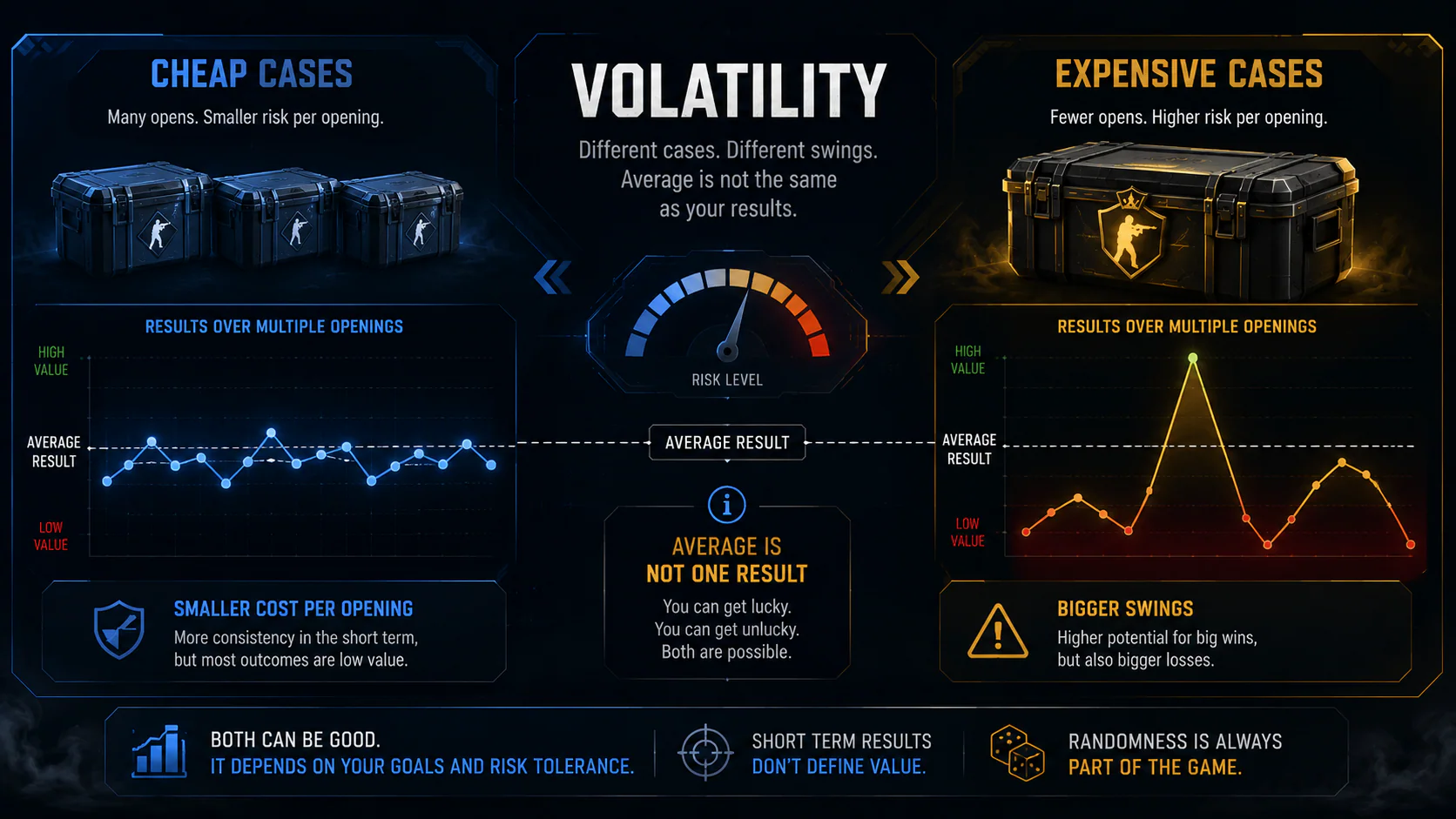
Volatility describes how much results can swing between low-value and high-value outcomes. In CS2 case opening, volatility is strongly affected by the item pool and drop chances.
Expensive cases may have bigger swings. A user might receive a low-value common item despite paying a high opening cost, or they might receive a rare high-value item. The distance between these outcomes can be large.
Cheap cases may feel more stable because each opening costs less, but they are still random. If a cheap case has a rare high-value reward and many low-value common rewards, it can still be volatile relative to its price. The user may experience many small losses while hoping for a rare outcome.
Rare high-value drops can distort expectations. Seeing one lucky result from another player does not show the average experience. A short session can differ heavily from theoretical averages, whether the case is cheap or expensive.
This is why users should not judge value based on one lucky or unlucky opening. Budget control matters for both case types. The more volatile the case, the more important it becomes to set limits before opening.
Drop Chance for High-Value Skins
High-value drops are often the main reason players compare CS2 cases. These may include rare skins, knives, gloves, Covert skins, or other premium rewards depending on the case and platform. However, these items usually have lower drop chances than common rewards.
Targeting one exact skin through cases is difficult. Even if a desired skin is included in the item pool, the probability of receiving that exact item may be low. If wear level, float value, StatTrak status, or special characteristics matter, the outcome becomes even less predictable.
Before opening a case, users should check whether the desired skin is actually included. A case can look related to a certain theme or weapon type without containing the exact item a player wants. Reviewing the full item pool prevents confusion and helps users avoid opening a case based on assumptions.
If a user wants one specific skin, buying it directly is usually more predictable than trying to obtain it through random case opening. Direct buying allows the user to choose the skin, wear level, float range, and other characteristics more deliberately. Case opening depends on drop chance and should not be treated as a reliable path to a specific item.
Skin Market Price, Float and Wear
Skin value is not determined only by the skin name. Two versions of the same skin can have very different market prices depending on float value, wear level, rarity, StatTrak status, stickers, supply, and demand.
Wear levels commonly include:
Factory New
Minimal Wear
Field-Tested
Well-Worn
Battle-Scarred
Factory New versions are often more desirable for many skins, but this depends on the specific item, finish, rarity, and market behavior. Some skins may have unusual float ranges or collector interest that affects value differently.
Float value gives a more precise measure of wear within a wear category. For example, two Minimal Wear skins may not have identical value if one has a cleaner float or more desirable appearance. Stickers can also influence value, especially if they are rare, well-positioned, or connected to collector demand.
StatTrak versions may carry different prices from non-StatTrak versions. Rarity and supply also matter. A skin that appears valuable in one condition may be much less valuable in another.
This is why users should not judge a reward only by skin name. When comparing cheap CS2 cases and expensive CS2 cases, the expected value depends on the actual versions of skins that can drop, not just the headline names.
Budget Control for Cheap and Expensive Cases
Budget control is one of the most practical parts of case opening. Because outcomes are random, users should decide their limits before opening any case.
A responsible approach includes:
Setting a fixed entertainment budget
Deciding the number of openings before starting
Understanding the cost per opening
Avoiding extra deposits during a session
Avoiding chasing losses after poor results
Accepting that results may be below the case price
Only spending what one can afford to lose
Cheap cases can lead to many small openings. This can make total spending feel less noticeable until the session is over. Expensive cases create the opposite problem: fewer openings can use the entire budget quickly.
Both case types require discipline. The price level changes the shape of the risk, but it does not remove it. Opening cases should remain entertainment, not a financial plan or recovery strategy after losses.
When Cheap CS2 Cases May Make More Sense
Cheap CS2 cases may make more sense for users with smaller entertainment budgets. A lower case price can allow more openings for the same total budget, which may be appealing to beginners who want to learn how case odds and item pools work.
They may also suit users who accept lower possible rewards. If the goal is casual case opening rather than chasing premium items, cheaper cases can provide a lower-cost way to experience the mechanics.
Cheap cases may be more reasonable when the user:
Has a small fixed budget
Wants more openings for the same spend
Understands that rewards may be lower value
Reviews the item pool first
Checks visible odds
Compares expected value and EV ratio where data is available
Treats the activity as entertainment
Cheap cases still require caution. A low opening cost does not guarantee good value, and repeated openings can become expensive. Users should still compare odds, drop chance, market prices, and platform rules before choosing.
When Expensive CS2 Cases May Make More Sense
Expensive CS2 cases may make more sense for users who understand higher risk per opening and are comfortable with larger variance. These cases may include higher-value possible rewards, but those rewards are not guaranteed and may have low drop chances.
They may be more suitable for users who:
Understand the higher cost per opening
Are interested in higher-value possible rewards
Can accept bigger swings in results
Compare EV, odds, and item pool before opening
Are not trying to chase one exact skin
Have strict budget limits
Understand that expensive does not mean safer
Expensive cases require careful budget control because poor results can become costly quickly. A user should not open expensive cases because of pressure, emotion, or the belief that higher price automatically means better value.
Cheap CS2 Cases vs Expensive CS2 Cases: Comparison Table
Factor | Cheap CS2 Cases | Expensive CS2 Cases |
|---|---|---|
Entry cost | Lower per opening | Higher per opening |
Number of openings per budget | More openings possible | Fewer openings possible |
Possible reward value | Usually lower ceiling | Often higher ceiling |
Risk per opening | Smaller single-opening cost | Larger single-opening cost |
Volatility | Can still be random | Often larger swings |
Common drop value | Often low | May still be below price |
Rare drop potential | Usually limited | Often higher |
EV comparison | Needs odds and item pool | Needs odds and item pool |
EV ratio usefulness | Helps judge efficiency | Helps normalize high price |
Beginner friendliness | Easier to try with limits | Requires more caution |
Emotional risk | Many small openings | Bigger losses per miss |
Best use case | Smaller entertainment budgets | Users accepting higher variance |
Common Mistakes When Comparing Case Prices
Many users compare cases too quickly. They look at price, visuals, or top rewards without reviewing the full structure of the case.
Common mistakes include:
Choosing only the cheapest case without checking the item pool
Choosing only the most expensive case and assuming it is better
Focusing only on the top reward
Ignoring case odds
Ignoring expected value
Ignoring EV ratio
Ignoring current skin market prices
Opening more because a case feels cheap
Assuming expensive means safer
Ignoring withdrawal rules on third-party sites
Chasing losses after bad results
The biggest mistake is treating case opening as a predictable value strategy. Randomness cannot be removed by choosing a cheap case, an expensive case, or a case with attractive visuals. Better comparison methods can help users understand risk, but they cannot make outcomes certain.
How to Compare Cheap and Expensive Cases More Carefully
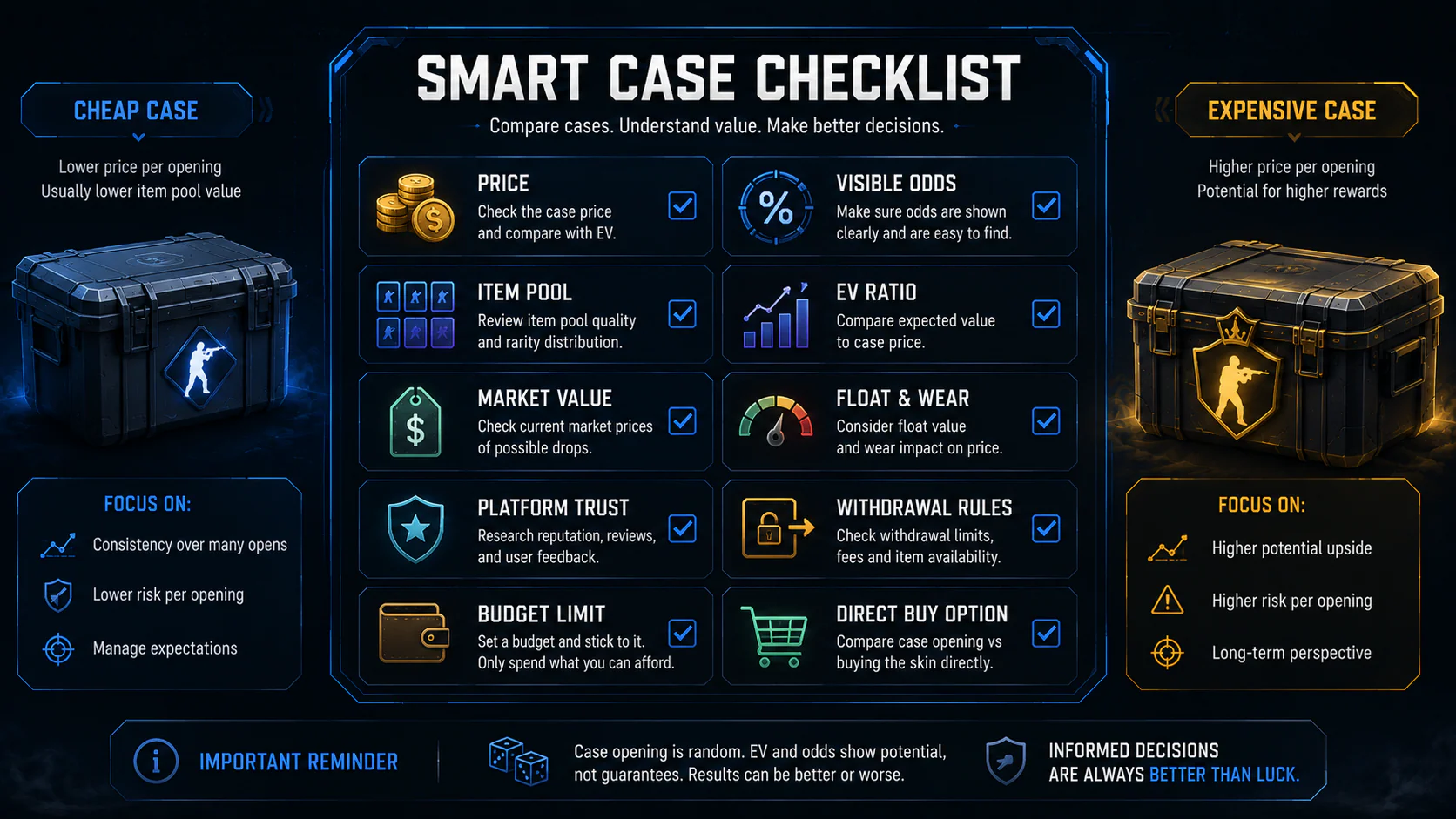
A practical decision framework can help users compare cases without relying only on price or emotion.
Check the case price
Start with the direct opening cost. This sets the baseline for value comparison.Review the full item pool
Look at every possible reward, not only the headline skins.Check visible odds
Case odds should be clear. If odds are hidden or unclear, comparison becomes much harder.Compare drop chances
Review the probability of common, mid-tier, and rare rewards.Check market prices
Consider current market context for possible rewards. Prices can change, so users should review current data rather than rely on old assumptions.Estimate expected value if data is available
EV can help compare the theoretical average reward value of different cases.Compare EV ratio
EV ratio helps normalize cheap and expensive cases by comparing expected value with case price.Consider volatility
A case with rare high-value rewards may have bigger swings, even if it looks attractive.Set budget and session limits
Decide the maximum spend and number of openings before starting.Check platform withdrawal rules
On third-party platforms, review whether rewards can actually be withdrawn.Review fees and platform terms
Check fees, KYC requirements, item availability, domain authenticity, terms of service, and reputation.Consider buying directly
If the goal is one exact skin, direct purchase is usually more predictable than random case opening.Avoid emotional decisions
Do not continue opening because of frustration, losses, or the belief that a rare item is “due.”
This framework does not guarantee a better outcome, but it helps users make more informed comparisons.
How Chance4Skin Can Help
Chance4Skin is designed as a CS2 skin analytics and wiki-style platform that can help users explore CS2 skins, review case-related information, and think more clearly about value before comparing cases.
For users evaluating cheap CS2 cases vs expensive CS2 cases, Chance4Skin may be useful for:
Exploring CS2 skins
Reviewing skin data
Understanding skin value factors
Comparing case odds where available
Reviewing drop chances
Thinking about expected value
Considering EV ratio
Comparing cheap and expensive case options
Reviewing market context before opening or buying
The goal is not to make case opening look predictable or risk-free. Instead, tools like Chance4Skin can help users slow down, compare item pools, understand the role of odds, and avoid judging cases only by price or headline rewards.
This kind of educational comparison is especially useful for beginners. A player who understands case price, market value, float value, wear level, and drop chance is less likely to make decisions based only on excitement or visual presentation.
Practical Checklist Before Choosing a Cheap or Expensive Case
Do I know the case price?
Have I checked the full item pool?
Are the case odds visible?
Do I understand the drop chance for rare skins?
Have I compared expected value?
Have I considered EV ratio?
Have I checked skin market prices?
Do I understand float and wear differences?
Do I have a fixed budget?
Am I opening for entertainment, not profit?
Have I checked withdrawal rules and platform terms?
Would buying the target skin directly be more predictable?
FAQ
Are expensive CS2 cases better than cheap cases?
Expensive CS2 cases are not automatically better than cheap cases. They may include higher-value possible rewards, but users should compare case odds, item pool, expected value, EV ratio, and market prices before deciding. A high case price does not guarantee stronger value.
Are cheap CS2 cases safer for beginners?
Cheap CS2 cases have a lower cost per opening, which can make them easier to approach with a small budget. However, they still involve random outcomes. Low price does not remove risk or guarantee better value.
What is the best way to compare cheap CS2 cases vs expensive CS2 cases?
The best way to compare cheap CS2 cases vs expensive CS2 cases is to look beyond price. Users should compare case price, item pool, drop chance, expected value, EV ratio, and skin market prices. This gives a more complete view of theoretical value and risk.
Does a higher case price mean better rewards?
A higher case price may mean the case includes higher-value possible rewards. However, those rewards may have low drop chances. The full item pool and odds matter more than the price alone.
What is EV ratio in CS2 case comparison?
EV ratio compares expected value with case price. It helps users compare CS2 cases with different prices more fairly. A higher EV ratio may suggest better theoretical value, but it does not guarantee profit.
Can cheap CS2 cases have bad expected value?
Yes, cheap CS2 cases can still have weak expected value. This can happen if the item pool, case odds, and reward values are poor compared with the opening cost. A low price does not automatically mean good value.
Can expensive CS2 cases have bad expected value?
Yes, expensive CS2 cases can also have bad expected value. If rare rewards have low probability or common drops are worth much less than the case price, the case may be poor value. Expensive does not mean safer or more efficient.
Should I buy a skin directly instead of opening cases?
Buying directly is usually more predictable if the user wants one exact skin. Case opening depends on random outcomes, drop chance, wear level, and item pool rules. Direct buying gives more control over the specific skin and condition.
Can Chance4Skin help compare CS2 cases?
Chance4Skin can help users understand CS2 skins, case odds, drop chances, market context, and EV-related information before comparing cheap and expensive cases. It is designed to support more careful research and case comparison. Users should still treat case opening as entertainment with risk.
Written by
Team Chance4Skin


