
Hellcase Review: Is It Legit or Too Risky?
Published: 06.05.2026
Updated: 24.05.2026
Introduction
Hellcase is often discussed through a simple question: is Hellcase legit? That framing is too narrow. A better review asks whether users can understand the economic risk before depositing, what the odds are, how withdrawals work, how bonuses are restricted, whether the RNG process can be checked, and whether displayed value can actually become usable value.
This review finds that Hellcase operates operationally, real rather than clearly fake, but it remains a high-risk CS2 case-opening platform. The central issue is not just whether the site exists. The more useful question is whether a user can evaluate probability, expected loss, withdrawal friction, and gambling-like exposure before spending money or skins.
Hellcase sits in a category where entertainment digital collectibles, and wagering-style mechanics overlap. Users pay or risk value for randomized CS2 skin outcomes. The economic result depends on probability, item pricing, fees, liquidity, and withdrawal access. Because no single public signal can prove that a case-opening platform is safe, odds disclosures, visible mechanics, legal terms, payment rules, and user reputation patterns should be assessed together.
Overview of Hellcase
Hellcase is a third-party CS2 case-opening platform. Users create an account, deposit funds or eligible value, open virtual cases, and receive CS2 skins or site-balance outcomes. The model is built around randomized item distribution rather than direct marketplace purchasing. A user does not choose a specific skin at a fixed price; the user pays for access to a case that contains a range of possible outcomes.
This distinction matters because Hellcase operates around Valve’s item ecosystem. Instead, Valve cases system is tied to the game client, Steam inventory, and the Steam Community Market. Hellcase is separate from those systems even when it uses Steam sign-in, Steam trade offers, skin pricing references, or inventory transfers. The platform can therefore apply its own rules for deposits, case prices, promotions, account restrictions, withdrawals, and dispute handling.
The core mechanic is simple: the user risks a known case price for an unknown output. The received item can be worth less than, close to, or more than the amount spent. In practical terms, Hellcase belongs to broader third-party skin gambling and case-opening market. It should be reviewed as a randomized digital-reward platform, not as a normal ecommerce store.
How Hellcase Works
The standard Hellcase user journey has several steps, and each step has a different risk point. A platform can function normally during deposits and case openings while still creating risk through unclear odds, locked bonuses, withdrawal limits, or account restrictions.
1. | Account creation: The user registers or signs in, commonly through Steam-linked authentication or platform credentials. Domain verification matters because fake login pages and impersonation links are common around skin platforms. |
2. | Deposit setup: The user adds value through supported payment methods, skins, or other available routes. Deposit availability should never be assumed to match withdrawal availability. |
3. | Case selection: The user chooses a case based on price, theme, item pool, perceived value, and visible odds. This is where expected value can be estimated if item-level probabilities are transparent. |
4. | Case opening: The platform applies its RNG process and assigns an outcome. The spin animation is interface theater; the real question is how the underlying outcome is generated and disclosed. |
5. | Inventory handling: The user appears in the user’s platform inventory. The user may keep, sell it internally, use it in battles or upgrades, or request withdrawal. |
6. | Withdrawal request: The user initiates a Steam trade or supported cash-out route. Minimums, fees, item availability, trade holds, KYC checks, regional restrictions, or provider limits may apply. |
7. | Post-withdrawal verification: The user should confirm that the received item, value, or payment matches the expected outcome after fees and conversion effects. |
Key Features
Case Variety
Hellcase offers themed CS2 cases with different prices, item pools, and potential reward values. Cases may be organized around weapon types, rarity categories, premium skins, budget outcomes, event themes, or creator-style collections. Variety gives users many price points, but it also makes direct comparison harder because each case can use a different distribution of low-value and high-value drops.
The most important variable is not the number of cases but the value distribution inside each case. A case can show rare gloves, knives, or high-tier rifle skins while assigning most probability to lower-value outcomes. Users evaluating Hellcase odds should look for item-level probabilities and compare them with the case price. Without that step, the presence of expensive skins can create a misleading impression of attainable value.
Case pricing should also be separated from market value. A skin shown on-site may use a platform price, a Steam marketplace reference, or third-party pricing feed, or an internal valuation method. Those values are not always equal to cash-out value, especially after fees, liquidity constraints, or withdrawal conversion.
Bonuses and Promotions
Hellcase uses common promotional systems found across CS2 case-opening sites, including deposit bonuses, free cases, promo codes, seasonal campaigns, loyalty rewards, and event-based incentives. These mechanics reduce the perceived cost of opening cases, but they can also encourage users to keep interacting with the platform after the original intent has been met.
Any bonus should be assessed through its conditions, not its headline value. A deposit bonus may require a minimum deposit, apply only to specific cases, be restricted from withdrawal, or require usage before any resulting value can be removed. Free cases may also be tied to account age, prior deposits, social tasks, wagering requirements, or limited inventory pools.
From a risk perspective, promotions are not neutral. They can increase session length, blur the difference between site credit and withdrawable value, and make further case openings feel less costly than they are. A cautious user should treat bonus balances as conditional platform credit unless the rules clearly state otherwise.
Payment Methods and Withdrawal Conditions
Hellcase generally supports digital payment flows associated with skin platforms, including site-balance deposits, skin-related transactions, and selected payment processors. Availability can vary by region, payment provider, account status, and platform policy. Users should confirm the live cashier page before assuming that a specific fiat, card, crypto, or skin-payment route is available.
Crypto and fiat methods carry different risk profiles. Fiat payment methods may provide familiar transaction records, but they can still be subject to processor restrictions or chargeback limitations. Crypto payments are usually faster and more global, but they are also harder to reverse. In both cases, the deposit path may be easier than the withdrawal path.
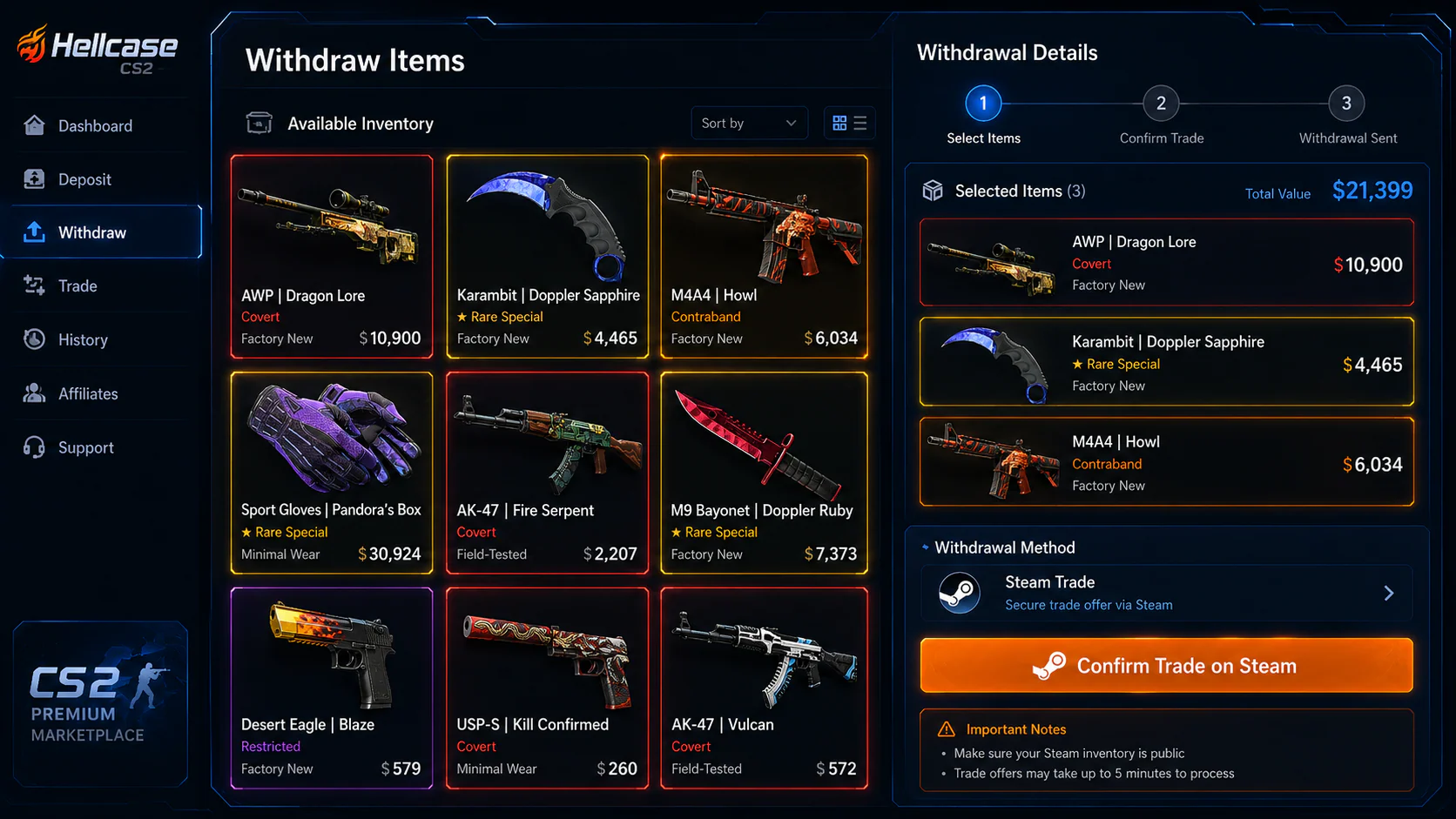
Withdrawal rules deserve closer attention than deposit options. Users may need a valid Steam trade URL, external Steam Guard, inventory privacy settings that allow trades, and access to the correct region or withdrawal provider. There may also be minimum withdrawal values, item availability issues, bot-inventory limitations, KYC checks, trade holds, or fees. These conditions can materially affect whether displayed value becomes usable value.
Game Modes
The base mode is case opening: the user pays a fixed price, the platform’s RNG system selects an outcome, and the user receives a skin or balance-equivalent result. This is the simplest mechanic to analyze because the user compares case price, visible item pool, and listed odds.
Case battles add competitive variance. Multiple users open cases in the same round, and the winning condition is usually tied to the total value of drops. This shifts the experience from individual randomized purchasing to head-to-head risk exposure. A user can receive a decent drop and still lose the round if another participant receives a higher combined value.
Upgrade systems create a different risk profile. The user risks an existing item or balance for a chance to receive a more expensive skin. If the upgrade fails, the starting value may be lost. Mathematically, the mechanic is closer to a probability bet than to collecting because the user chooses a target value and risk level. The higher the target multiple, the lower the success probability should be expected to be.
Why “Legit” Is Not the Same as “Low-Risk”
The phrase Hellcase legit should be separated into several smaller questions: does the website operate, does it process outcomes, does it allow withdrawals, does it disclose odds, does it explain bonus restrictions, and does it provide meaningful recourse if something goes wrong? A platform can satisfy some of these tests while failing others.
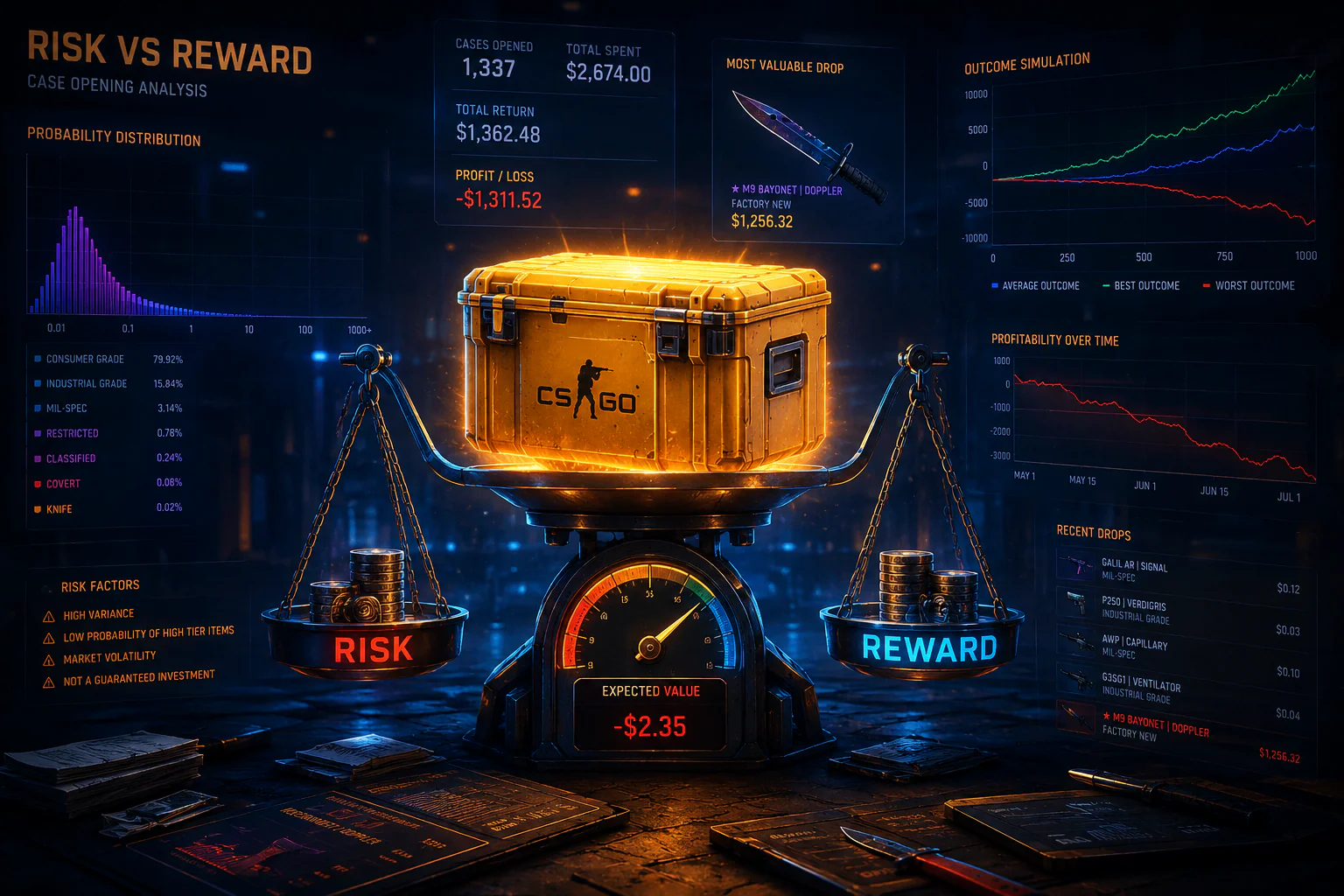
The most important user-level risk is expected value. If a case costs $10 and most probability is assigned to outcomes worth far less than $10, the user can lose value even when the RNG is functioning correctly. This is why “provably fair” and “profitable” are not the same thing. A result can be randomly generated and verifiable while still being economically unfavorable.
A simplified example illustrates the issue. Suppose a case costs $10 and contains many low-value skins, a small chance of mid-tier outcomes, and a tiny chance of a knife. The page may visually emphasize the knife, but the expected return depends on the probability-weighted value of every possible item, not the most attractive item shown on the case tile. If the combined expected return is lower than the case price, repeated openings are likely to lose value over time.
Pre-Deposit Checklist
Before depositing on Hellcase or any CS2 case-opening site, users should answer the following questions. A single negative answer does not automatically prove a scam, but multiple unclear answers materially increase risk.
Check | What to Look For | Why It Matters |
|---|---|---|
Item-level odds | Visible probability for each item or outcome group | Allows users to estimate expected value instead of relying on visual appeal |
Withdrawal minimums | Minimum item value, balance threshold, or provider requirement | Determines whether small wins can actually leave the platform |
Fees and conversion | Trade fees, provider fees, currency conversion, withdrawal pricing | Displayed value may not equal realizable value |
Bonus rules | Wagering requirements, withdrawal locks, eligible cases, expiration | Headline bonus value can be much lower than practical value |
Steam requirements | Steam Guard, trade URL, inventory visibility, trade holds | Technical account settings can delay or block withdrawals |
Support and disputes | Clear support channels and documented dispute process | Important when trades fail, accounts are restricted, or payments are delayed |
Account restrictions | Age limits, regional limits, KYC, multi-account rules | Violations can affect withdrawals after depositing |
Is Hellcase Legit or a Scam?
The fairest answer is that Hellcase appears to be a real operating platform, but that does not make it low-risk. The review should not stop at “real or fake.” Users should evaluate whether the platform provides enough information to make an informed decision before depositing.
Public-facing company information and platform disclosures are relevant but not always complete. Users should look for an identifiable legal entity, terms of service, privacy policy, responsible-use language, age restrictions, payment rules, jurisdiction information, and dispute-handling terms. If licensing status is unclear or the platform is not regulated like a conventional gambling operator, that should be treated as a material limitation rather than a minor detail.
RNG and provably fair systems require careful interpretation. A provably fair mechanism can let users verify that a specific result corresponds to a seed-based process, but it does not prove that the case is profitable, that the odds are favorable, or that withdrawals will be frictionless. Fair randomization and favorable expected value are separate concepts.
Transparency of odds is the strongest legitimacy signal for case-opening products. If Hellcase shows clear item-level probabilities for each case, users can inspect the probability distribution before opening. If odds are difficult to find, incomplete, or only presented in broad categories, users have less ability to evaluate expected return. Hellcase odds should be checked case by case because different cases may have different structures.
Reputation signals are usually mixed in third-party skin-gambling ecosystems. Positive user reports can indicate that the platform has processed normal transactions. Negative reports can highlight withdrawal disputes, bonus confusion, support delays, perceived unfairness, or account restrictions. Neither side should be treated as conclusive on its own. Patterns matter more than isolated comments.
Red Flags to Watch For
Unclear ownership: Users cannot easily identify the legal entity, jurisdiction, or operating terms.
Misleading or vague odds: Case pages emphasize rare skins but do not clearly show item-level probabilities.
Aggressive bonuses: Promotions look generous but include restrictive usage or withdrawal conditions.
Withdrawal mismatch: Deposits are simple, but withdrawal requires extra steps, minimums, unavailable items, or unexplained verification.
Value ambiguity: Displayed prices differ from Steam market prices or from realistic cash-out value.
Limited support accountability: Support channels are slow, unclear, or unable to explain account or withdrawal decisions.
Repeated complaint patterns: Multiple users report the same unresolved issue rather than isolated one-off frustration.
These red flags do not automatically prove a Hellcase scam, but they increase the level of caution required. The more value a user plans to deposit, the more important these checks become.
User Experience
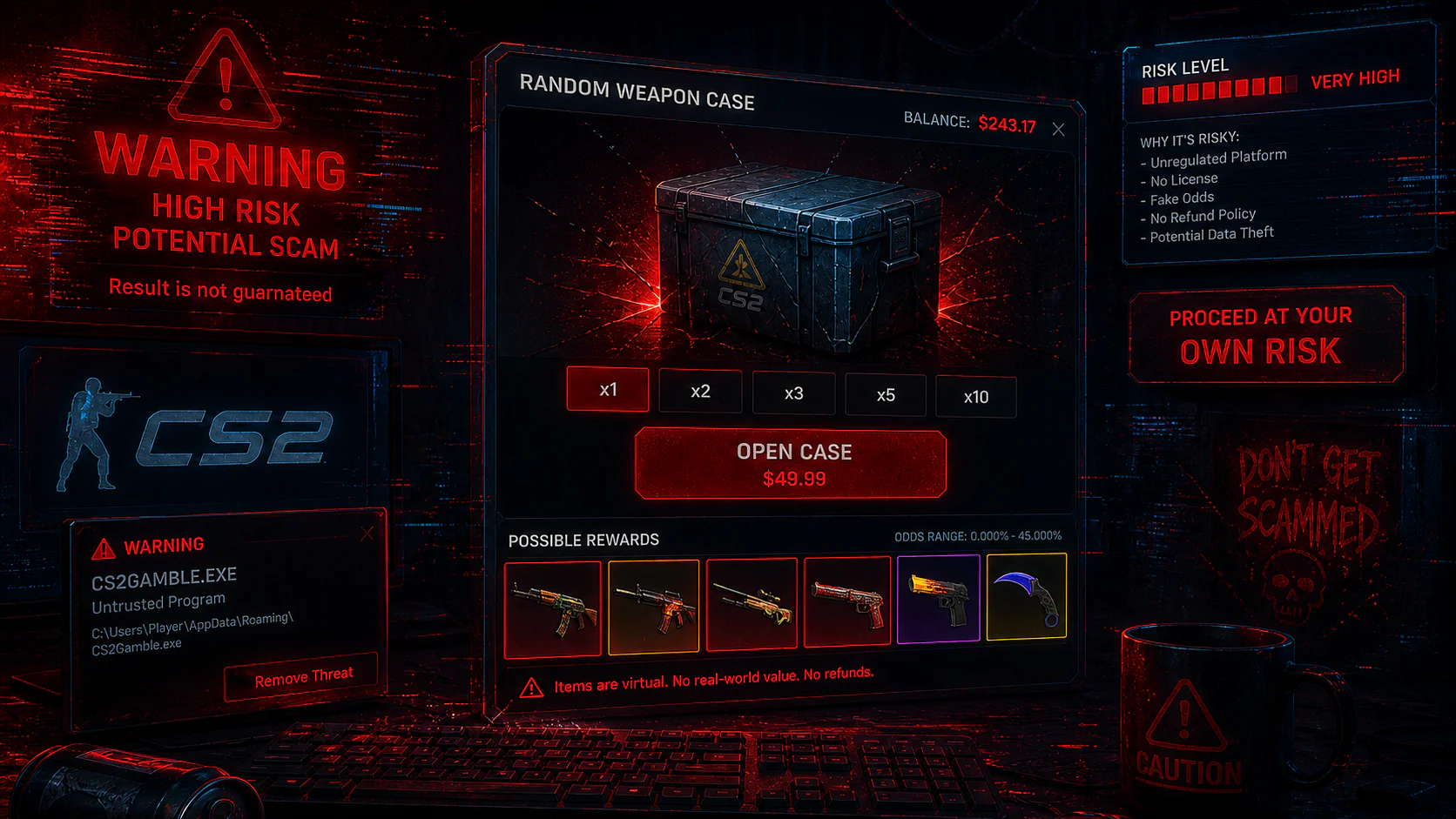
Hellcase follows the familiar visual structure used by many CS2 case-opening platforms: case tiles, animated openings, inventory panels, promotional banners, upgrade prompts, battle lobbies, and withdrawal controls. The interface is designed for rapid interaction. That improves usability, but it can also reduce deliberate decision-making.
Platform speed and responsiveness matter because randomized products rely on immediate feedback. Case openings need to feel instant, balance updates need to be visible, and inventory results need to appear without confusion. Technical stability during these moments can undermine trust because users are dealing with value-bearing digital items.
The main usability issue is economic clarity. A skin’s displayed value may not be the same as Steam marketplace value, third-party sale value, or actual cash-out value after fees. Users may also misunderstand the difference between available site balance, bonus balance, locked promotional value, and withdrawable items. Good interface design should make these distinctions explicit.
Technical stability should be assessed especially during promotions and high-traffic periods. Events may increase server load, support demand, withdrawal requests, and bonus-condition disputes. For users comparing Hellcase with other CS2 case-opening sites, stable withdrawal processing is more meaningful than animation quality or case artwork.
Pros and Cons
Pros | Cons |
|---|---|
Recognizable name in the case-opening market, which creates more public discussion than obscure platforms. | Gambling-like exposure; users risk value for randomized outcomes and can lose quickly through repeated openings. |
Multiple mechanics including standard case openings, battles, and upgrades. | Regulatory uncertainty compared with conventional gambling operators or normal marketplaces. |
Skin-withdrawal model connects outcomes to the broader CS2 skins economy. | Withdrawal friction may depend on Steam trade settings, item availability, fees, verification, or third-party providers. |
Different price tiers let users avoid the highest-cost cases, although lower-cost does not remove negative expected-value risk. | Displayed item prices may differ from Steam prices and realizable cash-out value. |
RNG or provably fair references can improve verifiability when implemented clearly. | Bonuses and events can include restrictions that reduce practical value. |
Public reputation can include both normal-use reports and complaints, requiring pattern-based evaluation. |
Comparative Context
Compared with smaller CS2 case-opening sites, Hellcase benefits from greater visibility. Older and larger platforms typically leave more public evidence: user reviews, complaint histories, screenshots, guides, withdrawal reports, and community discussions. That visibility helps users evaluate the platform, but it does not eliminate product risk.
Transparency is the main differentiator among the best CS2 case sites. A stronger platform makes item-level odds easy to inspect, explains RNG verification, separates bonus balance from withdrawable balance, discloses withdrawal rules, and avoids presenting rare skins in a way that obscures probability. A weaker platform may emphasize rare outcomes, large multipliers, and deposit promotions while giving less attention to expected value or cash-out conditions.
Game mechanics also affect risk exposure. Sites that only offer basic case opening are easier to analyze because the user receives fixed odds and item pools. Platforms with battles, upgrades, contracts, and event missions create more strategic choices but also more ways to re-risk value after an initial drop. More mechanics usually mean more entertainment complexity, not necessarily better user control.
User control is strongest when the platform lets users inspect odds before opening, set spending limits, understand fees, withdraw without unnecessary conversion steps, and verify outcomes independently. If any of those controls are missing or unclear, users carry additional platform risk. Hellcase should be compared on these criteria rather than on case artwork, headline bonuses, or isolated high-value drops.
Practical Guidance for Users
Treat deposits as entertainment spend, not investment capital. Do not deposit money or skins you cannot afford to lose.
Check odds before opening any case. Rare skins on a case tile are not a meaningful signal without probabilities.
Test withdrawal before scaling up. A small withdrawal can reveal trade settings, minimums, fees, and support responsiveness.
Ignore bonus headline value until rules are read. Bonus balance may be locked, non-withdrawable, case-specific, or time-limited.
Separate displayed value from cash value. A site price, Steam price, and actual sale value can differ materially.
Avoid chasing losses. Battles and upgrades can quickly re-risk value after an initial drop.
Protect the Steam account. Use Steam Guard, verify the domain, avoid suspicious trade links, and never share credentials outside legitimate authentication flows.
Final Verdict
This Hellcase review concludes that Hellcase appears operationally legitimate but financially high-risk. The platform should not be treated as a predictable way to acquire CS2 skins or as a low-risk alternative to the Steam Marketplace. Its central mechanic is randomized value distribution, and users may receive outcomes worth less than the amount spent.
Hellcase is best understood as a gambling-adjacent CS2 case-opening platform. The strongest factors for caution are variable odds, uncertain expected value, withdrawal dependencies, bonus restrictions, and limited regulatory clarity. The platform may be usable only for users who already understand CS2 skins, Steam trade mechanics, RNG systems, and the possibility of losing deposited funds.
For users asking whether Hellcase is legit, the answer is more nuanced than yes or no. It appears real, but real does not mean safe. The appropriate risk level is high, especially for users who are unfamiliar with third-party skin economies or who expect guaranteed value from case openings.
FAQ
Is Hellcase legit?
Hellcase appears to be a real operating CS2 case-opening platform, but legitimacy should be assessed through odds transparency, withdrawal reliability, public company information, payment rules, and user dispute patterns. It should not be treated as low-risk simply because it is active.
Is Hellcase safe to use?
Hellcase is not safe in the sense of predictable financial outcome. Users face randomized case results, possible loss of deposited value, withdrawal conditions, bonus restrictions, and account-security risks common to third-party skin platforms.
Can you withdraw skins from Hellcase?
Hellcase supports skin-withdrawal workflows, but users should check current withdrawal rules, Steam trade settings, item availability, minimum values, fees, and any verification steps before depositing.
Are the odds fair on Hellcase?
Odds should be reviewed case by case. A provably fair or RNG-based result can verify randomization mechanics, but it does not prove that a case has favorable expected value.
Is Hellcase gambling?
Hellcase uses gambling-like mechanics because users risk value for uncertain outcomes. The exact legal classification may vary by jurisdiction, but the product structure resembles wagering on randomized digital rewards.
Is Hellcase real or fake?
Hellcase appears real as an operating platform. The more important question is whether the platform's odds, withdrawal rules, bonus conditions, and risk disclosures are acceptable before any deposit is made.
Should beginners use Hellcase?
Beginners should be very cautious. Users who do not understand CS2 skin pricing, Steam trade mechanics, case odds, and withdrawal conditions are more likely to misread the risk profile.
Written by
Team Chance4Skin


