
CS2 Case Site Red Flags: Odds, KYC, Withdrawals, Fake Bonuses
Published: 28.05.2026
Updated: 31.05.2026
Choosing a CS2 case site is not just about finding interesting cases or chasing rare CS2 skins. A third-party case-opening platform can involve real money deposits, skin deposits, Steam inventory value, personal data, withdrawal rules, bonus terms, and account restrictions. Before using any platform, players should understand the warning signs that may indicate higher risk.
Not every CS2 case site with confusing terms is automatically unsafe, and not every complaint proves a scam. Some issues can come from delays, misunderstanding of bonus rules, regional restrictions, or normal verification checks. Still, users should not deposit money or skins without checking how the site handles case odds, withdrawals, KYC, support, ownership, and user complaints.
This guide explains the most important CS2 case site red flags in a practical, beginner-friendly way. The goal is not to label every platform as dangerous, but to help users identify risk signals before they spend money, deposit skins, connect their Steam account, or share personal documents. A careful review can help protect your balance, your inventory, and your personal data.
What are the main CS2 case site red flags? The main CS2 case site red flags include hidden case odds, unclear withdrawal rules, surprise KYC checks at cashout, fake bonuses with restrictive terms, unrealistic profit promises, repeated withdrawal complaints, weak customer support, vague ownership details, manipulated reviews, and poor skin withdrawal availability. These signs do not always prove that a platform is a scam, but they can increase user risk. Before depositing, users should verify case odds, item pools, bonus terms, withdrawal rules, KYC requirements, recent reviews, and support quality.
Why Red Flags Matter in CS2 Case Opening
CS2 case opening can involve more than casual entertainment. Many platforms allow users to deposit real money, crypto, or CS2 skins. Some users may also connect their Steam account, trade skins, claim bonuses, or attempt to withdraw items back to their inventory. That means a risky site can affect both your money and your Steam inventory value.
The main problem is that a CS2 case site can look professional while still having risky or unclear terms. A polished design, animated drops, influencer videos, and large bonus banners do not guarantee fair case odds, reliable skin withdrawal, or transparent support. The most important details are often hidden in the terms of service, bonus policy, withdrawal page, privacy policy, or support response.
Red flags matter because they help users slow down before depositing. A site may advertise expensive CS2 skins, but the actual drop chance may be extremely low. A bonus may look attractive, but the bonus terms may restrict withdrawals. A platform may allow instant deposits, but require verification only when a user tries to cash out. A support team may respond quickly before deposit, then become vague when withdrawals are involved.
Users should check risk signals before spending money or skins. This includes reviewing case odds, expected value, withdrawal rules, KYC requirements, user complaints, company transparency, and responsible gaming information. The purpose is not to find a “perfectly safe” site, because no third-party platform can be treated as risk-free. The purpose is to avoid obvious warning signs and make better-informed decisions.
Red Flag #1: Hidden or Unclear Case Odds
Hidden or unclear case odds are one of the biggest warning signs on any CS2 case-opening platform. Case odds explain the probability of receiving each possible item, rarity group, or value tier from a case. Without this information, users cannot understand the actual drop chance behind the skins shown on the case page.
A case may display expensive knives, gloves, or high-value rifle skins as possible drops. However, the presence of a rare skin in the item pool does not mean a user has a meaningful chance of receiving it. If the platform shows “featured drops” without exact probabilities, the presentation can create a misleading impression. The important question is not only “Can this item drop?” but “How likely is it to drop?”
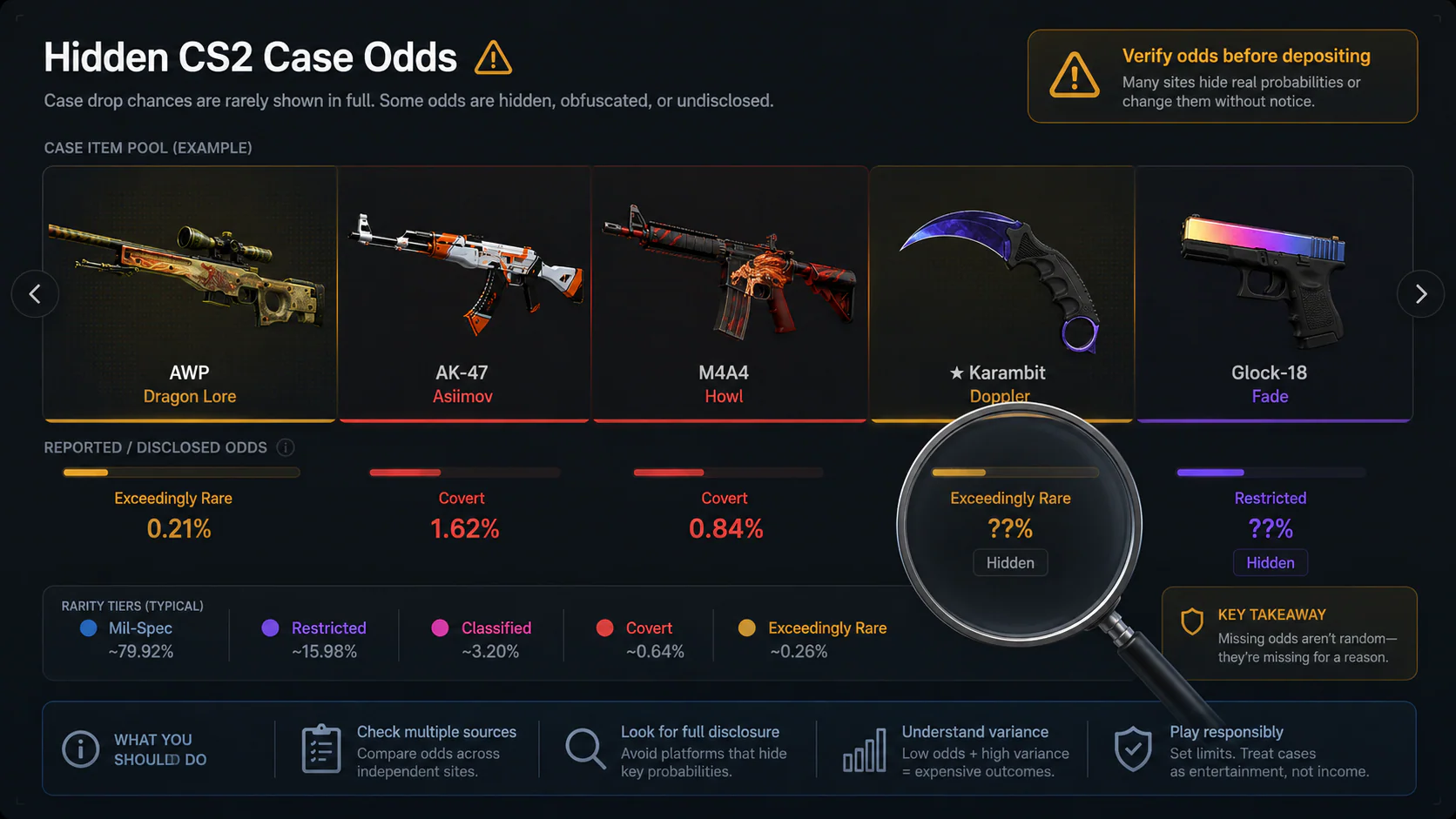
Clear case odds help users understand risk. They also make it possible to compare compare case odds across platforms. A transparent case page should show the item pool, the relative or exact probabilities, and enough pricing context for users to evaluate the case. If probabilities are missing, vague, or hidden behind broad labels, expected value becomes difficult or impossible to estimate.
Before depositing, users should check whether each case shows its possible drops, whether rare-item odds are visible, whether low-value filler items are included, and whether probabilities are presented clearly. If a site refuses to show odds or only highlights the most expensive drops, that may indicate poor transparency.
Red Flag #2: No Clear Expected Value or Poor Value Transparency
Expected value, often shortened to EV, is a way to estimate the average value of outcomes over many openings. In simple terms, EV considers the case price, the drop chance of each item, and the market price of the possible skins. It does not predict what will happen in one opening, and it does not guarantee profit. It is only a mathematical way to understand the average return behind a case.
For example, a case may contain one expensive skin and many low-value skins. Even if the expensive skin looks attractive, the case may still have poor value if the drop chance is very low and most outcomes are worth much less than the case price. This is why users should not judge a case only by the most expensive skin shown.
Negative EV is common in case opening. This means the average expected return may be lower than the cost of opening the case. A user can still receive a valuable item, but the average outcome may not favor the user. This is a central case-opening risk and one reason users should treat case opening as entertainment rather than an investment plan.
Poor value transparency becomes a flag when a platform hides odds, hides item values, uses unclear pricing, or does not explain how site balance relates to skin market price.Clear CS2 case odds can help users think about CS2 case odds, skin value, drop chances, and EV calculations before comparing case-opening options. The key is to look beyond headline skins and evaluate the full item pool.
Red Flag #3: Complicated or Hidden Withdrawal Rules
Withdrawal rules are critical because depositing is usually easier than withdrawing. A platform may accept money or skins quickly, but the real test is whether users can withdraw fairly under clear conditions.
Important withdrawal rules include minimum withdrawal limits, withdrawal fees, processing times, required wagering, bonus-related restrictions, account verification, and available withdrawal methods. Users should also check whether balances are locked, whether bonus balance and real balance are separated, and whether withdrawals are valued differently from public skin market prices.
A common red flag is when withdrawal rules are difficult to find before depositing. Another warning sign is when a site advertises easy withdrawals but later introduces requirements that were not clearly shown. Some platforms may require users to wager deposited funds before withdrawal. Others may block withdrawals after a bonus is claimed. Verification may also be required before cashout, which is discussed in more detail in the KYC section below.
Before depositing, users should read the withdrawal page, terms of service, bonus policy, and FAQ. They should check minimum withdrawal amounts, fees, skin availability, verification requirements, and whether bonus acceptance changes withdrawal eligibility. If the rules are unclear before deposit, the user carries more risk.
Red Flag #4: Withdrawal Complaints in Recent Reviews
User reviews can reveal important patterns, especially when complaints are recent and repeated. One withdrawal complaint does not automatically prove a site is unsafe. A single user may misunderstand bonus terms, violate platform rules, or experience a temporary delay. However, repeated recent complaints about the same issues should be taken seriously.
Warning patterns include delayed withdrawals, missing skins, locked accounts, ignored support tickets, unexplained verification problems, and blocked withdrawals after bonus use. Complaints about skin withdrawals are especially important because a CS2 case site may show items on the website without having enough real inventory available for users to withdraw.
Users should compare old reviews with recent reviews. A platform that had a good reputation two years ago may have changed ownership, changed withdrawal rules, reduced inventory, or developed support problems. Recent behavior matters more than old reputation when evaluating current CS2 case sites.
At the same time, reviews can be fake, manipulated, outdated, emotional, or influenced by affiliate incentives. Users should compare multiple sources instead of relying on one review page or one influencer video. Look for detailed experiences, screenshots of support conversations, dates, and repeated patterns across different communities.
Red Flag #5: KYC Appears Only After You Try to Withdraw
KYC means “Know Your Customer.” It usually refers to identity verification, such as confirming a user’s name, age, location, or identity documents. Some platforms may require KYC for compliance, fraud prevention, payment processing, age restrictions, or anti-abuse controls. KYC is not automatically a scam signal.
The red flag appears when KYC is hidden until withdrawal. If a site allows easy deposits but only reveals identity verification requirements when the user tries to cash out, users may feel trapped. They may have funds or skins on the platform but be unable to withdraw without submitting sensitive personal data.
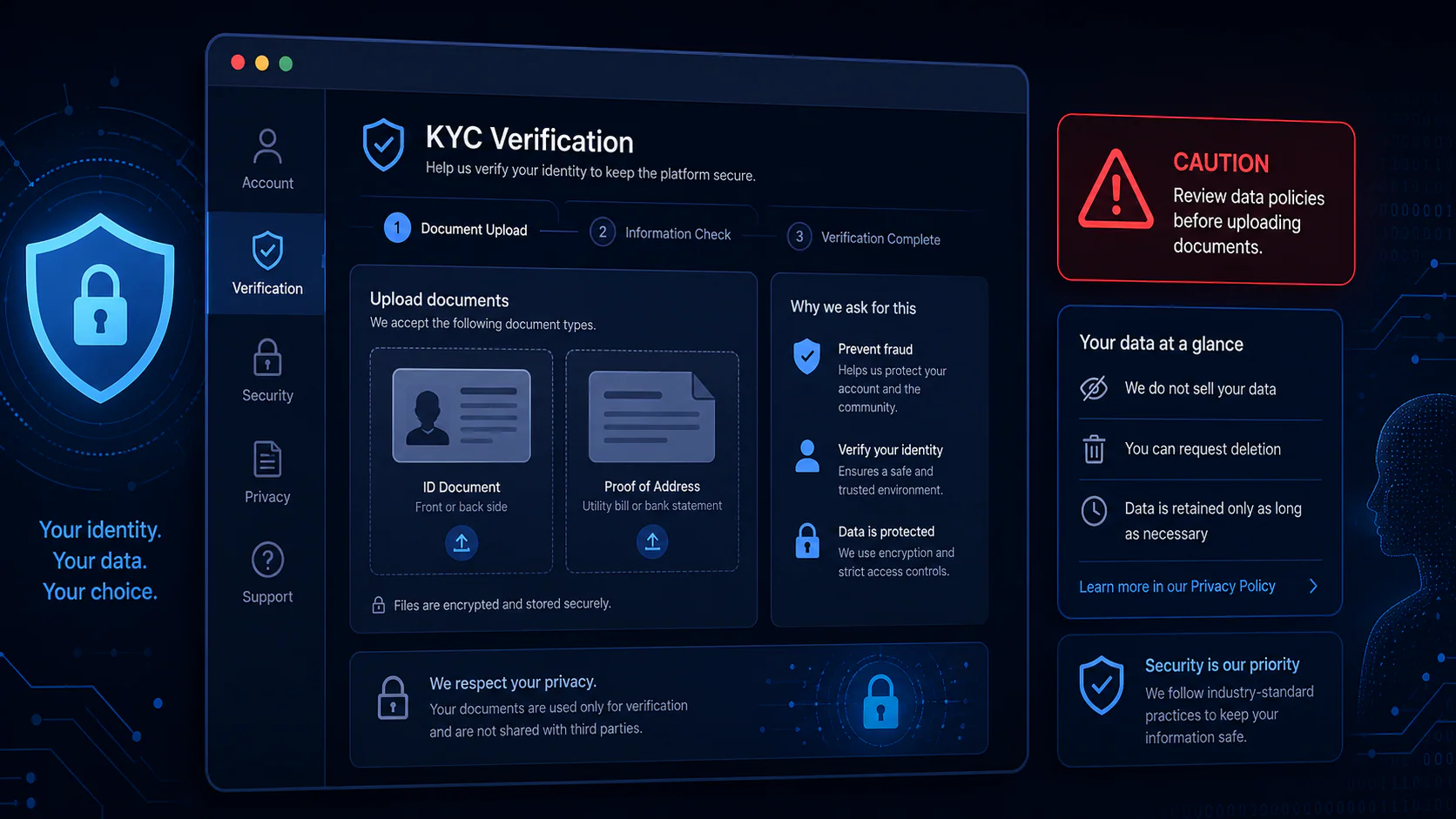
Before depositing, users should check whether KYC is required, when it may be triggered, what documents may be requested, how long verification can take, and how personal data is stored. Depending on the platform, documents may include identity documents, proof of address, payment method verification, or age verification. The exact requirements vary, so users should read the platform’s policies carefully.
Users should never upload sensitive documents to a platform they do not trust. They should review the privacy policy, ownership details, data handling practices, and support quality before submitting personal information. The goal is not to bypass KYC or avoid platform rules. The goal is to understand verification requirements before depositing.
Red Flag #6: Fake or Misleading Bonus Offers
Bonuses are one of the most common areas where users misunderstand risk. A CS2 case site may advertise deposit match bonuses, free case offers, promo codes, “no deposit” rewards, cashback, rakeback, or limited-time promotions. These offers can look attractive, but the important details are usually in the bonus terms.
A bonus may create a separate bonus balance rather than real withdrawable balance. It may require wagering before withdrawal. It may restrict which cases can be opened, limit maximum withdrawals, expire after a time limit, require a minimum deposit, or block withdrawals until conditions are met. In some cases, accepting a bonus can make withdrawals more complicated than using the site without a promotion.
Fake urgency is another warning sign. A site may use countdown timers, flashing bonus popups, or language that pressures users to deposit quickly. Large bonuses with unclear terms should be treated carefully. The larger and more urgent the offer, the more important it is to read the restrictions.
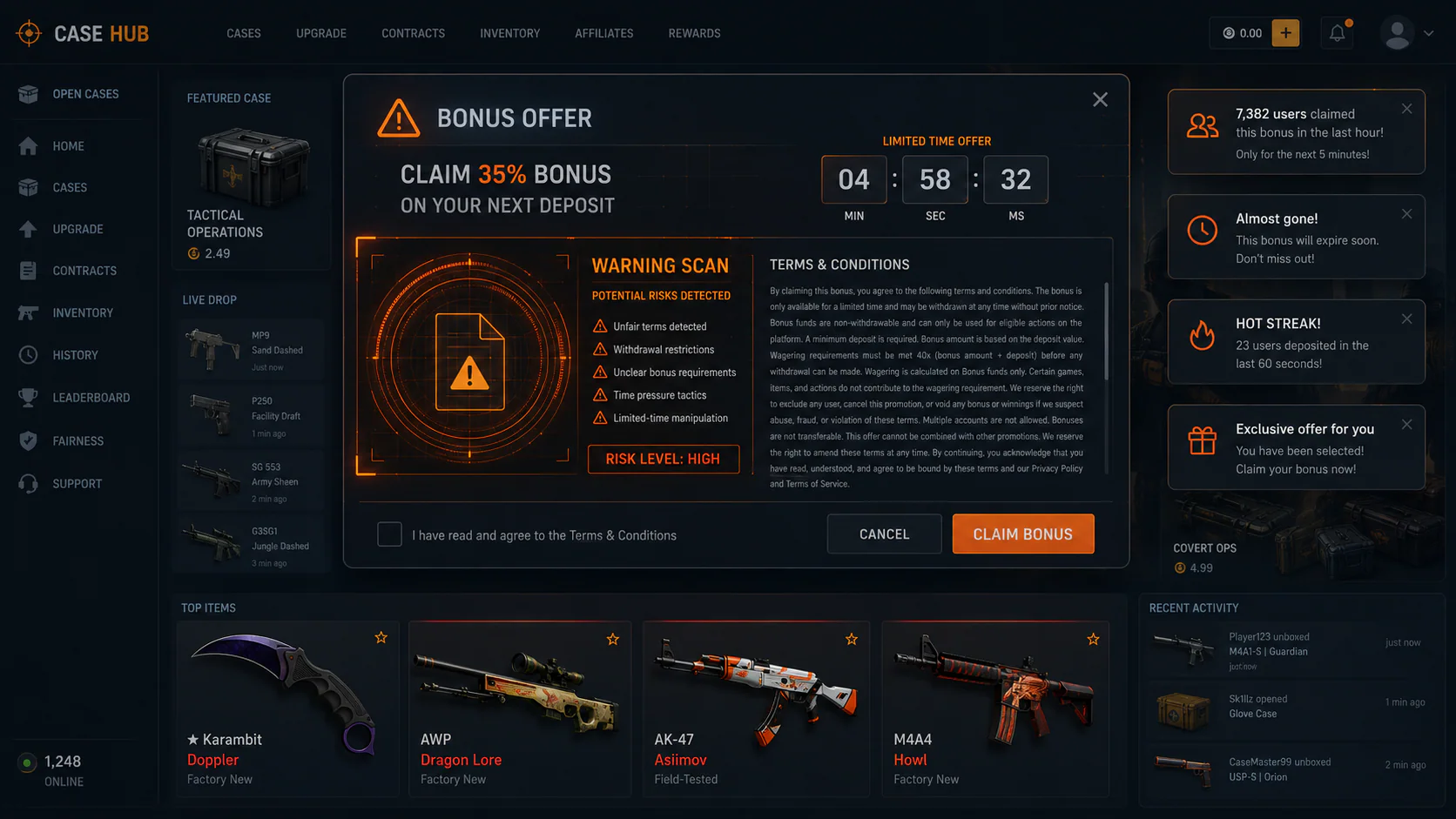
Before accepting any bonus, users should check whether the bonus is withdrawable, what wagering requirements apply, whether real balance and bonus balance are separate, whether withdrawals are restricted, and whether the offer changes KYC or account rules. If the bonus terms are vague or missing, that is a serious trust concern.
Red Flag #7: Unrealistic Promises and Profit Language
Unrealistic promises are a major scam warning in CS2 case opening. Phrases such as “guaranteed profit,” “100% win,” “risk-free case opening,” “easy money,” or “secret winning method” are dangerous because case opening is based on random outcomes.
A platform or promoter may show jackpot screenshots, large wins, influencer clips, or selected user highlights. These examples do not represent normal outcomes. A rare drop can happen, but that does not mean it is likely. Users should remember that screenshots are easy to select, edit, or present without context.
Influencer hype can also distort expectations. Some creators may receive sponsorships, affiliate commissions, free balance, boosted accounts, or special promotional conditions. Even when content is entertaining, it should not be treated as trust evidence or financial guidance.
Users should treat CS2 case opening as entertainment, not income. If a platform presents case opening as an investment plan or reliable profit method, that is a strong red flag. A legitimate trust-focused presentation should discuss risk, randomness, odds, and limitations.
Red Flag #8: Poor or Missing Terms of Service
Terms of service are not exciting to read, but they often contain the most important platform rules. A CS2 case site should make key policies accessible before deposit. Missing, vague, or confusing terms can increase user risk.
Users should look for withdrawal policy, bonus policy, account restrictions, KYC requirements, refund policy, dispute process, country restrictions, age restrictions, responsible gaming information, and rules for locked or banned accounts. The terms should explain what happens if a user violates rules, uses a restricted payment method, triggers verification, or has a withdrawal dispute.
Poor terms do not automatically prove a scam, but they reduce transparency. If a platform can change rules without clear notice, lock accounts without explanation, or apply broad restrictions without examples, users may have limited options when something goes wrong.
This is not legal advice. From a practical user-awareness perspective, the question is simple: can you understand the rules before depositing? If the answer is no, the platform may be harder to evaluate.
Red Flag #9: Unclear Ownership and Weak Contact Information
Transparency matters because users need to know who operates the platform and how to contact support. A trustworthy platform should provide some combination of company name, registration information where applicable, contact email, support system, privacy policy, data handling information, and social media presence.
Hidden ownership is not always proof of fraud. Some companies may operate through international structures, use support portals, or provide limited public details. However, the less information available, the harder it becomes for users to evaluate accountability.
Weak contact information is also a concern. If a site has no reliable support path, no email, no visible company details, no privacy policy, and no meaningful social presence, users may struggle to resolve disputes. This becomes especially important for withdrawal problems, KYC issues, missing skins, or locked accounts.
Before depositing, users should check whether the platform explains who operates it, how support works, how user data is handled, and where policy information is published. A lack of transparency increases risk, even if it does not prove wrongdoing.
Red Flag #10: Support Avoids Direct Questions
Support quality is one of the easiest things to test before depositing. Users can ask simple questions about withdrawals, case odds, bonus restrictions, KYC, withdrawal fees, skin availability, and account rules. A helpful support team should answer clearly or point to the correct policy page.
Red flags include vague answers, copy-paste replies, no response, pressure to deposit, refusal to explain bonus restrictions, or unclear statements about withdrawals. If support cannot answer basic questions before a user deposits, it may be even harder to get help after money or skins are already on the platform.
Users should be especially cautious when support gives answers that conflict with the terms of service. Written policies usually matter more than chat promises. If support says withdrawals are easy but the terms include broad restrictions, users should treat the written rules seriously.
Testing support does not prove a site is safe, but it can reveal obvious issues. A platform that avoids direct questions about odds, KYC, or withdrawals may not be transparent enough for users to trust with money, skins, or personal data.
Red Flag #11: Fake Reviews, Paid Promotions and Influencer Hype
Marketing can distort trust signals. A CS2 case site may have positive reviews, influencer videos, affiliate posts, social media giveaways, and community comments. Some of this content may be genuine. Some may be paid, incentivized, outdated, or manipulated.
Paid influencer promotions are not automatically dishonest, but users should understand the incentive. If a creator earns affiliate revenue from deposits, their content may focus on excitement rather than risk. Users should compare marketing claims with independent site reviews.
Fake positive reviews often use repeated generic language, lack details, or appear in large clusters. Review bombing can also create misleading negative impressions. This is why users should compare multiple sources and prioritize detailed, recent user experiences.
Old reputation should not be treated as proof of current reliability. Platforms can change policies, ownership, support quality, inventory, payment processors, or withdrawal behavior. Users should separate marketing from evidence and focus on current trust signals.
Red Flag #12: Case Prices Do Not Match Skin Value Logic
Case pricing should be evaluated carefully. A case price should be considered alongside the item pool, market price of possible drops, rarity distribution, low-value filler items, expensive headline items, and expected value.
A case with a famous skin can still have poor odds. The expensive item may be shown prominently, but the majority of outcomes may be low-value skins. In that situation, the case can look attractive while still offering weak average value. This is why drop chance and item distribution matter as much as the headline item.
Cheap cases are not automatically better. They may contain mostly low-value items or limited upside. Expensive cases are not automatically safer either. A higher price does not guarantee better expected value, better withdrawal reliability, or fairer odds.
Before opening a case, users should compare the case price with the likely outcomes, not only the best possible outcome. They should also consider whether market prices are current, whether float value and wear levels affect value, and whether site balance reflects real skin withdrawal value.
Red Flag #13: Limited or Unavailable Skin Withdrawals
Skin withdrawal availability is different from general withdrawal rules. A site may have a withdrawal page and still lack enough real inventory to fulfill user requests. This matters because users often want actual CS2 skins, not just site balance.
Warning signs include unavailable listed skins, replacement items, bots with empty inventories, long wait times, repeated “out of stock” messages, and large differences between displayed site value and real withdrawable inventory. A platform may show an item as a possible drop, but that does not always mean the exact item is readily withdrawable.
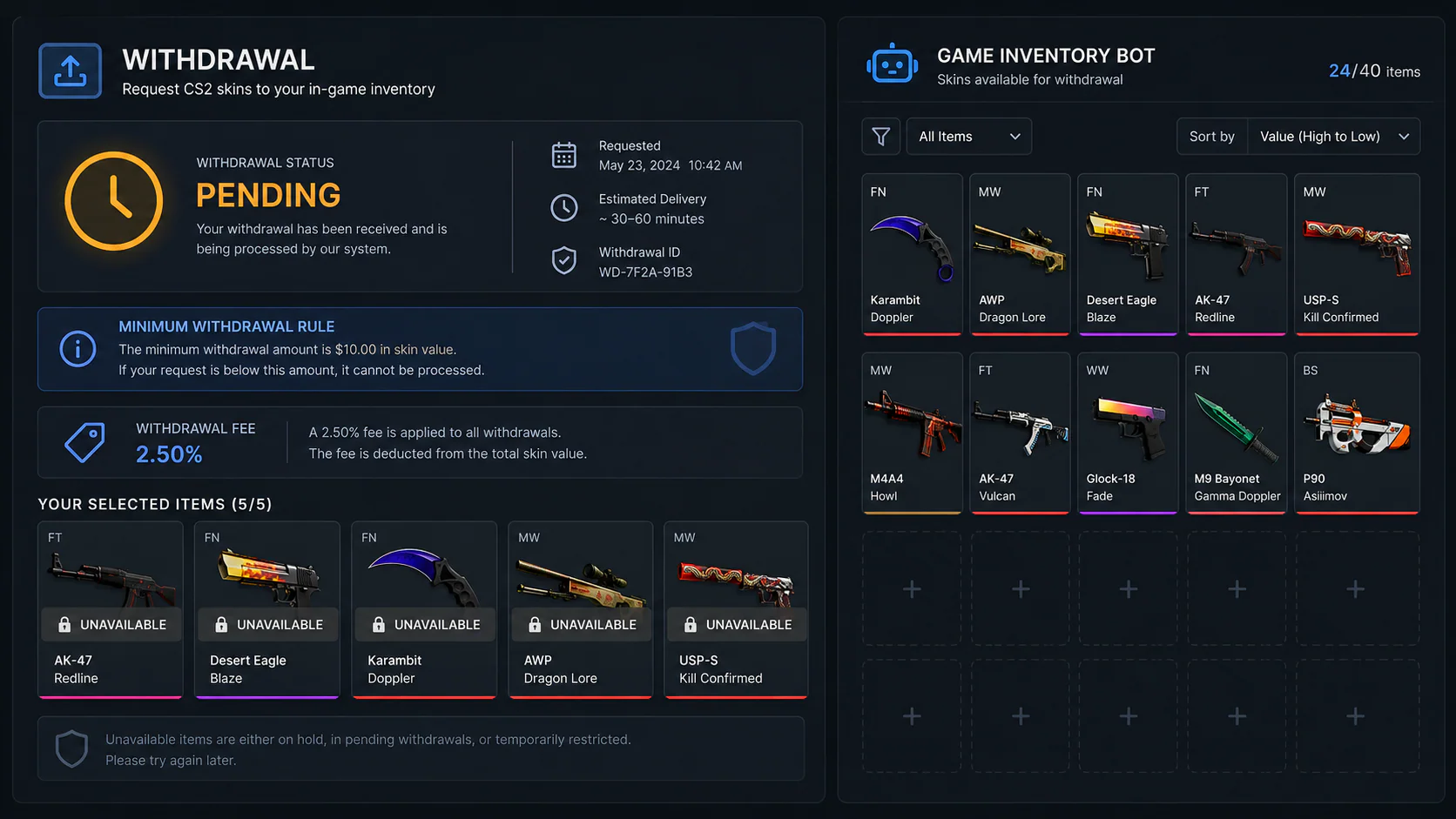
Users should check the withdrawal inventory before depositing when possible. They should look at whether skins are actually available, whether bots hold items, whether replacement items are offered, and whether withdrawal delays are common in recent reviews.
This issue overlaps with withdrawal rules, but the focus here is actual inventory. A platform can have written withdrawal terms and still create problems if it does not maintain enough skins for users to withdraw.
Red Flag #14: Pressure Tactics and Artificial Urgency
Pressure tactics are designed to make users act quickly instead of reviewing terms. Common examples include countdown timers, limited-time bonus pressure, “deposit now” popups, aggressive notifications, fake activity feeds, fake recent wins, and social proof messages showing other users supposedly receiving valuable drops.
Urgency can push users into poor decisions. A player may accept a bonus without reading restrictions, deposit more than planned, or ignore unclear withdrawal rules because the offer appears to expire soon. This is especially risky for beginners who may not understand bonus terms, expected value, or skin withdrawal limitations.
Fake activity feeds are another concern. Some sites show constant wins or large drops to create the impression that valuable outcomes are common. Without verifiable odds and transparent item pools, these feeds should not be treated as evidence.
Users should slow down when a site creates pressure. A trustworthy decision does not require rushing. Check the terms, odds, withdrawal rules, KYC policy, and reviews before depositing.
Red Flag #15: No Clear Responsible Gaming or Risk Information
Responsible gaming information matters because CS2 case opening involves risk. A user-friendly platform should clearly explain that outcomes are random, spending can result in losses, and users should only spend what they can afford to lose.
Helpful risk information may include age limits, spending limits, self-exclusion tools, cool-off options, support resources, and clear warnings about case opening risk. Availability varies by platform and jurisdiction, but the absence of any risk information can be a warning sign.
Platforms that hide risk may not be prioritizing user protection. If a site only promotes bonuses, wins, and expensive drops while avoiding discussion of losses, odds, and restrictions, users should be cautious.
Before depositing, users should check whether the platform provides meaningful disclosures and user protection tools. Responsible gaming information does not make a site fully safe, but it is part of a more transparent user experience.
How to Build a Safer Pre-Deposit Checklist
A safer pre-deposit checklist helps users evaluate a CS2 case site before money, skins, or personal data are involved. The goal is not to remove all risk, but to avoid obvious warning signs.
Start by checking case odds. Look for visible item probabilities, full item pools, and clear drop chance information. Do not rely only on featured drops or expensive skins displayed at the top of the page.
Next, compare case price and skin market value. Consider the likely outcome, not only the rarest possible drop. Review expected value where possible, and remember that EV does not guarantee individual results.
Read withdrawal rules before depositing. Check minimum withdrawal limits, fees, delays, verification requirements, wagering requirements, and whether bonus acceptance affects withdrawals. Also review actual skin withdrawal inventory if the site provides it.
Read bonus terms carefully. Check whether the bonus balance is withdrawable, whether wagering applies, whether there are time limits, and whether withdrawals are restricted after accepting a promotion.
Check KYC requirements. Understand when verification may be required, what documents may be requested, and how the platform handles personal data. Do not submit sensitive documents to a platform you do not trust.
Test support before spending money. Ask direct questions about odds, withdrawals, KYC, fees, and bonus rules. Vague or evasive answers are warning signs.
Search recent reviews across multiple sources. Look for repeated patterns involving withdrawal problems, missing skins, locked accounts, or ignored tickets. Separate detailed user experiences from generic praise or emotional complaints.
Finally, check company transparency, responsible gaming information, and pressure tactics. Avoid rushing into deposits because of countdown timers, bonus popups, or influencer hype. Only deposit what you can afford to lose.
Case Opening vs Buying Skins Directly
Users should consider their goal before choosing between CS2 case opening and buying skins directly. If a user wants one specific skin, buying CS2 skins directly is usually more predictable. The buyer can compare market price, wear level, float value, stickers, pattern, and seller options before making a decision.
Case opening is different because outcomes are random. A user may spend less than the target skin price and get lucky, but they may also spend more and never receive the desired item. Case opening should not be treated as a reliable way to obtain one exact skin.
Buying directly is easier to compare by market price. Users can look at listings, inspect float value, evaluate wear levels, and decide whether the price fits their budget. In case opening, the user is paying for a random outcome from a pool of possible drops.
This does not mean every user must avoid case opening. Some users view it as entertainment. However, it should not be treated as an investment plan or a dependable method for building inventory value. Understanding the difference can prevent unrealistic expectations.
How Chance4Skin Can Help Users Evaluate Risk
Chance4Skin is designed as a CS2 skin analytics and wiki-style platform. It can help users explore CS2 skins, understand skin data, review market context, compare case odds, and think more carefully about drop chances and expected value.
For users evaluating a CS2 case site, data matters. Knowing the difference between a rare headline item and the full item pool can change how a case looks. Understanding skin value, wear levels, float value, and market price can also help users avoid judging a case only by its most expensive possible drop.
Chance4Skin can support research by helping users compare case-opening options more carefully. It can provide context around CS2 skins, case odds, drop chances, skin prices, and EV-related information. This does not make any platform fully safe, and users should still verify each site’s withdrawal rules, bonus terms, KYC policy, support quality, and reputation before depositing.
The most useful approach is to combine data analysis with trust checks. Case odds and skin values help users understand the product. Withdrawal rules, reviews, KYC transparency, and support quality help users evaluate the platform.
Quick Red Flag Summary
Red Flag | Why It Matters | What to Check |
|---|---|---|
Hidden odds | Users cannot understand drop chance or expected value | Item probabilities, full item pool, rarity distribution |
Unclear withdrawals | Deposits may be easy while cashout is restricted | Minimums, fees, delays, wagering, locked balances |
Hidden KYC | Users may learn verification rules at withdrawal | KYC policy, trigger points, document requirements |
Fake bonuses | Promotions may restrict withdrawals or lock balances | Bonus terms, wagering, time limits, withdrawal cap |
Unrealistic promises | Profit language misrepresents random outcomes | Claims like guaranteed profit, 100% win, risk-free |
Repeated withdrawal complaints | Patterns may indicate operational or trust problems | Recent reviews, missing skins, locked accounts |
Vague terms | Users may not understand platform rules before deposit | TOS, refund policy, dispute process, account rules |
Weak support | Problems may be harder to resolve after deposit | Response quality, direct answers, support channels |
Fake reviews | Marketing can distort trust signals | Multiple sources, detailed reviews, recent complaints |
Unclear ownership | Limited accountability increases user risk | Company info, contact details, privacy policy |
Poor skin withdrawal availability | Site balance may not equal real withdrawable skins | Inventory, bot availability, replacement items |
Pressure tactics | Urgency can push users into poor decisions | Timers, popups, fake activity feeds, bonus pressure |
FAQ
What are the biggest red flags on a CS2 case site?
The biggest CS2 case site red flags include hidden odds, unclear withdrawals, surprise KYC checks, fake bonuses, unrealistic profit claims, repeated withdrawal complaints, and weak support. These signs do not always prove a scam, but they should make users slow down and verify the platform carefully.
Are hidden case odds a scam warning?
Hidden case odds do not automatically prove a scam, but they are a serious transparency issue. If users cannot see item probabilities, they cannot properly understand drop chance, case opening risk, or expected value.
Is KYC on a CS2 case site always bad?
No. KYC is not automatically bad because some platforms may require verification for compliance, age checks, payment security, or fraud prevention. It becomes a concern when the requirement is hidden until withdrawal or when users are asked for sensitive documents by a platform they do not trust.
Why do bonus offers cause withdrawal problems?
Bonus offers may include wagering requirements, locked balances, time limits, minimum deposits, or withdrawal restrictions. Users should read the bonus terms before accepting any promotion, especially if the offer looks unusually large or urgent.
How can I check if withdrawal rules are fair?
Check minimum withdrawal amounts, fees, processing times, verification rules, skin availability, withdrawal delays, and bonus restrictions before depositing. A platform should make these rules easy to find and understand.
Can reviews prove that a CS2 case site is legit?
Reviews can help, but they are not proof by themselves. Users should compare recent reviews, community feedback, withdrawal complaints, terms, support quality, and ownership transparency before deciding whether a platform appears trustworthy.
Is it safer to buy CS2 skins directly instead of opening cases?
Buying directly is usually more predictable if a user wants a specific skin. CS2 case opening depends on random outcomes, so it should not be treated as a reliable way to get one exact item or build value.
Can a site with good design still be risky?
Yes. Professional design does not guarantee fair odds, clear withdrawal rules, reliable support, or transparent ownership. Users should check actual data and policies instead of judging a platform by appearance alone.
How does Chance4Skin help with case-opening risk?
Chance4Skin helps users understand CS2 skins, case odds, drop chances, market context, and EV-related data. It can support better research, but users should still verify each platform’s terms, withdrawals, KYC rules, and reputation before depositing.
Should I deposit before reading the terms?
No. Users should read withdrawal rules, bonus terms, KYC requirements, account restrictions, and responsible gaming information before depositing money or skins. If the terms are missing or unclear, that may indicate higher risk.
Written by
Team Chance4Skin


