
CS2 Case Opening Strategy: Bankroll, EV Ratio and Risk
Published: 31.05.2026
CS2 case opening strategy must be based on random outcomes. A case may contain valuable CS2 skins, but the chance of receiving those items is usually much lower than the chance of receiving common or lower-value drops. Beginners often focus on the most expensive possible skin inside a case, while overlooking case odds, drop chance, expected value, EV ratio, drop chance, expected value, EV ratio, skin market price, float value, wear level, platform rules, and withdrawal conditions.
A careful CS2 case opening strategy does not mean predicting the next drop or beating randomness. It means making more informed decisions before spending money. Players can compare cases, understand how probabilities affect results, control their bankroll, set stop-loss and stop-win limits, and decide whether opening cases is worth the entertainment risk compared with buying CS2 skins directly.
No strategy can guarantee profit, rare drops, or specific outcomes. CS2 case opening should be treated as entertainment with financial risk, not as an investment method or reliable income source. The goal of this guide is to help beginners think more clearly before opening cases, avoid emotional decisions, and use tools such as Chance4Skin to research skins, odds, market context, and case value more carefully.
What Does “Strategy” Mean in CS2 Case Opening?
In CS2 case opening, strategy does not mean knowing what item will drop next. Case results are random, and no player can force a specific skin, rarity, float, or wear level to appear. A useful strategy is about preparation and risk control.
A beginner CS2 case opening strategy usually includes:
Understanding case odds before opening.
Comparing case prices instead of choosing randomly.
Reviewing the full item pool, not only the headline reward.
Checking possible skin value and market price.
Understanding expected value and EV ratio when data is available.
Setting a fixed budget before opening.
Avoiding extra deposits after losses.
Reading withdrawal rules and bonus terms.
Knowing when to stop after losses or wins.
This makes strategy a decision-making framework. It helps users avoid impulsive behavior and understand what they are risking. It does not remove randomness.
For example, a player may see a case that includes a rare knife or premium rifle skin. Without strategy, they may open it only because the top item looks attractive. With strategy, they check the probability of that item, compare the case price with likely outcomes, review whether drops can be withdrawn, and decide whether the session fits their budget.
That is the difference between emotional opening and controlled opening.
Why CS2 Case Opening Is Always Risk-Based
CS2 case opening is risky because the result of each case depends on probability. Some items may be common, while others may be extremely rare. A case can include high-value CS2 skins, but the user is usually much more likely to receive a lower-value item than the most valuable reward.
Several factors create case opening risk:
Random outcomes.
Uneven item probabilities.
Rare drops with low drop chance.
Common drops that may be worth less than the case price.
Changing skin market prices.
Difference in float value, wear level, and demand.
Platform withdrawal rules, fees, or restrictions.
Bonus terms that may lock balances or require additional activity.
One lucky result does not prove that a system is reliable. A player may receive a valuable skin from one case, but that does not mean the next case has better odds. Past outcomes do not make future rare drops more likely.
This is why CS2 case opening should never be treated as income. It is not a salary, investment plan, or predictable trading method. Even when users apply bankroll management and compare EV ratio, they are still dealing with random outcomes.
Understanding Case Odds Before Opening
Case odds describe the probability of receiving different items or item categories from a case. In simple terms, odds answer the question: “How likely is each possible drop?”
Beginners should understand that not all items inside a case have the same drop chance. A knife, glove, covert skin, or high-demand item may appear in the case preview, but its probability may be much lower than common or lower-tier skins.
Before opening a case, users should check:
The full list of possible drops.
The probability of each rarity or item group.
Whether odds are clearly displayed.
Whether the case contains mostly low-value items.
Whether the most attractive item has a very low drop chance.
Whether the odds are easy to understand.
The headline skin is not the whole case. A case may promote one expensive reward, but most actual outcomes may come from less valuable parts of the item pool. That is why users should not judge a case only by its best possible drop.
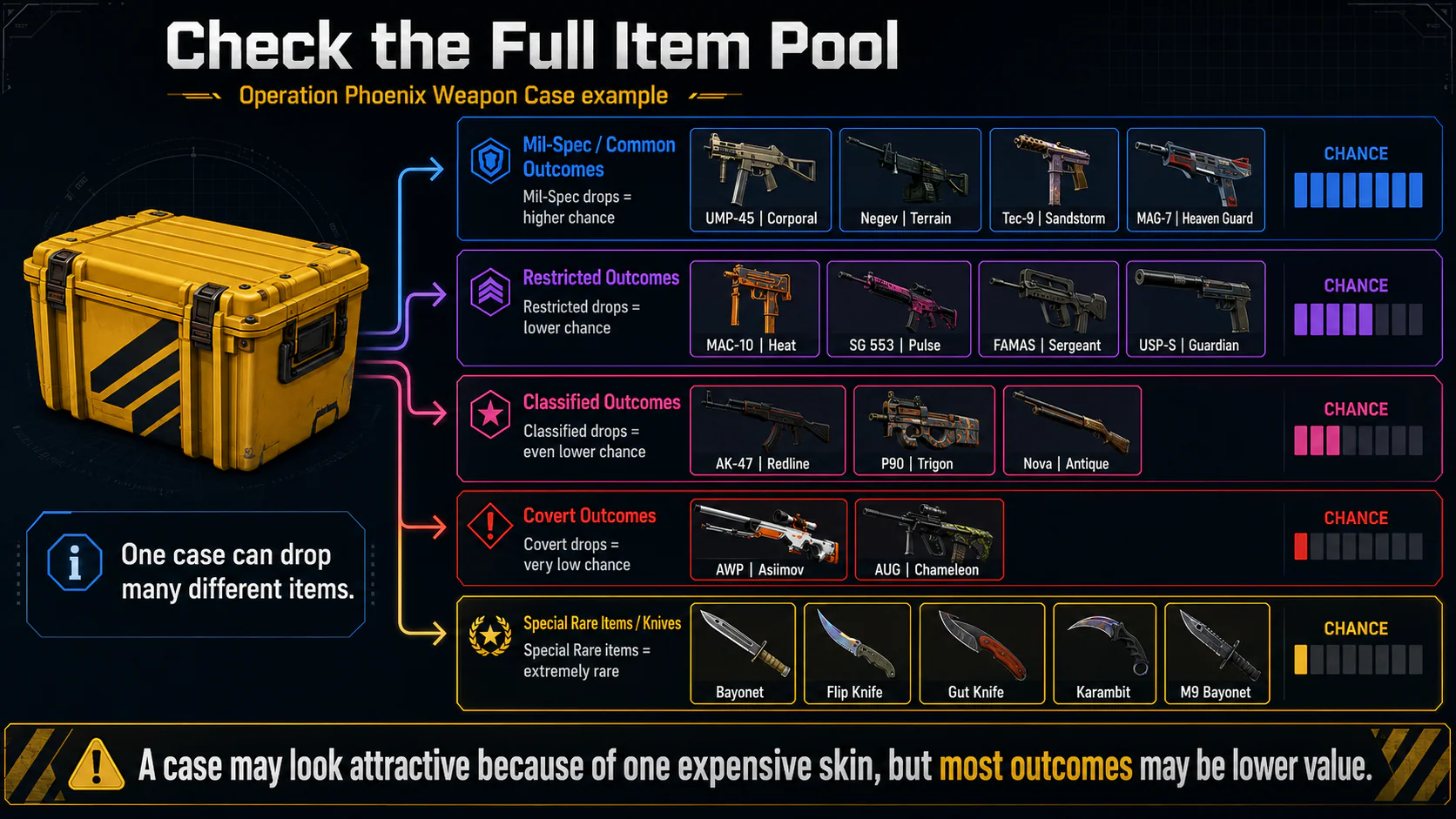
Unclear or hidden odds are a red flag. If a platform does not explain drop chances clearly, beginners have less information to assess risk. A careful user should prefer transparent data and avoid making decisions based only on visuals, hype, or promotional language.
Odds should be checked before every session because case pools, prices, and market values can change over time.
What Is Expected Value in CS2 Case Opening?
Expected value, often shortened to EV, is a theoretical estimate of the average value of a case over many openings. It combines three main elements:
The case price.
The possible item values.
The drop probability of each item or item group.
EV does not predict what will happen in one opening. It is an average-value concept. A case can have a certain theoretical EV, but a single user may still receive a low-value drop, a high-value drop, or anything in between.
A simple conceptual example:
Imagine a case has several possible outcomes. Some drops have low market value and appear often. One drop has a much higher market value but appears rarely. To estimate EV, each possible reward value would be weighed by its drop chance, then combined into an average theoretical result.
This does not mean the user will receive that average result. It only helps compare the case’s theoretical value against its cost.
Negative EV is common in case opening. That means the average theoretical return may be lower than the price paid to open the case. Even if a rare item is valuable, its low probability may not be enough to make the overall case favorable.
Beginners should avoid relying only on the most expensive possible drop. Expected value is about the entire item pool, not the dream outcome.
What Is EV Ratio?
EV ratio compares the expected value of a case with the case price. It is a way to estimate theoretical value relative to cost.
A simplified way to think about it:
EV ratio = expected value divided by case price
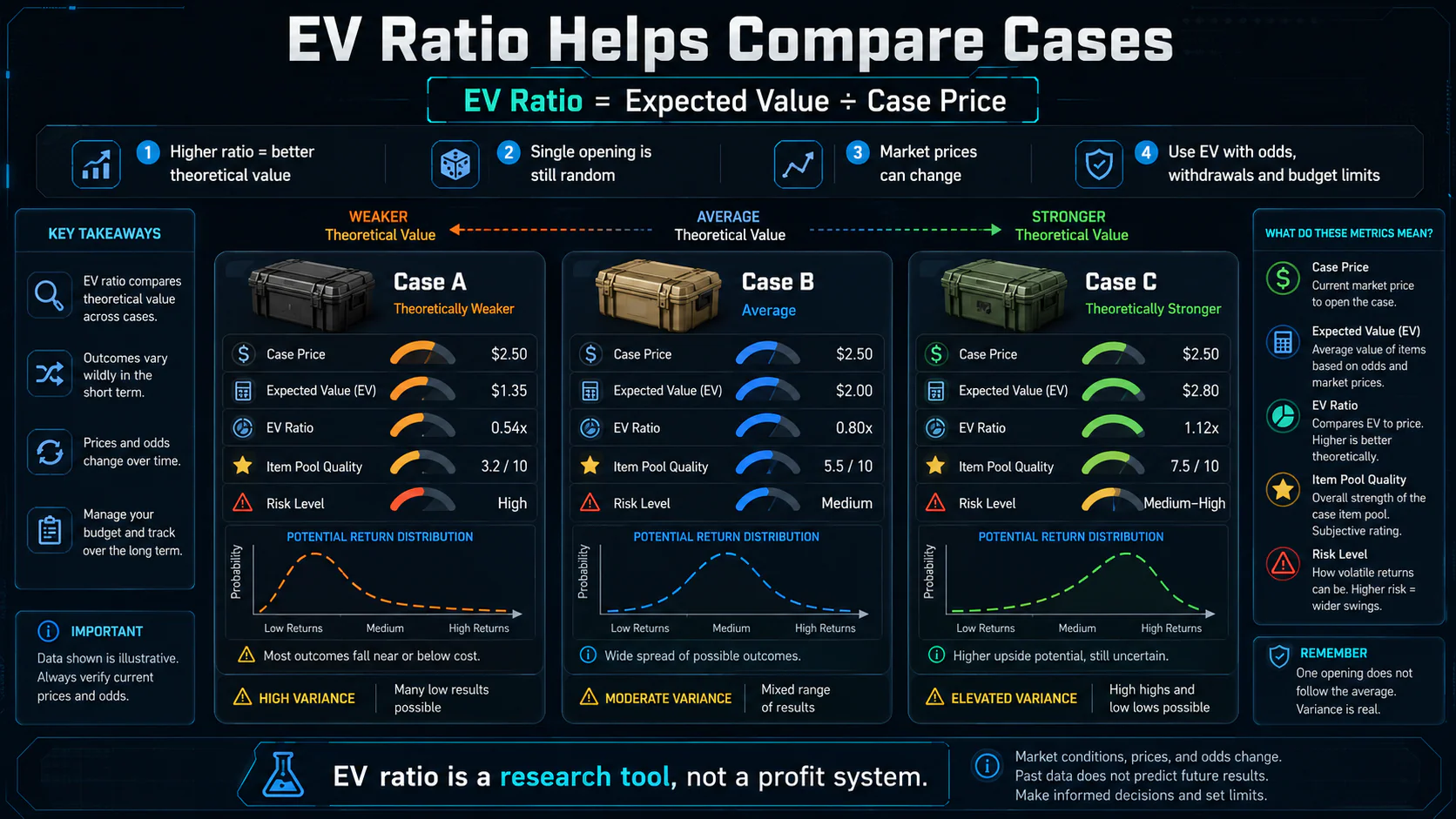
If a case has a higher EV ratio than another case, it may offer better theoretical value. However, EV ratio still does not guarantee profit, rare drops, or positive results in a session.
EV ratio can change when:
Skin market prices change.
Demand for certain skins rises or falls.
Float and wear values affect actual sale prices.
Case prices change.
Platform fees or withdrawal rules affect usable value.
Item pools or displayed odds change.
A useful CS2 case EV ratio should be combined with other information. Beginners should also review case odds, item pool quality, withdrawal options, platform trust signals, bonus restrictions, and personal risk tolerance.
A case should not be chosen only because it looks cheap or visually exciting. Comparing cases with EV ratio can help users think more analytically, but it cannot remove case opening risk.
Bankroll Management for CS2 Case Opening
Bankroll management means setting a fixed amount of money for case opening before the session begins. It is one of the most important parts of CS2 case bankroll management.
A bankroll should be separate from essential money. It should not include rent, bills, food money, savings, debt payments, or funds needed for daily life. Users should only spend an amount they are comfortable losing completely.
Practical bankroll rules include:
Decide the total session budget before opening.
Do not increase the budget after losses.
Avoid extra deposits during emotional moments.
Track how much was spent.
Stop when the budget is reached.
Keep case opening as entertainment, not income.
Use smaller controlled sessions instead of impulsive opening.
A beginner might decide in advance: “This is my entertainment budget for the week. If I lose it, I stop.” That decision should be made before opening any cases, not after emotions are already involved.
Bankroll management does not improve drop chances. Its purpose is to limit damage from bad outcomes and reduce impulsive spending.
Setting Stop-Loss and Stop-Win Limits
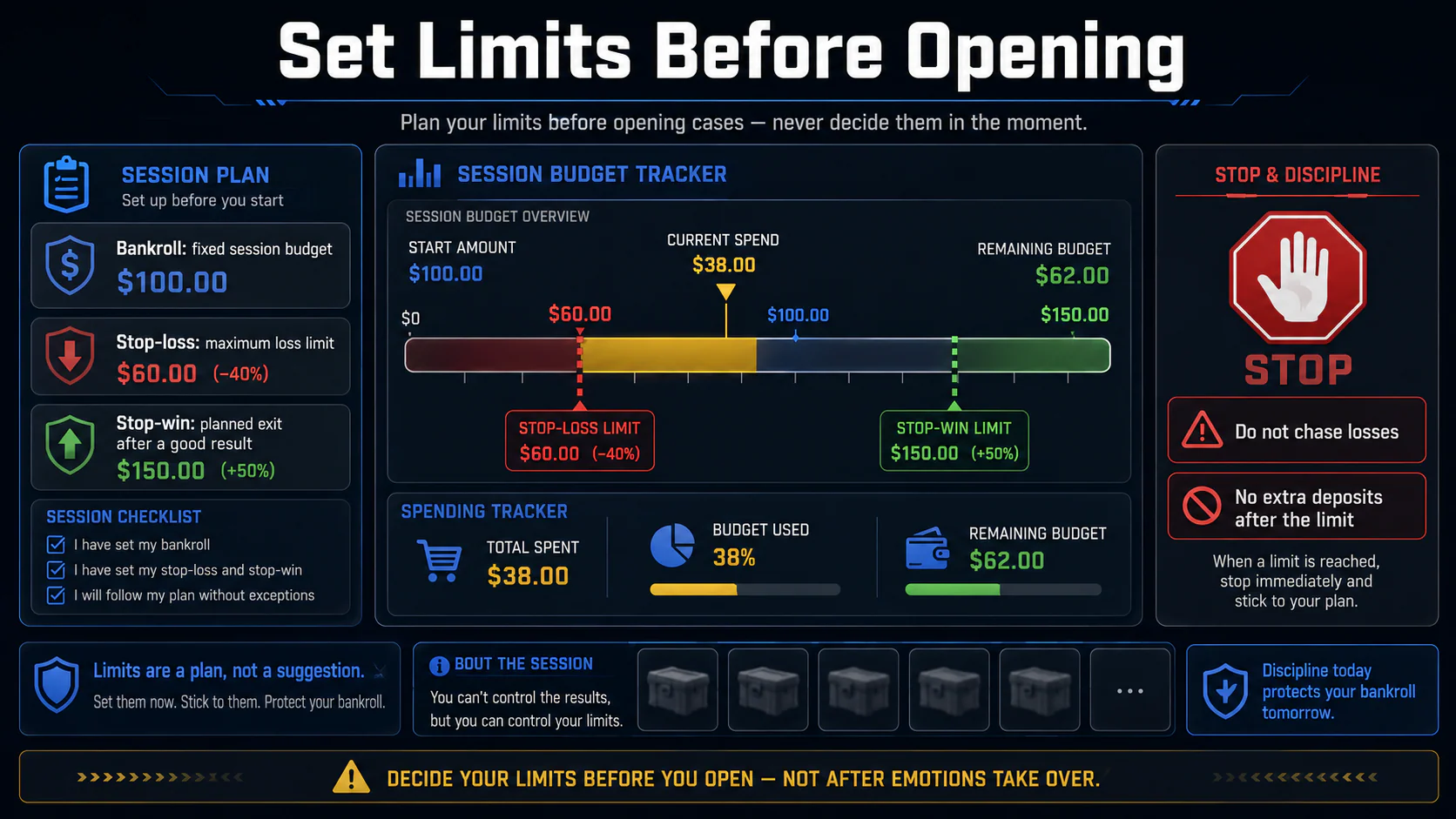
A stop-loss is the maximum amount a user is willing to lose in a session. A stop-win is the point where the user stops after a favorable result.
Both limits should be set before opening cases.
A stop-loss prevents a player from continuing after losses pile up. For example, if the session budget is reached, the session ends. The user does not deposit more to recover losses.
A stop-win helps prevent excitement from turning into overconfidence. A player may receive a good drop, continue opening, and lose much of the gained value. Stopping after a positive result can be difficult because the session feels lucky, but randomness does not become more favorable after a win.
Stop-loss in CS2 case opening and stop-win in CS2 case opening are not prediction tools. They are emotional-control tools. They create a clear stopping point before the session begins.
Good limits reduce decision-making under pressure. They help users avoid chasing, overextending, and turning a controlled session into an impulsive one.
Why Chasing Losses Is One of the Biggest Mistakes
Chasing losses means opening more cases to recover money or value lost in previous openings. It often involves extra deposits, larger case purchases, or riskier decisions after bad results.
This is dangerous because random outcomes do not “owe” the user a win. Losing several cases in a row does not make the next case more likely to drop a rare item. Past losses do not improve future drop chances.
Chasing losses is closely connected to the sunk cost fallacy. A user may think, “I already spent this much, so I should keep going until I recover.” But the money already spent does not change the odds of the next opening.
Common signs of chasing include:
Depositing again after reaching the budget.
Opening higher-priced cases after losses.
Ignoring the original stop-loss.
Feeling that a rare drop is “due”.
Continuing because stopping feels like accepting the loss.
The safer response is to step away. If the session limit is reached, the session should end. A good CS2 case opening strategy protects users from emotional escalation.
Comparing Case Price With Possible Skin Value
A case price should always be compared with possible skin value inside the case. Beginners often ask whether a case is “worth it,” but the answer depends on odds, item pool, market prices, and withdrawal conditions.
Important factors include:
Case price.
Full item pool.
Common low-value drops.
Rare high-value drops.
Average market price of rewards.
Skin rarity.
Float value and wear level.
StatTrak availability.
Current demand for the skins.
Platform fees or withdrawal restrictions.
Expensive cases are not automatically better. A higher price may simply reflect the presence of a rare premium item, while the average outcome may still be weak.
Cheap cases are not automatically safer. A low price may reduce session cost, but if the item pool is weak or withdrawals are limited, the practical value may still be poor.
Skin market value changes over time. A skin that was popular in one period may lose demand later, while another may rise because of rarity, player interest, or market trends. Users should check current data before judging a case.
Looking Beyond the Most Expensive Drop
Many beginners choose cases because they contain one famous or expensive skin. This is understandable, but it is not a complete strategy.
The most expensive drop usually has a low probability. The case may also include many lower-value outcomes that are far more likely. If a user only looks at the headline reward, they may misunderstand the real risk.
A better approach is to review:
The probability of the top item.
The value of common drops.
The value of mid-tier drops.
The number of outcomes below the case price.
The average theoretical return.
Whether the case is promoted around a rare item.
Promotional visuals can overemphasize rare skins. A case may look attractive because the preview highlights a premium knife, glove, or covert weapon skin, but the actual drop table may tell a different story.
Average return matters more than the best possible result. A case with one famous skin can still have poor theoretical value if most outcomes are low value and the rare item is extremely unlikely.
Skin Value, Float and Wear: Why They Matter
Not every version of the same CS2 skin has the same value. Skin price can vary significantly based on float value, wear level, StatTrak, stickers, rarity, and market demand.
Wear levels commonly include:
Factory New.
Minimal Wear.
Field-Tested.
Well-Worn.
Battle-Scarred.
Float value is a numeric condition indicator that affects how a skin appears. Lower float often means a cleaner-looking skin, though value depends on the specific item and market demand.
StatTrak versions may have different prices than non-StatTrak versions. Stickers can also affect value, especially if they are rare, desirable, or placed on popular skins. However, sticker value is complex and should not be assumed without checking market context.
Two versions of the same skin can have very different prices. A Factory New version may be worth much more than a Battle-Scarred version. A rare float pattern or desirable sticker combination may also change value.
Beginners should check actual market context before judging a drop. Seeing a familiar skin name is not enough. The specific condition, float, variation, and demand all matter.
Bonus Terms and Withdrawals: Strategy Is Not Only About Odds
Case odds and EV ratio are important, but they are not the whole picture. Platform rules can affect the practical value of a case opening session.
Before depositing or accepting a bonus, users should review:
Deposit bonus terms.
Free case conditions.
Wagering requirements.
Locked balances.
Minimum withdrawal limits.
Skin availability for withdrawal.
Withdrawal fees.
KYC or identity verification requirements.
Time limits on bonuses.
Restrictions on bonus winnings.
A case may look attractive based on odds or visuals, but unclear withdrawal rules can reduce its practical value. For example, if a user cannot withdraw the skin they receive, or if a balance is locked behind unclear conditions, the experience may be very different from what they expected.
Bonus terms require special attention. A free case or deposit bonus may come with wagering requirements or withdrawal restrictions. Users should read the full conditions before accepting.
A careful strategy includes platform research, not only case comparison.
Case Opening vs Buying Skins Directly
Buying CS2 skins directly and opening cases are very different approaches.
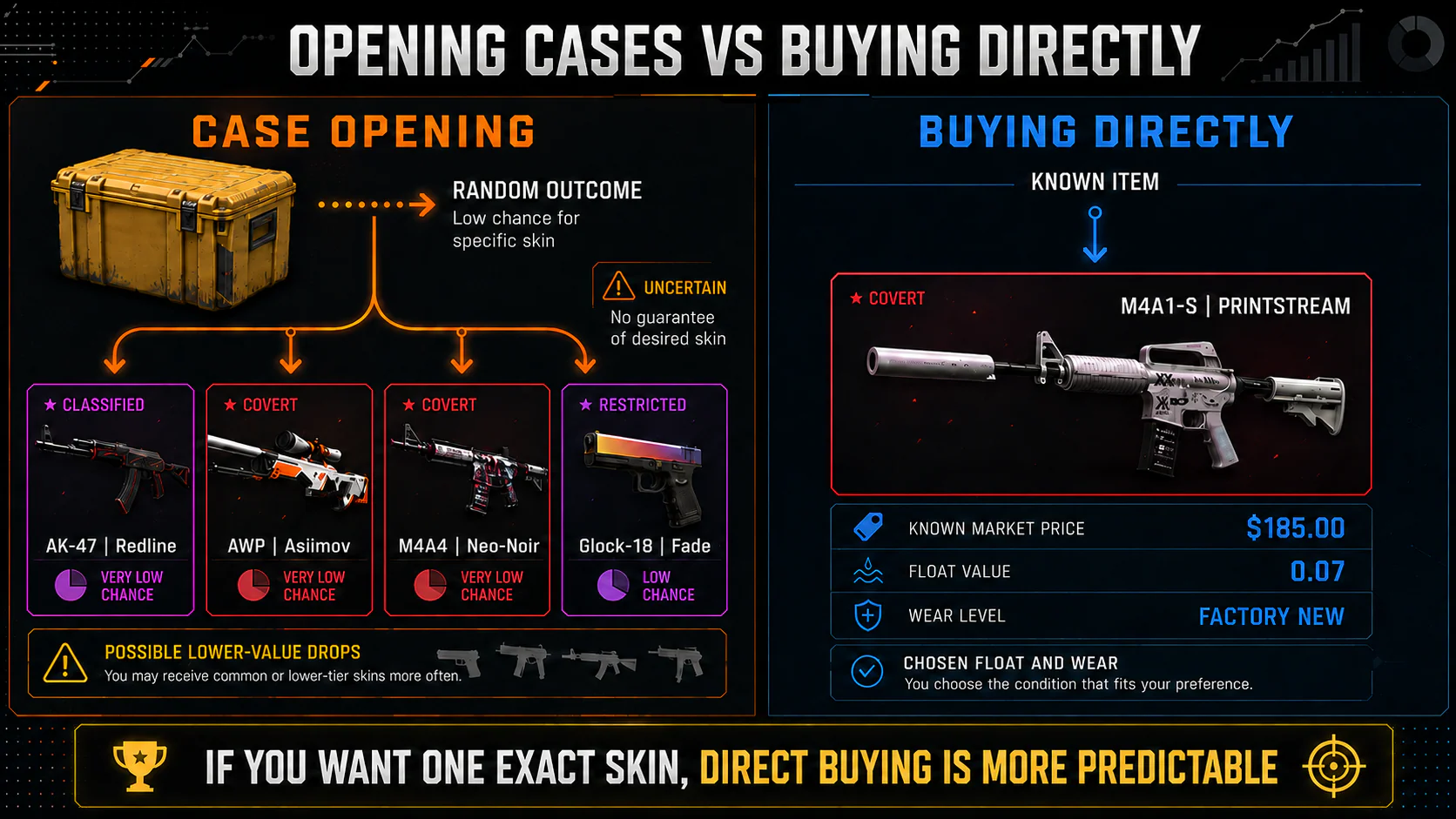
A direct purchase gives certainty. The user chooses the skin, condition, float range, and price they are willing to pay. This is usually more predictable for players who want one specific skin.
Case opening depends on random outcomes. A player may spend less than the target skin price and get lucky, but they may also spend more and still not receive the desired item. The chance of receiving a specific skin may be low, especially if the case contains many possible drops.
Buying directly is often better when:
The user wants one exact skin.
The desired wear level matters.
Float value matters.
The user wants price certainty.
The user does not want random outcome risk.
Case opening may only make sense for users who accept the entertainment risk and understand that the result may be worth less than the case price.
Every beginner CS2 case opening strategy should include this comparison: “Would it be more predictable to buy the skin directly?”
CS2 Case Opening Strategy: How to Choose a Case More Carefully
A careful CS2 case opening strategy starts before the case is opened. Beginners can use the following process to evaluate a case more clearly.
First, check the case odds. If odds are unclear or missing, treat that as a warning sign.
Second, review the full item pool. Do not judge the case only by the most expensive skin. Look at common, mid-tier, and rare outcomes.
Third, compare the case price with possible skin values. Consider how many possible drops may be worth less than the case price.
Fourth, estimate expected value or EV ratio if reliable data is available. Use it as a comparison tool, not as a guarantee.
Fifth, check current skin market prices. Market price can change, and old information may be misleading.
Sixth, review withdrawal rules. Make sure skins can actually be withdrawn and understand any limits, fees, or requirements.
Seventh, check platform trust signals. Look for transparent rules, clear odds, accessible support information, and warning signs such as unclear terms or unrealistic claims.
Eighth, decide the budget before opening. Set stop-loss and stop-win limits before the session begins.
This process does not make case opening predictable. It makes the decision more informed.
Common Beginner Mistakes in CS2 Case Opening
Beginners often make similar mistakes when opening CS2 cases. These mistakes usually come from focusing on excitement instead of probability and risk control.
Common mistakes include:
Ignoring odds.
Choosing a case only because of the most expensive skin.
Chasing losses after bad results.
Accepting bonuses without reading terms.
Depositing more than planned.
Opening cases without checking withdrawals.
Assuming a rare drop is “due”.
Treating case opening as investment.
Ignoring market price, float value, and wear level.
Judging a case only by visuals or hype.
For a more detailed checklist, users can read “CS2 Case Opening Mistakes Beginners Should Avoid”.
The key lesson is simple: beginners should slow down before opening. A few minutes of research can prevent many poor decisions.
Risk Control Checklist Before Opening Cases
Before opening CS2 cases, ask these questions:
Have I checked the case odds?
Do I understand the full item pool?
Do I know the case price?
Have I compared possible drops with market prices?
Do I understand expected value?
Have I considered EV ratio?
Do I have a fixed budget?
Have I set a stop-loss limit?
Have I set a stop-win limit?
Am I opening for entertainment, not profit?
Have I checked withdrawal rules?
Have I read bonus terms?
Am I comfortable losing the full amount I plan to spend?
If the answer to any important question is “no,” it may be better to pause and research first.
How Chance4Skin Can Help With Case Strategy
Chance4Skin is designed as a CS2 skin analytics and wiki-style platform. It can support a more careful case opening approach by helping users explore CS2 skins, compare skin data, understand skin value, review market context, and think about case odds and expected value.
Users can use Chance4Skin to research:
CS2 skins and item details.
Skin value and market context.
Case odds and drop chances.
Case comparisons.
Expected value concepts.
EV ratio considerations.
Float value and wear levels.
Market price differences.
Risk signals and trust guidance.
This kind of research can help beginners move away from impulse-based decisions. Instead of choosing a case only because it looks exciting, users can compare the data behind the case and decide whether the risk fits their budget and expectations.
Chance4Skin does not remove randomness. It helps users understand the factors that matter before opening or buying.
Example: How a Beginner Should Think Before Opening a Case
Here is a simplified example. It does not use live prices, exact odds, or platform-specific data.
A beginner wants a specific CS2 skin. They find a case that includes that skin and feel tempted to open it. The case preview highlights the desired item, making it look like a realistic target.
Before opening, the user checks the full drop table. They notice that the desired skin has a low drop chance, while the case also includes many lower-value drops. They compare the case price with the possible outcomes and realize that several likely drops may be worth less than the cost of opening.
Next, they think about expected value. They understand that EV is based on many openings, not one result. Even if the case has a reasonable theoretical value compared with other cases, it still does not guarantee the skin they want.
They then check the market price of the target skin. Buying the skin directly would cost more upfront, but it would guarantee the exact item. Case opening might cost less in one lucky result, but it could also cost more without delivering the target skin.
Finally, they check withdrawal rules and bonus terms. They confirm whether skins can be withdrawn, whether there are fees, and whether any bonus conditions apply.
The user realizes that buying directly is more predictable. They only open the case if they accept the entertainment risk and are comfortable losing the session budget.
This is not a profit formula. It is a safer decision process.
Quick Strategy Summary Table
Strategy Point | Why It Matters | What to Do |
|---|---|---|
Case odds | Odds show how likely different drops are. | Check probabilities before opening. |
Expected value | EV estimates average theoretical return. | Use EV as a comparison tool, not a prediction. |
EV ratio | EV ratio compares theoretical value with case price. | Compare cases, but remember risk remains. |
Bankroll | A fixed budget limits overspending. | Set a session budget before opening. |
Stop-loss | Prevents chasing after losses. | Stop when the loss limit is reached. |
Stop-win | Helps protect a good result from overplaying. | Stop after reaching a planned positive point. |
Market price | Skin values change over time. | Check current market context. |
Float value | Condition can strongly affect price. | Review float and wear level before judging value. |
Buying directly | Direct purchase gives certainty. | Buy directly if you want one exact skin. |
Bonus terms | Bonuses may include restrictions. | Read terms before accepting. |
Withdrawal rules | Value matters only if usable or withdrawable. | Check limits, fees, and skin availability. |
Emotional control | Impulsive decisions increase risk. | Take breaks and follow pre-set limits. |
FAQ
Is there a real CS2 case opening strategy?
Yes, but not in the sense of predicting drops or guaranteeing profit. A real CS2 case opening strategy is mostly about understanding odds, managing budget, comparing case value, reading platform rules, and reducing impulsive decisions.
What is bankroll management in CS2 case opening?
Bankroll management means setting a fixed budget before opening cases and not exceeding it. Users should only spend money they can afford to lose, and the budget should be separate from essential expenses.
What is EV in CS2 case opening?
EV, or expected value, estimates the average theoretical return of a case based on item values and drop chances. It is calculated across many openings and does not guarantee what will happen in a single opening.
What is EV ratio?
EV ratio compares expected value with case price. It can help users compare cases, but it does not remove randomness or guarantee profit.
Can I make profit from CS2 case opening?
Profit is not guaranteed, and CS2 case opening should not be treated as a reliable income method. Random outcomes, platform fees, withdrawal limits, and negative EV can make losses common.
Is it better to open cases or buy skins directly?
Buying directly is usually more predictable if the user wants one exact skin. Case opening depends on drop chance and can cost more than the target item without delivering it.
Why should I set stop-loss and stop-win limits?
Stop-loss and stop-win limits help prevent emotional decisions. They give users a clear point to stop before losses or excitement lead to more spending.
Are cheap CS2 cases better for beginners?
Cheap CS2 cases are not automatically better. Users should compare odds, item pool, market value, expected value, EV ratio, and withdrawal rules instead of judging only by price.
Should I accept CS2 case site bonuses?
Bonuses may include wagering requirements, locked balances, time limits, or withdrawal restrictions. Users should read all bonus terms before accepting.
Can Chance4Skin help me choose better CS2 cases?
Chance4Skin can help users understand CS2 skins, case odds, drop chances, market context, and EV-related data. It supports better research, but users should still manage risk carefully.
Written by
Team Chance4Skin


