
Skin.Club Review: Cases, Odds, Bonuses, Withdrawals and Trust Signals
Published: 18.06.2026
Skin.Club is a CS2 case-opening platform that many players research before depositing money or skins. A platform can look simple from the outside: sign in, add balance, choose a case, open it, and receive a possible CS2 skin reward. The real evaluation is more complex. Users should understand Skin.Club odds, drop chance transparency, expected value, bonuses, withdrawals, KYC, support, trust signals, and recent user feedback before spending anything.
This Skin.Club review is educational, not promotional. CS2 case opening involves random outcomes, and no review can guarantee safety, profit, successful withdrawals, or specific drops. A case with expensive possible rewards can still have a low chance of returning those items, and a user trying to obtain one exact skin may often find direct buying more predictable than opening cases. Skin.Club's public information describes a CS2 skin platform with case opening, Steam-bot skin withdrawals, account balance top-ups, promo codes shared through social channels, and a Provably Fair system, but users should still compare those claims with the current terms and live case pages before depositing.
Information checked: June 2026. Platform rules, bonuses, withdrawals, and verification requirements may change, so users should review the current Skin.Club terms before depositing.
What Is Skin.Club?
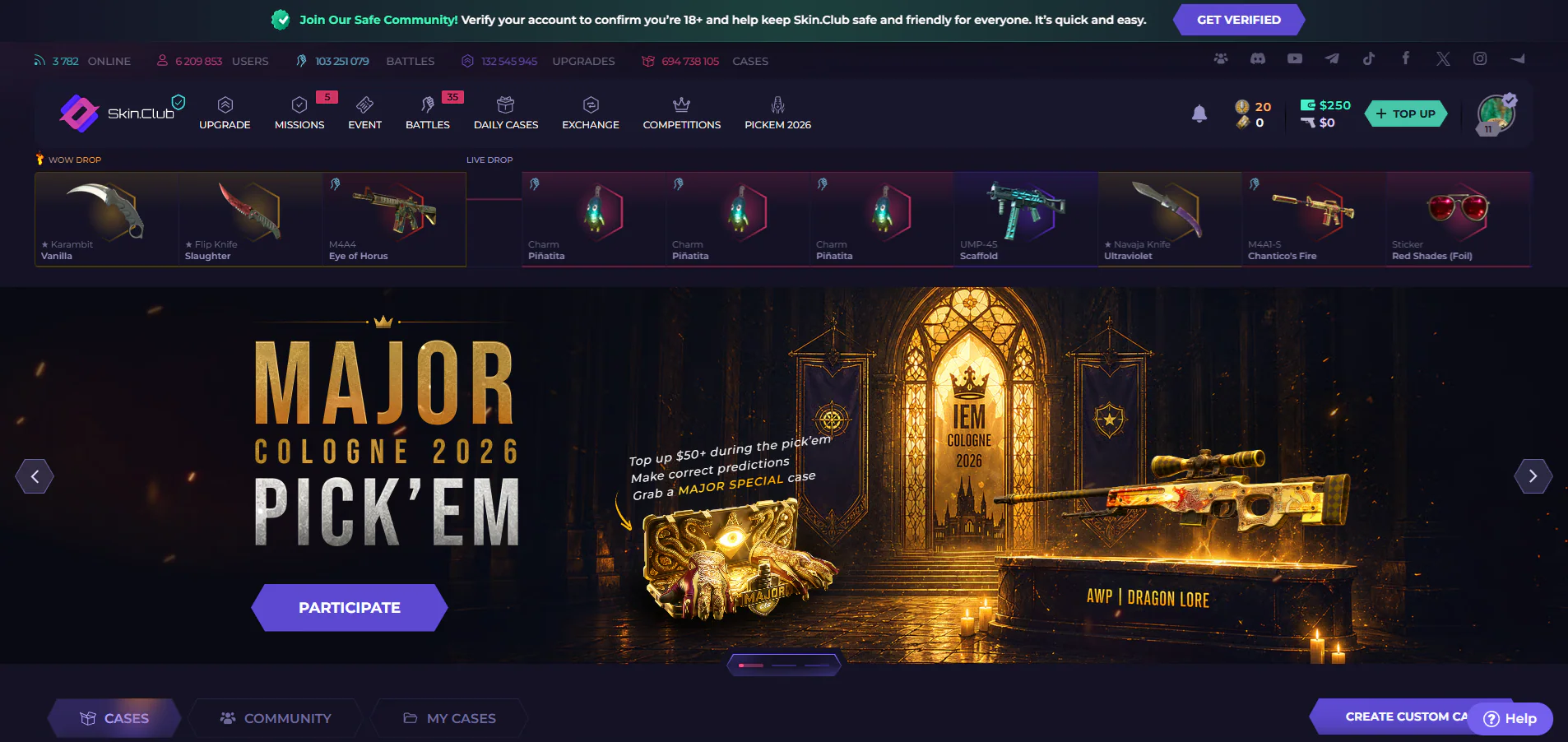
Skin.Club is a CS2 case site where users can interact with skin-focused mechanics such as case opening, upgrades, battles, missions, exchange features, and free case areas listed on the site. Skin.Club's public information identifies Moontrain Limited, registered in Cyprus, as the operating company, and presents the platform as a place where users can sign in, replenish balance with money or CS2 skins, and use CS2-skin mechanics.
For beginners, the basic idea is that a user chooses a case, pays the listed case price with site balance, and receives a randomly selected CS2 skin from that case's item pool. The result may be a low-value skin, a mid-value skin, or a rarer high-value item depending on the case odds and item probabilities. Skin.Club states that skins obtained on the platform may be withdrawn to a Steam inventory, sold back to the website, upgraded, or exchanged, but users should confirm the current rules in their own account before relying on any specific withdrawal route.
This Skin.Club review focuses on trust, odds, bonuses, withdrawals, KYC, and risk because those areas matter more than the visual excitement of the case-opening interface. A site can have many cases and active promotions while still requiring careful review of expected value, locked balances, verification rules, and item availability.
How Skin.Club Case Opening Works
The general Skin.Club case-opening flow appears similar to other CS2 case-opening sites. A user signs in, adds balance if eligible, chooses a case, opens it, and receives a randomly selected CS2 skin from that case's item pool. Skin.Club's public pages describe balance replenishment with money or CS2 skins and state that users can choose a CS2 case to open when they have sufficient funds.
The most important beginner concept is that a case result is not a purchase of one exact item. It is a random result from a predefined pool. Before opening any case, users should check the current case price, the full list of possible skins, each item's probability if shown, and whether the displayed value reflects market reality for the item's wear level and float range.
Skin.Club also describes a Provably Fair system that users can use to verify previous results through seed and roll history. That is a useful trust signal, but it should not be misunderstood. A provably fair system can help verify randomness mechanics; it does not make a case profitable, remove variance, or guarantee that a user will receive a high-value skin. Skin.Club says future outcomes cannot be predicted, while previous results can be verified.
Skin.Club Case Selection
Skin.Club's public navigation lists multiple case categories, including weapon- or item-themed examples such as Knife Case, AK-47 Case, AWP Case, Gloves Case, and Agents Case. These names were visible on the public site during the June 2026 check, but users should still confirm live availability because case names, item pools, and pricing can change.
Case variety can make a CS2 case site easier to browse, but variety does not automatically mean better value. A cheaper case may still have poor expected value if most outcomes are low-value items. A premium-looking case may include expensive possible rewards but still assign them very low drop chances. A themed case may be useful for browsing skins from a specific category, yet it should still be judged by its price, item pool, probability table, and realistic market value.
Before opening any Skin.Club case, users should compare:
Factor | Why it matters |
|---|---|
Case price | Sets the cost of each random outcome. |
Item pool | Shows what can actually drop. |
Drop chance | Explains how likely each item or tier is. |
Market price | Helps estimate whether displayed rewards are fairly valued. |
Wear and float | Can strongly affect the value of a CS2 skin. |
Withdrawal availability | Matters if the user wants the item in Steam. |
A beginner-friendly case is not only a low-cost case. It is a case where the user can clearly understand the price, odds, possible outcomes, and likely downside.
Skin.Club Case Review: Odds, Drop Chance and Item Pools
Odds transparency is one of the most important parts of any Skin.Club case review. Visible case odds help users understand whether a case has a realistic distribution of outcomes or whether the attractive rewards are mostly marketing visuals with very low probabilities. Skin.Club publicly describes its Provably Fair system and says users can review roll and seed history, but the public pages available during this check did not provide a stable, complete probability table for every live case without using the platform interface directly. Users should inspect each current case page before opening.
For each case, users should look for three separate things. First, the full item pool: every skin that can drop. Second, the item or tier probabilities: the chance of each result or category. Third, the valuation basis: whether the displayed skin value is close to current market price for that item, wear level, and float.
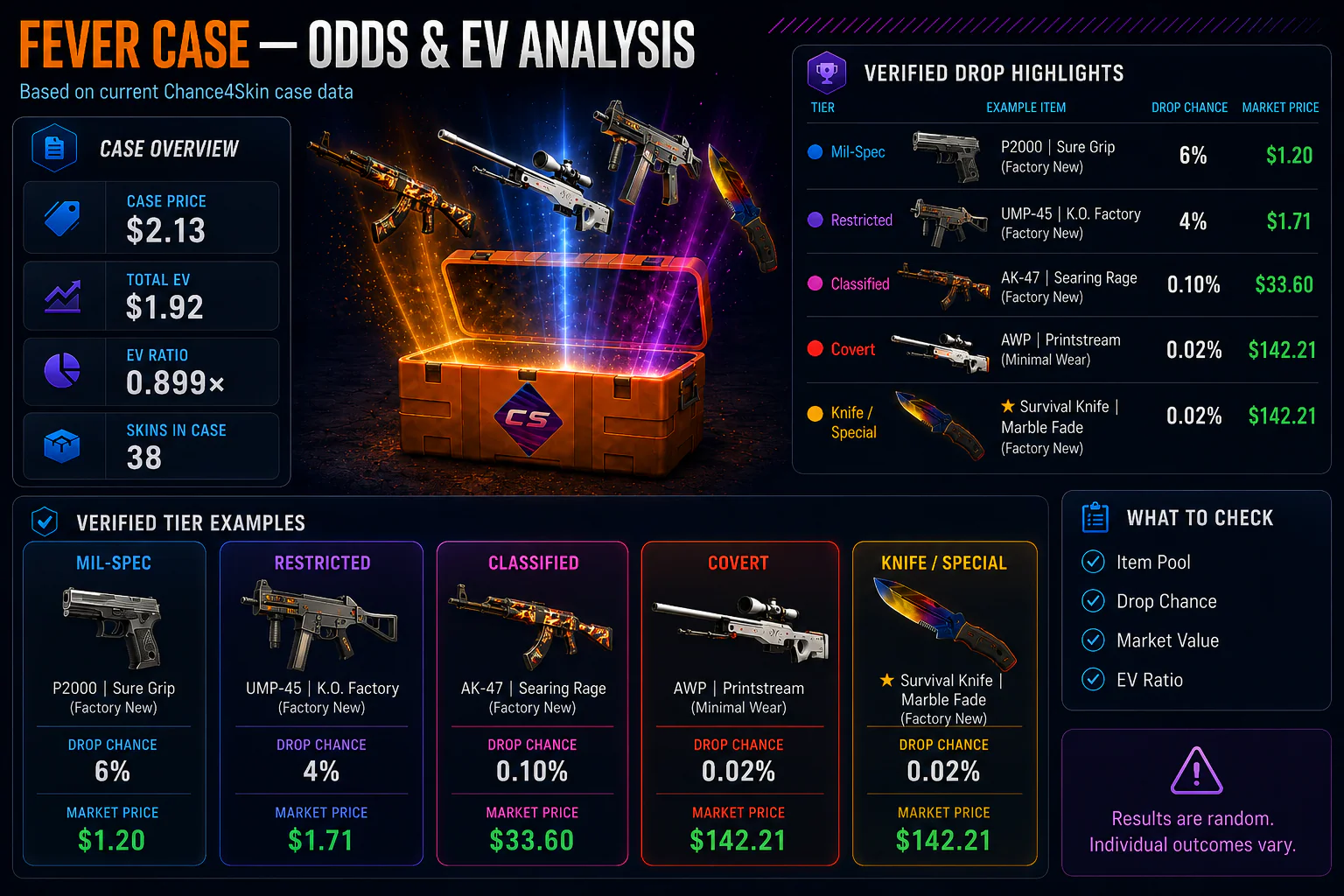
Rare item drop chances deserve special caution. A case can show a knife, gloves, or expensive rifle skin on the page, but if the drop chance is extremely small, the item should not be treated as a realistic expectation. The correct way to read a case page is not "what is the best item here?" but "what are the most likely outcomes, and how do they compare to the price I pay?"
Hidden, hard-to-find, or incomplete odds increase user risk. If a user cannot clearly see the drop chance or item pool, they cannot estimate expected value. Even when odds are visible, users should remember that probability does not smooth out over a few openings. A 1% drop chance does not mean the item appears once in every 100 openings for a specific user.
Expected Value and Case Value
Expected value, or EV, is the theoretical average return of a case over a very large number of openings. It combines the case price, every possible reward value, and every item's drop probability. A simple EV ratio compares theoretical average return with the price paid. For example, a case with a lower EV ratio may return less theoretical value per opening than a case with a stronger ratio, even if both cases show attractive high-value skins.
EV does not guarantee individual results. A user can open a case with a reasonable theoretical EV and still receive low-value outcomes. A user can also hit a rare item from a poor-EV case. That does not make the case a reliable strategy. It only reflects variance.
Skin value also depends on CS2-specific details. The same skin can have different market value based on wear level, float value, pattern, stickers, StatTrak status, and market liquidity. A drop that looks attractive by name may be less attractive if the wear is poor or if the market price is lower than the site's displayed valuation. This is where Chance4Skin's analytics-style approach can help: users can compare case odds, drop chances, market value, EV ratio, float, and wear context before deciding whether opening a case makes sense compared with buying the skin directly.
A case with expensive skins can still be poor value if the expensive items have tiny probabilities and the common outcomes are worth much less than the case price. That is why users should evaluate the whole item pool, not only the headline rewards.
Bonuses and Promotions
Skin.Club's public pages state that special promo codes for balance top-ups are regularly shared on its social media platforms. This confirms that promotional offers may exist, but it does not confirm the current value, rules, time limits, country restrictions, wagering requirements, or withdrawal conditions of any specific promotion. Users should read the current bonus terms before accepting any offer.
Bonuses can be useful only if the user understands the restrictions. A bonus may involve separate bonus balance, limited eligible cases, time limits, wagering requirements, withdrawal restrictions, maximum conversion rules, or account/location limits. A promotion that looks generous on a banner can become less attractive if it locks the user into opening cases they would not otherwise choose.
Before using Skin.Club bonuses, users should ask:
Is this bonus applied as withdrawable balance, site-only bonus balance, free cases, tickets, or another promotional form?
Are winnings from the bonus withdrawable immediately, conditionally, or not at all?
Is there a minimum deposit?
Is there a required number of case openings or balance turnover?
Are certain payment methods or countries excluded?
Does accepting the bonus affect withdrawal eligibility?
This section should be treated as a checklist because exact Skin.Club bonus rules can vary and were not fully verified from public pages during this check.
Withdrawal Rules
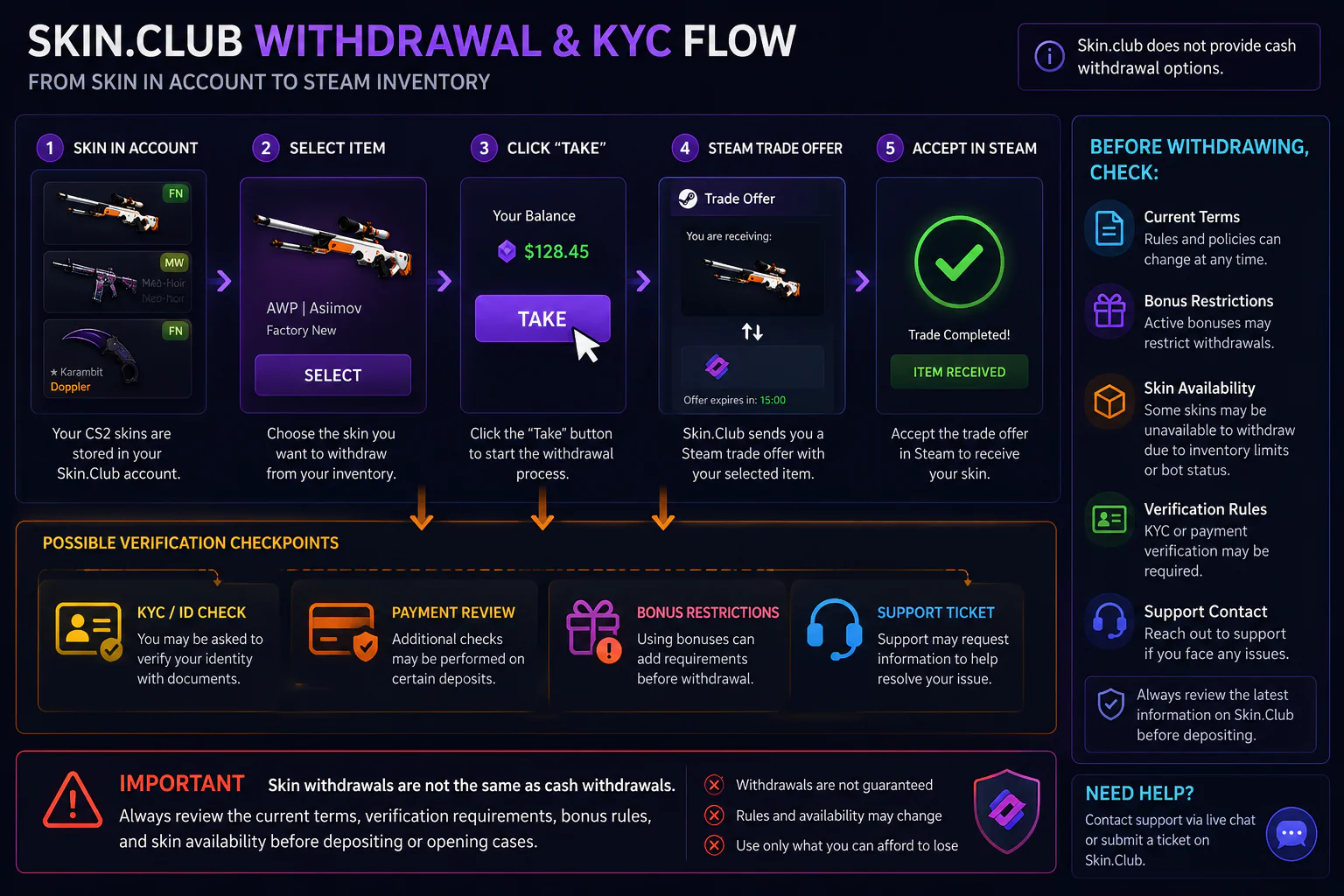
Skin.Club's public page describes skin withdrawals as a Steam trade-offer process: users select desired items in their profile, click "Take," wait for a Steam trade offer, and accept it to add the skin to their inventory. The same public information states that Skin.Club does not provide cash withdrawal options and that skin trades are processed automatically using Steam bots.
This is an important distinction. Skin.Club withdrawals, based on the public information checked, should be understood as skin withdrawals rather than cash withdrawals. Users who want real money should consider separate third-party marketplace risks, fees, rules, and regional restrictions outside Skin.Club.
Withdrawal conditions should be reviewed before depositing. Skin availability may change, Steam trade limitations may affect timing, bots may not always have the desired item, and account restrictions or verification checks can affect access. Skin.Club's Terms also state that there may be situations where skins obtained on the website are not available for withdrawal due to reasons beyond its control.
Users should check the current rules for:
Minimum withdrawal value, if any.
Fees or spread between site value and market value, if applicable.
Whether the exact skin is available in stock.
Steam trade hold or trade protection effects.
Verification requirements before withdrawal.
Bonus-related restrictions.
Whether locked or provisional balances can be used.
What support can do if a trade fails or expires.
No review should promise that withdrawals will always succeed. The practical question is whether the user understands the current withdrawal process and what can go wrong before depositing.
KYC and Account Verification
KYC means Know Your Customer. It is a verification process where a platform may ask users to confirm identity, age, payment ownership, address, or source of funds. KYC is not automatically negative; compliant platforms may use it for fraud prevention, AML compliance, age checks, payment security, or account integrity. The user risk is that KYC may appear late in the process, such as after a deposit or before withdrawal, and can be frustrating if the user did not expect it.
Skin.Club's Terms say it may request personally identifiable information for KYC and anti-money-laundering purposes and may temporarily or permanently block or terminate an account if requested information is not provided. Its KYC section says checks may be performed when user activity, a transaction, or a payment method raises suspicion. It also lists possible documents such as government ID, a selfie with the document, proof of payment, source of funds, proof of address, and other documents required for completion of verification.
The Privacy Policy also states that Skin.Club may collect Steam profile data, payment transaction information, IP history, website usage data, email, device/browser fingerprinting data, and personal information during verification, including identity documents, live selfie, proof of address, and other AML-related documents.
Users should not try to bypass KYC, age checks, location rules, payment rules, or platform restrictions. Instead, they should decide before depositing whether they are comfortable with the current verification policy and privacy terms.
Deposits and Payment Methods
Skin.Club's public pages mention balance replenishment with money or CS2 skins and list examples such as G2A Pay, credit cards, and CS2 skins. The public footer also displays payment-related icons including Visa, Mastercard, Maestro, Sofort, and Interac, but payment availability can depend on region, account status, payment provider rules, and platform changes.
The Cardholder Agreement says users authorize card charges for the purchase amount, including applicable taxes and fees, and that payment details are handled by a payment provider rather than stored on Skin.Club systems. It also says suspicious or fraudulent transactions may be declined or canceled.
Skin.Club's Terms define credits as internal website tokens used only for services on the website and state that credits cannot be withdrawn, transferred, or exchanged for cash. The Terms also say credits are not worth real money, may be non-refundable, and are for entertainment purposes only.
Before depositing, users should check deposit fees, currency conversion, payment-provider terms, refund limitations, chargeback rules, skin deposit valuation, and whether a deposit creates any locked balance or verification obligation.
User Experience and Interface
Skin.Club's public navigation suggests a broad interface with cases, battles, upgrades, missions, free cases, exchange, community areas, FAQ, contacts, and a Provably Fair page. This indicates a feature-rich CS2 case-opening environment, but the most important interface question is not whether the site looks active. It is whether important information is easy to find before spending balance.
A good user experience for a CS2 case site should make these details clear:
Case price.
Full item pool.
Drop chance or item probability.
Skin valuation source.
Withdrawal path.
Bonus restrictions.
Account verification triggers.
Support contact options.
Responsible-use or risk information.
If users have to search too hard for odds, bonus terms, or withdrawal restrictions, they should slow down. Case-opening sites are easiest to use when opening a case; the harder part is evaluating whether opening that case is a sensible entertainment choice.
Customer Support
Skin.Club's contact page lists support via [email protected] and says support works 24/7. It also lists [email protected] for personal data requests, [email protected] for official government or institutional requests, partner emails, communication domains, a phone number, and social networks including Facebook, X, Instagram, and Discord.
Support is a trust signal because CS2 case sites can involve payment issues, Steam trade problems, skin availability questions, bonus disputes, and KYC checks. Users can test support before depositing by asking specific questions such as:
Are case odds visible for every case?
What happens if a selected skin is unavailable for withdrawal?
Can bonus balance restrict withdrawals?
When can KYC be requested?
What documents may be required?
What is the current refund policy for mistaken deposits?
Clear, direct answers are more useful than generic reassurance. If support avoids specific questions about withdrawals, odds, KYC, or bonuses, users should treat that as a caution signal.
Trust Signals to Check
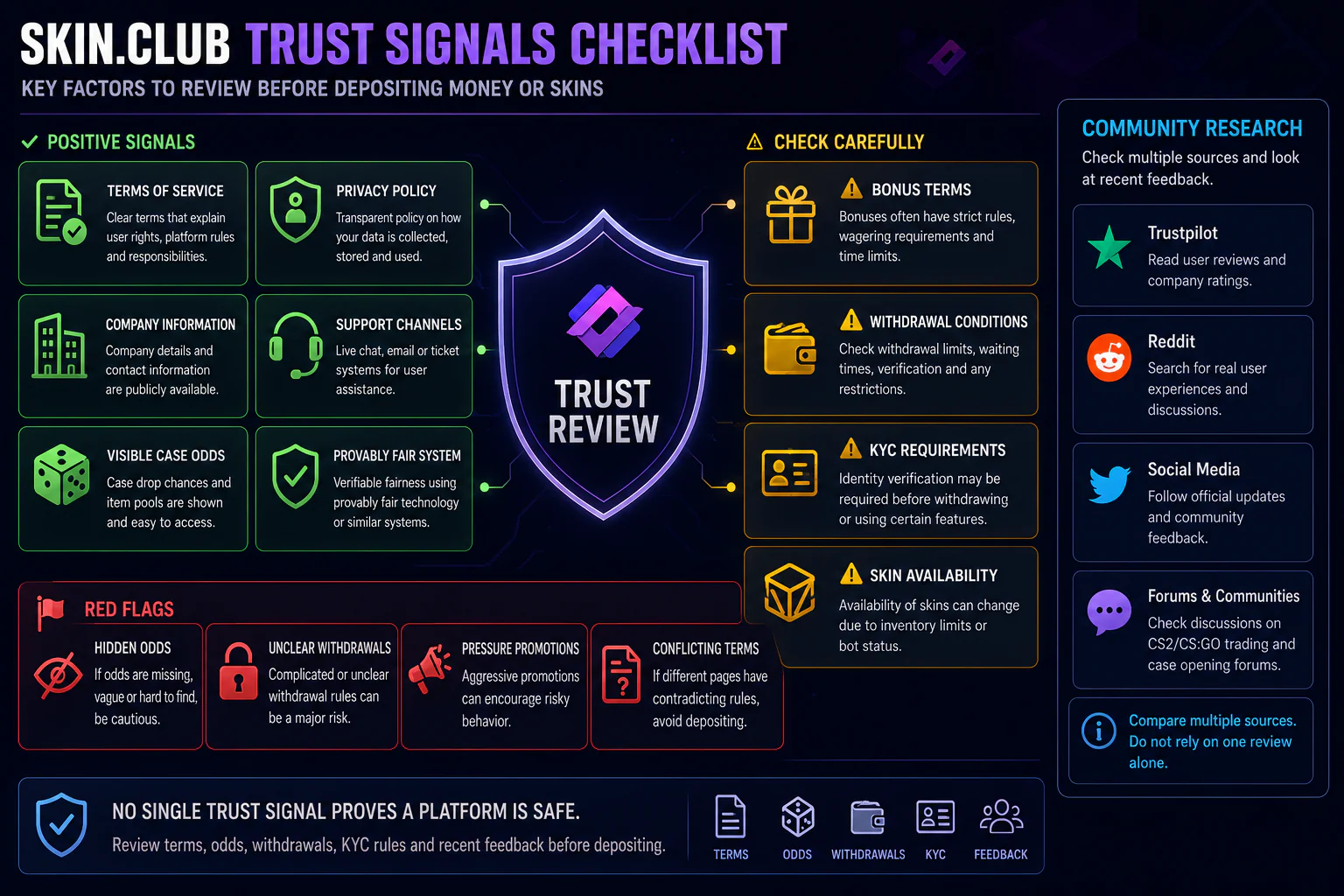
Skin.Club has several visible trust signals: public Terms of Service, Privacy Policy, Cardholder Agreement, contact information, company information, a FAQ page, and a Provably Fair page. Its Terms were last modified April 16, 2026, and its Privacy Policy was last modified February 19, 2026, according to the pages checked.
Those signals are useful, but they do not prove that every user will have a smooth experience. A careful Skin.Club trust signals review should include:
Trust signal | What to check |
|---|---|
Terms of Service | Age rules, regional restrictions, credits, refunds, account restrictions. |
Privacy Policy | KYC data, retention, sharing, GDPR rights. |
Withdrawal rules | Cash vs skin withdrawals, minimums, bot availability, delays. |
Case odds | Whether item probabilities are visible on live case pages. |
Provably Fair | Whether previous outcomes can be independently checked. |
Bonus terms | Turnover, locked balance, time limits, withdrawal restrictions. |
Support | Direct answers about withdrawals, KYC, odds, and disputes. |
Company details | Legal entity, address, official contact channels. |
User feedback | Recent patterns across multiple independent sources. |
Risk disclosures | Whether random outcomes and entertainment-only use are clear. |
Users should also check whether promotional claims match written terms. If a banner, influencer code, or social media post says one thing while the written terms say another, the written terms usually matter more.
Recent User Reviews and Community Feedback
Community feedback should be treated as a signal, not as proof. Third-party review platforms, Reddit, forums, Discord discussions, and social media posts can help users identify repeated themes, but they cannot confirm every individual story. Public feedback visible during this check appeared mixed, with some users describing positive experiences and others raising concerns about withdrawals, losses, support, or fairness.
This mixed pattern is common in CS2 case-opening discussions. Some users leave positive reviews after a good result or a smooth withdrawal. Others leave negative reviews after a losing session, a delayed trade, a bonus misunderstanding, or an account-verification issue. Both types of feedback can contain useful clues, but neither should be treated as complete evidence on its own.
When evaluating Skin.Club reviews, readers should look for patterns instead of isolated comments. Repeated recent withdrawal complaints, repeated KYC complaints, repeated support complaints, or repeated claims about unclear odds deserve attention. At the same time, generic positive reviews, affiliate content, influencer promotions, and emotionally charged posts should be read carefully.
No single review source is enough. Reviews can be outdated, manipulated, incomplete, emotional, affiliate-biased, or heavily shaped by whether the user personally won or lost. Users should compare recent reviews across multiple sources and focus on repeated operational issues rather than isolated outcomes.
Skin.Club Pros and Cons
Pros | Cons / Risks |
|---|---|
Familiar CS2 case-opening format with skins, cases, upgrades, and exchange-style mechanics visible in public navigation. | Case opening remains random and can lead to losing the deposited value. |
Public pages describe Steam-bot skin withdrawals and state that cash withdrawals are not available. | Users who want cash need to consider separate marketplace steps, fees, and risks. |
Skin.Club publishes Terms, Privacy Policy, Cardholder Agreement, contacts, FAQ, and Provably Fair information. | Published documents do not remove the need to check live case odds, withdrawal rules, and bonus restrictions. |
Public pages mention balance top-ups with money or CS2 skins and social promo codes. | Exact Skin.Club bonuses, restrictions, and current promo terms may vary and should be checked before use. |
KYC and verification policies are described in the Terms and Privacy Policy. | KYC may require sensitive personal documents and can be frustrating if triggered late. |
Community platforms provide recent user feedback signals. | User reviews are mixed and should not be treated as absolute proof. |
Chance4Skin-style EV and market-value analysis can help users evaluate cases more carefully. | Direct buying may be more predictable for users who want one exact skin. |
Skin.Club Red Flags to Watch For
These are general red flags users should watch for on any CS2 case site, including when reviewing Skin.Club or alternatives:
Case odds are hidden, incomplete, or difficult to access.
The full item pool is unclear.
Rare high-value skins are highlighted without clear probabilities.
Withdrawal rules are vague or scattered across several pages.
The site does not clearly explain cash vs skin withdrawals.
KYC requirements are only discovered after a user tries to withdraw.
Bonus terms are vague, missing, or inconsistent with promotional claims.
Users report repeated recent withdrawal issues across multiple independent sources.
Support gives generic replies instead of answering direct questions.
Promotions create pressure to deposit quickly.
Influencer or affiliate content ignores downside risk.
The site or promoter frames case opening as profit, investment, or a reliable method to obtain expensive skins.
Written terms conflict with banner claims, social posts, or promo-code promises.
A red flag does not automatically prove a site is a scam. It means users should pause, verify, and avoid depositing until the issue is clear.
Skin.Club vs Buying CS2 Skins Directly
Buying CS2 skins directly is usually more predictable than opening cases for one exact item. Direct buying lets the user choose the skin, market price, wear level, float, pattern, stickers, and seller. Case opening does not.
For example, a player who wants one exact AWP, AK-47, knife, or glove skin should compare the direct market price with the likely cost of repeated case openings. Even if a Skin.Club case includes the target item, the drop chance may be low, and the user may spend more than the item's direct market value without receiving it.
Case opening may be entertainment for users who understand random outcomes, set a strict budget, and accept that the result can be lower than the amount spent. It should not be treated as investing, and it should not be used as a strategy to obtain guaranteed profit or a specific skin.
Who Skin.Club May Be Suitable For
Skin.Club may be suitable for users who already understand CS2 case opening, random outcomes, drop chance, expected value, and the difference between site balance and withdrawable skins. It may also suit users who carefully review the current Terms, bonus rules, withdrawal conditions, KYC policy, and live case odds before depositing.
A more prepared user is someone who sets a strict entertainment budget, does not chase losses, does not expect a specific item, and is comfortable with possible identity verification and the platform's skin-withdrawal model. That user should still compare Skin.Club with direct skin buying and other CS2 case-opening options.
Who Should Be More Cautious?
Users should be more cautious if they want one specific skin, do not understand odds, or expect case opening to produce profit. They should also be cautious if they are uncomfortable with KYC, do not want to submit personal documents, cannot afford to lose the deposited amount, or are unsure whether Skin.Club is allowed in their region.
Skin.Club's Terms state that users must be at least 18 or the legal age of majority in their jurisdiction, must be allowed to use the service under local law, and must not reside in restricted areas such as Washington or Nevada in the United States. Users are responsible for checking whether their local rules allow the activity.
Anyone who may chase losses should avoid case opening. Random results can create emotional pressure, especially after several low-value drops. A strict budget should be set before opening any case, and direct buying should remain the comparison point for users who want a predictable outcome.
How Chance4Skin Can Help Before Using Skin.Club
Chance4Skin can help users think more analytically before using Skin.Club or any other CS2 case site. Instead of focusing only on the most expensive possible reward, users can explore CS2 skins, compare case odds, review drop chances, understand skin value, check market context, and think about expected value.
For a Skin.Club case review, Chance4Skin-style analysis is useful in four ways. First, it helps users compare the case price with the likely reward distribution. Second, it helps users understand EV ratio rather than judging a case by its headline items. Third, it gives context for market price, float value, wear level, and skin demand. Fourth, it can show when buying a skin directly may be more predictable than opening cases for that item.
This does not make case opening safe or profitable. It simply helps users make more informed entertainment decisions and recognize when the numbers do not support the excitement of the case page.
Skin.Club Review Checklist
Are the case odds visible?
Is the full item pool clear?
Do I understand the case price?
Have I checked expected value or market value?
Do I understand the EV ratio?
Are bonus terms clear?
Are withdrawal rules clear?
Are KYC requirements explained?
Is support easy to contact?
Have I checked recent user reviews?
Am I opening for entertainment, not profit?
Would buying the skin directly be more predictable?
Am I comfortable with the possible loss of the deposit?
FAQ
What is Skin.Club?
Skin.Club is a CS2 case-opening platform where users can open cases for possible CS2 skin rewards. Its public pages describe account sign-in, balance top-ups, case opening, skin withdrawals through Steam trade offers, and other CS2 skin mechanics. Users should review current platform rules, odds, withdrawals, and bonus terms before depositing.
Is Skin.Club legit?
A careful Skin.Club review should not rely on one signal only. Skin.Club publishes company information, Terms, Privacy Policy, contact channels, and Provably Fair information, but users should also check live case odds, withdrawal rules, bonus terms, support responsiveness, and recent user feedback before depositing.
Does Skin.Club show case odds?
Skin.Club publicly describes a Provably Fair system and seed/roll verification, but users should check each current case page for item probabilities and drop chance details before opening. Visible odds are important because they help users estimate expected value and understand how unlikely rare drops may be.
Can I withdraw skins from Skin.Club?
Skin.Club's public page describes skin withdrawals through Steam trade offers and states that it does not provide cash withdrawal options. Users should review current Skin.Club withdrawal rules, minimum limits if any, skin availability, fees if any, delays, Steam restrictions, and verification requirements before depositing.
Does Skin.Club require KYC?
Skin.Club's Terms say KYC may be performed when user activity, transactions, or payment methods raise suspicion, and the platform may request documents such as ID, selfie, proof of payment, source of funds, or proof of address. Users should read the current Terms and Privacy Policy before depositing or submitting personal data.
Are Skin.Club bonuses worth it?
Skin.Club's public pages mention promo codes for balance top-ups, but exact current bonus terms were not fully verified from public pages during this check. Any Skin.Club bonuses should be evaluated for wagering requirements, locked balances, time limits, withdrawal restrictions, eligible cases, and country or account restrictions before accepting them.
Can I make profit on Skin.Club?
Profit is not guaranteed. CS2 case opening is random, and expected value is only a theoretical long-run average, not a prediction for individual openings. Users should not treat Skin.Club, or any CS2 case site, as an investment method.
Is buying skins directly safer than using Skin.Club?
Buying directly is usually more predictable if the user wants one exact skin. Direct buying lets users choose the exact item, float, wear, and price, while case opening depends on drop chance and random outcomes.
What should I check before depositing on Skin.Club?
Users should check case odds, full item pools, bonus terms, withdrawal rules, KYC requirements, support channels, payment terms, refund policy, and recent user reviews. They should also confirm whether their region, age, payment method, and Steam account setup comply with the current rules.
Can Chance4Skin help evaluate Skin.Club?
Yes. Chance4Skin can help users understand CS2 skins, skin value, case odds, drop chances, market price, float value, wear levels, expected value, and EV-related data before making decisions. That analysis can also help users compare case opening with direct buying.
Written by
Team Chance4Skin


